Tire Pressure vs Air Temperature: Impacts and Management
Explore how air temperature affects tire pressure, interpret TPMS readings, and implement practical checks and adjustments to maintain optimal inflation across seasons.


Temperature changes directly affect tire pressure because air expands when warm and contracts when cold. A common rule of thumb is roughly 1 psi per 10°F change. For best accuracy, check tire pressures when cold and compare against the vehicle’s recommended psi. The Tire Pressure Tips team emphasizes using a reliable gauge and accounting for seasonal shifts.
Why temperature matters for tire pressure
Tire pressure does not stay constant. The air inside each tire behaves like a gas that expands when heated and contracts when cooled. Ambient air temperature, road heat, and even the heat generated during driving influence tire inflation. This matters because under- or over-inflated tires change how a vehicle handles, wear, and fuel economy. According to Tire Pressure Tips, understanding this relationship helps drivers make better inflation decisions across seasons. For many drivers, the practical takeaway is simple: measure tires when they are cold, because the temperature at the moment of measurement will skew the result if the tires have recently heated from driving. In cold weather, the same tire can register a noticeably lower pressure than in warm weather, even if the actual tire structure and load are the same. Recognizing this, modern vehicles emphasize both manual checks and sensor-based alerts to keep inflation within the manufacturer’s recommended range.
This section lays the groundwork for practical actions you can take regardless of your vehicle type or climate. It also highlights why a blended approach—manual checks plus TPMS alerts—tends to yield the most reliable inflation targets. Tire Pressure Tips notes that consistency in measurement conditions improves accuracy and makes seasonal adjustments predictable rather than reactive.
How air temperature translates to pressure changes
In everyday driving, temperature is a major driver of tire pressure fluctuations. A widely cited rule of thumb is that tire pressure changes by about 1 psi for every 10°F change in ambient temperature. When temperatures rise, air inside the tire expands, pushing up the gauge reading; when it cools, the pressure can drop. The practical takeaway is to measure tires when they are cold and to compare readings to the manufacturer’s recommended specification for each tire and axle. If a season or location produces persistent temperature swings, you may notice a gradual misalignment between your gauge reading and the target pressure. The Tire Pressure Tips team emphasizes using a high-quality gauge and calibrating it periodically to ensure consistency across checks. This helps you plan adjustments in anticipation of seasonal shifts rather than chasing weather.
Additionally, remember that road heat and driving time can temporarily raise tire temperatures and inflate pressures even before you measure. The goal is to establish a baseline when tires are cold, then adjust when necessary to maintain target pressures as temperatures change.
The role of the Ideal Gas Law and practical caveats
The underlying physics follows PV = nRT, often summarized for tire care as: as temperature rises, pressure tends to rise; as temperature falls, pressure tends to fall. In practice, tires are not perfectly rigid systems, and contact with the road, flexing of the sidewalls, and heat generated by braking and rolling resistance all alter the pressure. The result is that real-world changes deviate from textbook calculations. Drivers should treat the simple 1 psi per 10°F rule as a guideline rather than a universal law. The Tire Pressure Tips Analysis, 2026 notes that the most actionable takeaway is to rely on repeated measurements under consistent conditions and to account for temperature-driven drift when planning seasonal inflations. This is especially relevant for vehicles that frequently shuttle between indoor garages and outdoor parking, or across day-long temperature gradients.
When you update the inflation target for a season, consider both ambient temperature trends and the specific tire you use, because different tire constructions can respond slightly differently to heat and cold.
Real-world scenarios: winter, summer, and daily driving
Seasonal shifts are the most visible manifestations of temperature effects on tire pressure. In winter mornings, you may observe a noticeable drop in readings compared to summer afternoons, even if the same load and vehicle are in use. In hot summer months, tires can appear over-inflated due to heat build-up while driving or standing in direct sun. Daily driving adds another layer: long highway commutes raise tire temperatures, while short trips keep them closer to ambient levels. A practical approach is to check pressure on a consistent schedule—ideally when tires are cold—and then account for the expected temperature difference when setting your target. The Tire Pressure Tips team recommends establishing a baseline in each season and documenting the target psi for your vehicle so you can adjust without guessing. This habit helps protect tire life, improves fuel economy, and preserves handling characteristics under a wide range of conditions.
How to measure accurately: tools and best practices
Accurate tire pressure starts with a good gauge and disciplined technique. Use a high-quality analog or digital gauge and calibrate it periodically according to the manufacturer’s instructions. When taking readings, ensure the tire is cool and the vehicle has not been driven for several hours. Compare the measurement to the vehicle-specification pressure printed on the placard or owner’s manual. If your gauge shows inconsistent numbers, test it against a known reference or borrow a second gauge for cross-checks. Keep a small log of readings across different temperatures to build intuition about how your tires respond to weather. The Tire Pressure Tips team emphasizes documenting these checks to create a practical reference you can rely on through seasonal transitions.
TPMS vs manual checks: differences and how to use
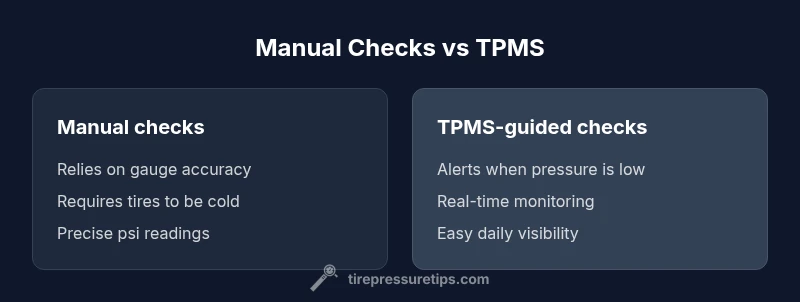
Tire Pressure Monitoring Systems (TPMS) provide real-time alerts when pressure falls below a defined threshold, offering fast feedback between regular checks. Manual checks, by contrast, supply precise psi readings and allow targeted adjustments to exact targets. Both methods have strengths: TPMS excels at early leak detection and convenience, while manual checks yield precise inflation values that match vehicle specifications. The key is to use both in tandem: rely on TPMS alerts for quick warnings, and verify with a gauge during planned checks, especially after temperature changes or tire maintenance. The Tire Pressure Tips team notes that understanding the limitations of TPMS—such as sensor lag, slow leaks, or calibration drift—helps you interpret alerts more effectively and reduces the risk of ignoring subtle but important changes.
Effects on safety, fuel economy, and tire wear
Tire inflation levels directly influence how a vehicle handles, braking performance, and cornering stability. Under-inflation increases rolling resistance, promotes uneven wear, and can degrade fuel efficiency. Over-inflation reduces the contact patch with the road, potentially worsening traction and ride quality. Temperature-driven pressure changes can amplify these effects if not managed properly. Consistently inflated tires within the manufacturer’s recommended range help preserve tread life, optimize grip, and improve mileage. The Tire Pressure Tips team stresses that drivers who maintain correct pressures in response to seasonal temperature shifts typically experience more predictable handling and safer performance in adverse weather. Regular checks enable you to catch slow leaks before they become safety concerns.
How to adjust pressure for temperature changes
When approaching a temperature transition, plan a proactive check-and-adjust routine. Start by noting the current ambient temperature and comparing it to your last target pressure. If you expect a significant drop, anticipate a downward drift and adjust the PSI target slightly higher within the manufacturer's range to compensate once temperatures fall; conversely, warmer periods may require a slight reduction. Always confirm after a cooling period and record the new target. The practical rule is simple: maintain the recommended tire pressure and adjust gradually as weather shifts. The Tire Pressure Tips team recommends performing a test inflation in the late afternoon after temperatures have stabilized for a few hours, then keep your records so you can refine the target over time.
Case studies and examples
Example A: On a dry, calm day, you measure all tires and find 32 psi on the driver’s front and 30 psi on the rear. If overnight temperatures drop by roughly 15°F, you might see a drop of about 1.5 psi, bringing readings closer to 30-31 psi. After a long cold morning commute, you re-check and confirm the pressures align with the recommended targets once tires cool again. Example B: In a heatwave, the tires heat up quickly during city driving; after a highway stint, you check and find 34 psi in front tires that were 32 psi earlier. You would adjust back toward the spec once temperatures normalize because the reading reflects hot inflation rather than the steady-state target. These scenarios illustrate why seasonality and short-term temperature shifts matter for inflation control.
How to maintain pressure year-round
A year-round plan combines scheduled manual checks with continuous TPMS monitoring. Create a quarterly routine to verify inflation against the vehicle’s recommended psi in each season and after major weather events (e.g., unusually cold snaps or heat waves). Maintain a log of readings, calibrate gauges annually, and carry a portable pressure gauge for on-the-road checks. Also keep the spare tire at the correct pressure and include it in your checks. By staying proactive and combining TPMS with regular manual verification, you minimize safety risks and optimize fuel economy across weather conditions. The Tire Pressure Tips team endorses this holistic approach as the most reliable way to keep tires performing at their best.
Common myths debunked
Myth: Temperature doesn’t affect tire pressure. Reality: it does, and the effect can be noticeable across seasons. Myth: If TPMS shows normal pressure, everything is fine. Reality: TPMS reports alerts, but precise inflation should still be verified with a gauge for accuracy. Myth: You only need to check pressure once a year. Reality: Seasonal and temperature fluctuations mean more frequent checks are prudent. The Tire Pressure Tips team emphasizes debunking these myths to encourage proactive maintenance and better driving safety.
Quick-start checklist for temperature-related pressure management
- Check tires when they are cool and before daily driving.
- Use a reliable gauge and calibrate it yearly.
- Record readings and compare to the manufacturer’s target.
- Account for seasonal changes and adjust gradually.
- Use TPMS alerts as a safety net, not a substitute for manual checks.
- Include the spare tire in your pressure routine.
- Log temperatures and readings to spot trends over time.
Comparison
| Feature | Manual checks (cold) | TPMS-guided checks |
|---|---|---|
| Measurement trigger | Check when tires are cold | Real-time sensor-based alerts |
| Accuracy | High with a good gauge (cold tires) | Depends on sensor calibration and lag |
| Ease of use | Requires gauge and time; slower | Instant feedback; easy |
| Best for | Exact inflation targets; seasonal adjustments | Early leak detection; convenience |
| Cost/maintenance | Low upfront (gauge) - minimal upkeep | Maintenance cost varies; sensor lifecycle |
| Best scenarios | Seasonal changes and precise tuning | Everyday driving with alerts for safety |
Strengths
- Improved safety from proper inflation
- Better fuel economy when pressures are correct
- Enhanced tire wear patterns with correct targets
- Clear, gauge-based validation for seasonal changes
Drawbacks
- Requires discipline to perform regular checks
- Gauges can be misread if not calibrated
- TPMS may not detect slow, gradual leaks promptly
Use a combined approach: manual checks when tires are cold plus TPMS alerts for year-round accuracy.
The Tire Pressure Tips team recommends pairing manual measurements with TPMS monitoring. This dual approach mitigates the weaknesses of each method and adapts to seasonal temperature shifts, improving safety and efficiency.
Frequently Asked Questions
Does TPMS adjust for temperature changes automatically?
No, TPMS does not automatically adjust for temperature changes. It alerts you when pressure falls outside the threshold, but you should verify the actual psi with a gauge and adjust toward the manufacturer’s target as temperatures shift.
TPMS flags pressure issues, but you still need to check with a gauge and adjust to the recommended psi as temperatures change.
When is the best time to check tire pressure?
The best time to check is when tires are cold, meaning the car has not been driven for several hours. This reduces heat-driven pressure changes and gives a baseline that aligns with the manufacturer’s specification.
Check when cold for the most accurate reading, matching the recommended psi.
How often should I check tire pressure in different seasons?
In general, check at least once a month and more often during season transitions or after temperature extremes. Use TPMS as a complementary check to catch slow leaks or rapid changes.
Check monthly, and especially during seasonal changes or after temperature swings.
Can temperature changes cause tire damage?
Extreme pressure fluctuations can increase wear and affect safety, but temperature changes alone do not damage tires directly. Maintaining proper inflation reduces the risk of uneven wear and blowouts during temperature swings.
Extreme inflation shifts happen due to temperature, but proper inflation mitigates risk.
Should I adjust tire pressure for hot days?
Yes. On very hot days, tires can over-inflate due to heat buildup. If readings rise above the target after driving, recheck after the tires have cooled and adjust back toward the recommended level.
Hot days may over-inflate tires; recheck after cooling and adjust toward the target.
What is the role of the spare tire in this process?
Treat the spare tire the same as the others: keep it at the recommended pressure and include it in your seasonal checks so you’re not surprised by a flat or misfit wheel.
Keep the spare properly inflated and check it with the others.
What to Remember
- Check tire pressure when cold to avoid temperature bias
- Use a reliable gauge and calibrate it regularly
- Balance manual checks with TPMS alerts for best results
- Adjust inflation seasonally to stay within recommended ranges
- Maintain logs of readings to track temperature-related changes