How Temperature Affects Tire Pressure: A Quick Guide
Learn how ambient and driving temperatures raise tire pressure, why readings vary, and how to adjust inflation safely with practical steps and seasonal tips.


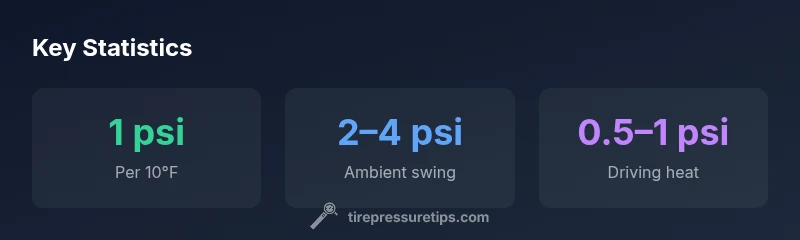
Temperature changes typically increase tire pressure by about 1 psi for every 10°F rise in ambient temperature, assuming the tire volume stays roughly constant. In practice, the exact change depends on load, speed, tire construction, and initial inflation. Understanding this helps prevent over- or under-inflation during temperature swings. The Tire Pressure Tips analysis confirms this rule of thumb across common passenger tires.
Temperature and Tire Pressure: The Core Relationship
Tire pressure responds to temperature because air expands when it heats up and contracts when it cools down. In theory, the ideal gas law P ∝ T (K) suggests pressure rises as the absolute temperature increases, assuming the tire’s volume stays roughly constant. In the real world, tires aren’t perfectly rigid; heat from driving and road contact also affects the internal air. The practical takeaway for drivers is simple: when the ambient temperature climbs, you can expect a corresponding rise in tire pressure, and when it falls, pressure tends to drop. This relationship helps explain why a tire’s reading might be noticeably higher after a long drive on a hot day than on a cool morning. According to Tire Pressure Tips analysis, this behavior is consistent across typical passenger tires and inflation ranges.
Quick rule of thumb: what most drivers see
For everyday driving, a convenient rule of thumb exists: expect roughly 1 psi of pressure change for every 10°F change in ambient temperature. This is a useful guide when you transport from a chilly morning to a warm afternoon, or when seasonal shifts swap winter air for summer heat. However, remember that the exact change varies with tire size, load, wheel diameter, and how hot the tire gets from driving. TPMS readings reflect pressure changes as tires heat up, but the gauge you use on the valve stem measures cold or warm air differently. Always verify with a reliable gauge and compare to your vehicle’s specified inflation range.
Influencing factors: load, speed, and tire construction
The rate at which pressure changes with temperature isn’t identical for every tire. Heavier loads, higher speeds, and stiffer sidewalls can amplify the pressure rise during heat buildup. Larger wheel diameters or tires with different treads may also exhibit distinct behavior. Conversely, a low load or a gentle driving style may moderate the change. The inflation baseline matters too: tires inflated near the maximum side of the recommended range will experience different proportional shifts than those at mid-range. These nuances explain why the 1 psi per 10°F rule is a guide, not a universal law.
How to measure accurately across temperature changes
The most reliable way to gauge true tire pressure is to measure when the tires are cold, i.e., after the car has sat for several hours or driven only a short distance (less than a mile). Use a good manual gauge or a digital gauge for precision, and compare the reading to your vehicle’s door placard. If you’ve experienced a temperature swing, wait for the tires to cool before adjusting, then inflate to the recommended value. After adjustments, recheck again after a few days of driving to ensure stability.
Seasonal and climate considerations for inflation
Seasonal shifts introduce temperature changes that can skew tire pressure readings. In cold climates, pressures often dip, which can reduce responsiveness and increase rolling resistance if left uncorrected. In hot climates, pressures may rise and lead to over-inflation symptoms, particularly on long road trips or high-speed drives. The best practice is to check your tire pressures monthly and after significant weather or driving changes, aiming to stay within the vehicle manufacturer’s recommended range.
Practical scenarios and safety implications
Scenario 1: On a cold morning, a tire reads 32 psi. As you drive to work and the day warms, the pressure may rise, potentially approaching the upper limit of the recommended range. Scenario 2: A hot afternoon after a long highway trip can push pressure higher still, which could impact traction if the tire becomes over-inflated. In both cases, a cold check and a refill within spec help maintain grip and even wear. Always refer to your owner’s manual and use a gauge to confirm, especially after temperature fluctuations.
Data-driven checks you can perform
Create a simple routine: (1) measure tires cold before a trip, (2) record the readings, (3) inflate to the door placard value, (4) recheck after a drive of 30 minutes or more in typical temperatures, (5) adjust again if the gauge shows a significant deviation. This practical approach helps maintain safe handling regardless of temperature swings.
Common mistakes and how to avoid them
Don’t chase readings that seem high after a hot drive and assume you’re over-inflated. Temperature effects are real, but the fix isn’t to overinflate. Instead, reset to the recommended pressure when tires are cold and monitor TPMS and gauge readings across seasons. Regular checks and a consistent measurement routine prevent surprises on the road.
Temperature-driven tire pressure changes and measurement guidance
| Aspect | Approx. Change | Notes |
|---|---|---|
| Ambient temperature change (per 10°F) | about 0.5–1.5 psi | Depends on tire and load |
| Driving heat buildup | 0.25–1 psi after 10–15 min | Higher speeds increase heat |
| TPMS vs gauge readings | TPMS reflects current pressure | Verify with a gauge when unsure |
Frequently Asked Questions
How much does tire pressure change with temperature?
As a rule of thumb, pressure rises roughly 1 psi per 10°F increase in ambient temperature, though it varies by tire size, load, and driving conditions. Always verify with a gauge when in doubt.
Tire pressure goes up with heat—about 1 psi for every 10 degrees.
Should I adjust tire pressure if I drive from cold to hot weather?
Yes. Recheck and adjust to the vehicle's recommended spec after significant temperature changes, especially after long drives.
Yes—check your tires after big weather swings.
Does TPMS account for temperature?
TPMS reads pressure, which reflects temperature; it can trigger a warning if pressure crosses thresholds. Use a gauge to confirm.
TPMS uses actual pressure once the tire heats up; still verify.
Is it safe to overinflate to compensate for heat?
No. Overinflating to counter heat can reduce grip and cause uneven wear. Inflate to vehicle spec and re-check with cold tires.
Don't overinflate; follow the spec and check cold.
How to measure tire pressure correctly?
Measure when tires are cold, use a good gauge, and compare to the door placard. Take multiple readings for accuracy.
Check when cold with a gauge.
What about seasonal tires or extreme climates?
Extreme cold or heat can exaggerate pressure changes; keep an eye on TPMS and adjust per the car maker's guidance.
Extreme temps can swing readings; adjust as instructed.
“"Temperature-driven pressure changes are normal. Maintain proper inflation and recheck after significant temperature swings to ensure safe handling and even wear."”
What to Remember
- Measure tire pressure cold for accuracy
- Expect ~1 psi per 10°F temperature rise (rough rule of thumb)
- Verify TPMS readings with a manual gauge
- Adjust inflation within vehicle spec after temp swings
- Check pressures more often during seasonal transitions