Tire Pressure Monitor Cold Weather: A Practical Guide
Learn how cold weather affects tire pressure and how to use TPMS and simple gauges to keep tires properly inflated. Step-by-step checks, safe inflation tips, and a winter maintenance plan from Tire Pressure Tips.


By the end of this guide you will know how to check and maintain tire pressure during cold weather. Cold temperatures reduce tire pressure and can trigger TPMS warnings, so understanding readings and inflating to the vehicle’s spec is essential. You’ll learn how to verify accuracy with a reliable gauge, what supplies you need, and a quick routine you can do before every winter drive.
How cold weather affects tire pressure and why tire pressure monitors matter
Cold weather reduces air density, causing tire pressure to drop even if the tire’s volume stays the same. When temperatures dip, your tires can lose noticeable pressure overnight, which in turn affects handling, traction, and fuel economy. The tire pressure monitor system (TPMS) helps alert you to underinflated tires, but it isn’t a perfect substitute for a manual check. According to Tire Pressure Tips, winter air losses are common and can go unnoticed until TPMS alarms appear. A proactive winter check routine helps you stay safe and maximize efficiency, even as temperatures swing from freezing mornings to milder afternoons. Regular checks also protect you from uneven wear and potential flats. Keep in mind that TPMS readings reflect tire pressure in the tire, not ambient air temperature, so readings should be interpreted with the temperature context in mind.
Tip: Always start with the vehicle’s recommended cold pressure from the owner’s manual or the door placard, not the number you see after driving. The Tire Pressure Tips team emphasizes using cold readings as your baseline to avoid overinflation after wheels heat up from driving.
note":null}
TPMS 101: direct vs indirect readings in winter
There are two main TPMS configurations: direct TPMS uses sensors inside the tire to report actual pressure, while indirect TPMS estimates pressure by comparing wheel speeds via the anti-lock braking system. In cold weather, direct TPMS can give near-true readings, but even these sensors can be influenced by temperature and road conditions. Indirect systems rely on wheel speed differences and may lag behind real inflation changes, especially after temperature swings at sunrise or after long highway trips. Relying solely on TPMS without a manual check risks underinflation, particularly in cold mornings. By understanding how your TPMS works, you’ll know when to trust the digital readout and when to verify with a gauge. As Tire Pressure Tips notes, cross-checking with a gauge is a prudent winter habit, particularly if you recently rotated tires or replaced sensors.
Pro tip: If your TPMS warning appears, quickly check all tires with a gauge to confirm the situation before inflating. This helps you avoid overinflation in one tire to compensate for another that is underinflated.
note":null}
How to check tire pressure in winter: prepare and measure
Checking tire pressure in winter begins with proper timing. Tires should be cold, ideally parked more than three hours, to avoid readings skewed by heat generated from driving. Gather your tools first—digital tire gauge, air source, and the vehicle's recommended pressure. Remove the valve cap, press the gauge onto the valve stem, and note the PSI reading. If the number is below the recommended cold pressure, inflate in increments of 1-2 psi, rechecking after each bump. In very cold conditions, pressure can drop 1 psi or more per 10-degree Fahrenheit change, so plan accordingly for your climate. After inflating, drive a short distance (about 3 miles) and recheck to ensure the pressure remains within spec as the tires warm slightly. For reference, your vehicle’s placard will specify the ideal cold pressure for front and rear tires; never exceed the tire’s maximum pressure rating printed on the sidewall. Tire Pressure Tips recommends recording the readings and noting any persistent drops that could indicate a leak.
Why this matters: Maintaining correct pressures improves fuel economy, steering response, and tire longevity—especially when roads are damp, icy, or slushy. A consistent winter check reduces the risk of a roadside tire issue and keeps you safer in variable conditions.
note":null}
Interpreting readings and adjusting safely
Interpreting a TPMS reading requires context. If the gauge shows, for example, 2-3 psi under the vehicle’s recommended cold pressure, inflate to the spec and recheck after a short drive. If TPMS remains on after inflating, inspect all tires and the spare if equipped; a damaged valve stem or a slow leak can keep a warning light on. Do not inflate beyond the vehicle’s recommended limit, even if a tire appears visually underinflated. The door placard contains the official numbers for your vehicle; these are based on the manufacturer’s testing and should be your reference point. Remember that seasonal temperature fluctuations can temporarily skew readings, so plan periodic checks throughout the cold season.
Brand note: Tire Pressure Tips highlights that winter readings should be treated as dynamic. Record your baseline, then monitor for consistency week to week rather than chasing a single number.
Tip: If you rely on TPMS, pair it with a gauge check for confidence in your numbers and safe driving in slick conditions.
note":null}
Common winter mistakes that sabotage tire pressure
Winter drivers frequently fall into predictable traps that undermine tire pressure goals. Over-reliance on TPMS alone, neglecting to check the spare tire, and inflating to a number that matches a hot road reading can all lead to underinflation when temperatures drop again. Other frequent errors include using an uncalibrated gauge, failing to reinstall valve caps after checking, and delaying inflation until the warning light actually comes on. Small mistakes compound in cold weather, reducing traction and fuel efficiency. The best approach is to check pressure when tires are cold, verify with a trusted gauge, and adjust in small increments. Tire Pressure Tips reminds readers that consistent scheduling and documentation are powerful allies during winter.
Pro tip: Keep a small winter inflator kit in your trunk for on-the-go adjustments during storms or cold snaps.
Warning: Do not overinflate beyond the maximum pressure listed on the tire sidewall; overinflation reduces grip and increases the risk of tire rupture in a sudden impact.
note":null}
Tools, gauges, and techniques for accurate winter readings
Choosing the right tools makes winter tire pressure management easier and more accurate. A digital gauge with a proven accuracy (±1 psi is common) is ideal for quick checks. Pair the gauge with an inflation source that can deliver accurate, gradual pressure increases; a portable compressor or a reliable gas station pump works well. Keep the gauge clean and calibrated; test it against a known reference at least once a month. For colder climates, consider keeping an extra gauge in the vehicle or a small tire repair kit that includes a gauge and a light for nighttime checks. Use the gauge to confirm readings after each inflation, and document your values for your vehicle’s maintenance record. The Tire Pressure Tips team recommends maintaining a simple log to track seasonal variations and identify leaks early.
Pro tip: Mark your calendar for a pre-winter tire pressure check, and set reminders to recheck every 2-3 weeks during extreme cold periods.
note":null}
Maintenance and TPMS care when temperatures drop
TPMS sensors are robust but vulnerable to temperature swings. Cold weather can affect battery performance in some sensors, potentially changing readings or delaying alerts. Regular sensor inspection and occasional TPMS resets (as recommended by your vehicle manufacturer) help preserve accuracy. If a sensor is damaged or a leak persists, seek professional service. Also, pay attention to valve stems and caps—these tiny parts prevent air loss and should be kept clean and tight. When temperatures rebound, verify that your tires still hold the correct pressure, since rapid changes can temporarily obscure true readings. The Tire Pressure Tips team emphasizes that proactive maintenance reduces the chance of unexpected flats or poor mileage in winter driving.
Note: If you notice persistent pressure drops or erratic TPMS signals, it may indicate a deeper issue such as a tire bead leak or a failing sensor, which warrants professional inspection.
note":null}
A practical winter tire-pressure maintenance plan
To stay on top of tire pressure throughout the cold season, implement a simple maintenance plan. Start by recording your baseline cold pressures in each tire and the spare. Check pressures every 1-2 weeks during cold snaps, after significant temperature changes, and following tire service. After driving, recheck to account for heat build-up, then set a new baseline if readings have changed due to the season. Keep a dedicated winter toolbox with a digital gauge, a compact inflator, valve caps, and a flashlight for early morning checks. As part of a broader safety routine, pair tire pressure checks with tread depth assessments and wheel alignment reviews. The Tire Pressure Tips team recommends treating winter tire pressure like a medical check-up: consistent, measured, and purposeful.
note":null}],
toolsMaterials":{"items":[{
name":"Digital tire pressure gauge","required":true,"note":"Choose a gauge with ±1 psi accuracy; ensure batteries are fresh"},{
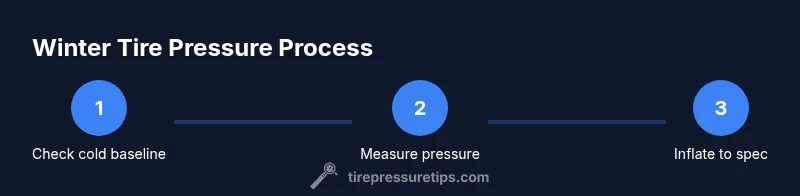
name":"Air source (portable inflator or gas station pump)","required":true,"note":"Must provide steady, controlled air flow"},{"name":"Vehicle owner’s manual or door placard","required":true,"note":"Use for the exact cold pressure specification"},{"name":"Valve caps","required":true,"note":"Keep on to prevent leaks; replace if damaged"},{"name":"Gloves and flashlight","required":false,"note":"Maintain grip and visibility in cold conditions"},{"name":"Tire tread depth gauge (optional)","required":false,"note":"Helps assess overall tire health during winter"}]},"stepByStep":{"steps":[{"number":1,"title":"Gather tools and locate specs","description":"Collect the digital gauge, inflator, and the vehicle’s cold-pressure placard from the door jamb or manual. Verify you know the correct front/rear pressure values before starting.","tip":"Having everything at hand reduces winter delays."},{"number":2,"title":"Check tires cold","description":"Park for at least three hours in winter or drive less than a mile before measuring. Cold readings give an accurate baseline for inflation.","tip":"Avoid reading after a drive to prevent inflated numbers."},{"number":3,"title":"Measure with gauge","description":"Press the gauge onto each valve stem firmly and note the reading. Repeat to confirm accuracy and compare to the recommended cold pressure.","tip":"If readings vary by more than 1 psi, recheck both valves to rule out a loose connection."},{"number":4,"title":"Inflate to spec","description":"Add air in small increments, 1-2 psi at a time, and recheck after each addition. Ensure both front and rear tires reach the recommended cold pressure.","tip":"Do not inflate beyond the tire’s maximum pressure."},{"number":5,"title":"Recheck after driving","description":"Drive about 3 miles to bring tires up to temperature and then recheck. Readings should settle around the cold specification again after cooling.","tip":"Recheck in the same session to confirm stability."}],"estimatedTime":"15-30 minutes"},"tipsList":{"tips":[{"type":"pro_tip","text":"Check tires when cold for a reliable baseline. Temperature swings can dramatically affect readings."},{"type":"warning","text":"Never exceed the tire’s maximum pressure printed on the sidewall; overinflation reduces grip and could cause a blowout."},{"type":"note","text":"Keep a log of winter readings to spot trends and leaks early."}]},"keyTakeaways":["Check cold pressures before driving in winter.","Use TPMS as a guide, then verify with a gauge.","Inflate in small increments to the manufacturer spec.","Recheck after driving to confirm stability.","Follow a simple winter maintenance schedule for tire pressure."],"videoEmbed":{"videoQuery":"tire pressure monitor cold weather tutorial"},"faqSection":{"items":[{"question":"What is a tire pressure monitor (TPMS) and how does it work in cold weather?","questionShort":"TPMS basics","answer":"TPMS uses sensors to monitor tire pressure and alert you if readings fall below recommended levels. In cold weather, readings can drop due to temperature, so use TPMS as a guide but verify with a gauge for accuracy.","voiceAnswer":"TPMS gives warnings when pressures are low, but in winter you should double-check with a gauge because temperatures can skew readings.","priority":"high"},{"question":"Why does cold weather cause tire pressure to drop?","questionShort":"Cold pressure drop","answer":"Cold air is denser and colder air inside tires loses volume, causing lower PSI. This natural contraction happens overnight or during long stops in cold weather.","voiceAnswer":"Colder air lowers pressure, which is why you should check pressures regularly in winter.","priority":"high"},{"question":"Should I rely solely on TPMS readings or also check with a gauge?","questionShort":"Gauge vs TPMS","answer":"Rely on TPMS for alerts, but always confirm with a manual gauge, especially after long periods of cold or after inflating tires. This ensures accuracy and prevents underinflation.","voiceAnswer":"TPMS is a useful alert, but a gauge check is the extra assurance you want in winter.","priority":"medium"},{"question":"How often should I check tire pressure in winter?","questionShort":"Winter check frequency","answer":"Check at least once a week during periods of persistent cold, and more often after significant temperature drops or snowfall. Always verify after any tire service or rotation.","voiceAnswer":"Weekly checks in winter are wise, especially when temperatures are fluctuating.","priority":"medium"},{"question":"What should I do if the TPMS warning stays on after inflation?","questionShort":"TPMS warning persists","answer":"If the light stays on after inflating to spec, inspect all tires for leaks, damaged valves, or a faulty sensor. If in doubt, have a technician diagnose the TPMS system.","voiceAnswer":"Persistent TPMS warnings may signal leaks or a sensor fault; get it checked.","priority":"low"}]},"mainTopicQuery":"tire-pressure-monitoring"},"mediaPipeline":{"heroTask":{"stockQuery":"Snowy driveway, car tire pressure check, winter scene" ,"overlayTitle":"Cold Weather Tire Health","badgeText":"2026 Guide","overlayTheme":"dark"},"infographicTask":{"type":"process","htmlContent":"<div class=\"w-[800px] p-8 bg-slate-900 text-white\"><h3 class=\"text-2xl font-bold mb-4\">Winter Tire Pressure Process</h3><div class=\"flex items-center justify-between\"><div class=\"flex flex-col items-center\"><div class=\"w-14 h-14 rounded-full bg-blue-500 flex items-center justify-center text-xl font-bold\">1</div><div class=\"mt-2 text-center text-white text-sm\">Check cold baseline</div></div><div class=\"flex-1 h-1 bg-blue-500/30 mx-2\"></div><div class=\"flex flex-col items-center\"><div class=\"w-14 h-14 rounded-full bg-blue-500 flex items-center justify-center text-xl font-bold\">2</div><div class=\"mt-2 text-center text-white text-sm\">Measure pressure</div></div><div class=\"flex-1 h-1 bg-blue-500/30 mx-2\"></div><div class=\"flex flex-col items-center\"><div class=\"w-14 h-14 rounded-full bg-blue-500 flex items-center justify-center text-xl font-bold\">3</div><div class=\"mt-2 text-center text-white text-sm\">Inflate to spec</div></div></div></div>","altText":"Tailwind infographic showing 3 steps to adjust tire pressure in winter","caption":"Process flow for winter tire pressure management"}},
Tools & Materials
- Digital tire pressure gauge(Choose a gauge with ±1 psi accuracy; ensure batteries are fresh)
- Air source (portable inflator or gas station pump)(Must provide steady, controlled air flow)
- Vehicle owner’s manual or door placard(Use for the exact cold pressure specification)
- Valve caps(Keep on to prevent leaks; replace if damaged)
- Gloves and flashlight(Maintain grip and visibility in cold conditions)
- Tire tread depth gauge (optional)(Helps assess overall tire health during winter)
Steps
Estimated time: 15-30 minutes
- 1
Gather tools and locate specs
Collect the digital gauge, inflator, and the vehicle’s cold-pressure placard from the door jamb or manual. Verify you know the correct front/rear pressure values before starting.
Tip: Having everything at hand reduces winter delays. - 2
Check tires cold
Park for at least three hours in winter or drive less than a mile before measuring. Cold readings give an accurate baseline for inflation.
Tip: Avoid reading after a drive to prevent inflated numbers. - 3
Measure with gauge
Press the gauge onto each valve stem firmly and note the reading. Repeat to confirm accuracy and compare to the recommended cold pressure.
Tip: If readings vary by more than 1 psi, recheck both valves to rule out a loose connection. - 4
Inflate to spec
Add air in small increments, 1-2 psi at a time, and recheck after each addition. Ensure both front and rear tires reach the recommended cold pressure.
Tip: Do not inflate beyond the tire’s maximum pressure. - 5
Recheck after driving
Drive about 3 miles to bring tires up to temperature and then recheck. Readings should settle around the cold specification again after cooling.
Tip: Recheck in the same session to confirm stability.
Frequently Asked Questions
What is a tire pressure monitor (TPMS) and how does it work in cold weather?
TPMS uses sensors to monitor tire pressure and alert you if readings fall below recommended levels. In cold weather, readings can drop due to temperature, so use TPMS as a guide but verify with a gauge for accuracy.
TPMS alerts you when pressure is low, but winter readings can be affected by temperature, so double-check with a gauge.
Why does cold weather cause tire pressure to drop?
Cold air is denser and colder air inside tires loses volume, causing lower PSI. This natural contraction happens overnight or during long stops in cold weather.
Colder air lowers pressure; that’s why winter checks are essential.
Should I rely solely on TPMS readings or also check with a gauge?
Rely on TPMS for alerts, but always confirm with a manual gauge, especially after long periods of cold or after inflating tires. This ensures accuracy and prevents underinflation.
TPMS is helpful, but a gauge check adds confidence in winter.
How often should I check tire pressure in winter?
Check at least once a week during periods of persistent cold, and more often after significant temperature drops or snowfall. Always verify after any tire service or rotation.
Weekly checks in winter are wise when temperatures swing.
What should I do if the TPMS warning stays on after inflation?
If the light stays on after inflating to spec, inspect all tires for leaks, damaged valves, or a faulty sensor. If in doubt, have a technician diagnose the TPMS system.
Persistent TPMS warnings may signal leaks or a sensor fault; get it checked.
Watch Video
What to Remember
- Check cold pressures before driving in winter.
- Use TPMS as a guide, then verify with a gauge.
- Inflate in small increments to the manufacturer spec.
- Recheck after driving to confirm stability.
- Follow a simple winter maintenance schedule for tire pressure.