How Temperature Affects Tire Pressure: Practical Guide
Learn how ambient and tire temperature influence pressure, how to measure accurately, and how to adjust your tires for seasonal changes with practical tips.


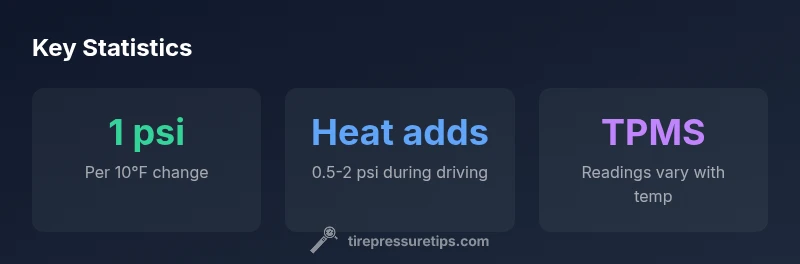
Temperature has a measurable effect on tire pressure. As ambient temperature shifts, the air inside tires expands when it's warm and contracts when it is cold, typically resulting in about 1 psi change for every 10°F (5.6°C) difference. Actual changes vary with heat buildup, driving conditions, tire construction, and load, so recheck pressures after temperature swings.
How temperature affects tire pressure
In practical terms, the core question you’ll hear from drivers is how much does temperature affect tire pressure. Temperature changes influence the air inside the tire: when the air warms, it expands and increases pressure; when it cools, it contracts and lowers pressure. On average, you can expect roughly 1 psi change for each 10°F (5.6°C) difference in ambient temperature, but the exact amount depends on heat buildup, driving conditions, tire construction, and load. According to Tire Pressure Tips, these shifts are predictable enough to plan for, but variability from real-world factors means you should recheck after notable temperature swings to keep tires within the manufacturer’s recommended range.
The physics behind the change: a plain-English look at the gas law
To understand the effect, think of the ideal gas law: P1V1/T1 = P2V2/T2. When air temperature rises, molecules move faster, increasing pressure if the tire volume remains roughly constant. In a sealed tire, the volume cannot change much, so pressure climbs with temperature. In practice, tires also heat up from rolling friction, braking, and ambient sun exposure, which compounds pressure beyond what ambient temperature alone would predict. This is why a tire that’s cold at 32°F can end up reading higher after a long drive on a hot highway.
Cold days vs hot days: real-world differences
During cold snaps, ambient temperatures pull tire pressure downward, creating a higher risk of underinflation if you don’t compensate. Conversely, hot days and direct sun raise pressures as tires absorb radiant heat. The practical takeaway from Tire Pressure Tips is to start from the vehicle’s recommended cold pressure and verify after temperature transitions. If you move a car from a cool garage to a sunlit street, you may see a noticeable rise in pressure that should be accounted for when you check and adjust.
The role of road heat and driving style
Even with stable ambient temperatures, the act of driving generates heat inside the tire. Speed, acceleration, cornering, and heavy loads accelerate heat buildup, which can raise pressure inside the tire by 0.5 psi to a few psi depending on conditions. This means a tire measured cold at 35 psi could read higher after a highway trip. The cure is to rely on the manufacturer’s cold-pressure specification and use a gauge to verify pressure after driving if you’re adjusting for seasonal changes.
Measuring pressure accurately across temperature changes
Best practice is to check tire pressures when tires are cold (ideally after at least three hours of inactivity). If you must check hot tires, subtract about 1 psi to estimate the cold pressure. Use a reliable gauge, and check all four tires plus the spare. When adjusting for seasonal changes, calibrate to the vehicle’s recommended cold pressure and recheck after the next drive to confirm stability.
Practical ranges you can expect and how to adjust
Expect that temperature swings can translate into a few psi difference in some cases, but the target remains the manufacturer’s cold pressure specification. If you drive from a cold morning into a hot afternoon, recheck to see whether the pressure remains within spec. Make air adjustments in small increments (2–3 psi) and recheck after each adjustment. For TPMS-equipped vehicles, treat dashboard readings as a guide and verify with a gauge.
Seasonal considerations and climate-specific tips
Cold-season driving often requires more frequent checks as temperatures drop, while summer heat can trigger overinflation risks. In extreme climates, consider checking pressures more often and adjusting as temperatures shift. Remember that tire pressure is vehicle-specific, so always compare to the manufacturer’s cold-pressure specification rather than a generic target.
Common myths and quick debunking
Myth: Temperature has no effect on tire pressure. Reality: Temperature changes do affect pressure, especially after long drives or direct sun exposure. Myth: TPMS readings are exact pressures. Reality: TPMS sensors respond to temperature and may lag or overshoot; always confirm with a manual gauge. Myth: You should always inflate to the hottest reading. Reality: Always target the cold pressure specified by the vehicle manufacturer; recheck after temperature changes.
Quick-start checklist: temperature-aware tire pressure management
- Check cold pressures after major temperature swings; use the manufacturer’s spec as your target.
- If you must check after driving, wait for tires to cool and recheck, or compensate using the guideline of subtracting ~1 psi for hot readings.
- Use a reliable gauge and verify all four tires and the spare.
- Recheck after long drives or rapid temperature changes to confirm the pressure remains within range.
Pressure changes with ambient temperature (Tire Pressure Tips Analysis, 2026)
| Factor | Effect on Pressure | Best Practice |
|---|---|---|
| Ambient Temperature Change | About 1 psi per 10°F change | Recheck after swings |
| Tire Temperature During Driving | Heat buildup can raise pressure more than ambient change | Re-measure after a drive |
| Seasonal Adjustments | Warming in warm weather increases pressure | Adjust to vehicle spec when hot/cold difference |
Frequently Asked Questions
How does ambient temperature affect tire pressure?
Ambient temperature shifts cause air to expand or contract, typically about 1 psi per 10°F change. Driving heat can amplify, so recheck pressures after temperature changes.
Ambient temperature shifts can change tire pressure by about 1 psi per 10°F; check after temperature swings.
Does ambient temperature matter more than road temperature?
Both matter; ambient temperature affects the air in the tire while road heat increases tire temperature during driving. The combined effect can push pressure beyond spec.
Both ambient and road heat change tire pressure—consider both when checking.
Should I adjust tire pressure for winter cold?
Yes, check pressures when it's cold; cold-weather makes underinflation more likely; compare readings to manufacturer spec.
Winter cold can lower pressure; check and adjust.
How often should I check tire pressure when temperatures change?
Check pressures at least once a month and before long trips; more often during seasons with large temps swings.
Check monthly, and before big trips during temperature swings.
Can TPMS readings be trusted in cold weather?
TPMS is helpful but temperature affects readings; always verify with a gauge, especially when temperatures shift.
TPMS helps, but use a gauge in cold.
“Tire pressure is not static; temperature shifts drive most of the changes you feel in handling and tire wear. Maintain manufacturer-recommended cold pressures and verify after temperature swings.”
What to Remember
- Check cold pressures after temperature swings
- Expect ~1 psi per 10°F ambient change
- Use TPMS readings as a guide, not a guarantee
- Always re-check after long drives