Cold Weather Tire Pressure Chart for Winter Driving
Explore how ambient temperatures affect tire pressure with a cold weather tire pressure chart. Learn practical steps to read, interpret, and apply PSI changes for safer winter driving and improved fuel efficiency.


Cold-weather tire pressures typically drop as ambient temperatures fall, so a dedicated cold weather tire pressure chart helps you adjust for winter conditions. As a rough rule, expect about a 1 psi decrease for every 10°F (5.5°C) temperature drop. Always check cold tires with a gauge and dial in the manufacturer’s recommended cold-inflation pressure (not the warm reading).
Why a Cold Weather Tire Pressure Chart Matters
According to Tire Pressure Tips, winter temperature shifts have a measurable impact on tire pressure, and a cold weather tire pressure chart helps drivers translate those shifts into safe, practical adjustments. The chart isn’t just about numbers; it guides you to maintain tire contact with the road, preserve fuel efficiency, and avoid sudden handling changes when you least expect them. In cold weather, even short trips can distort the readings you get from a gauge if you measure after driving, so establishing a winter-ready routine around a chart makes sense for most passenger vehicles and light trucks.
Understanding the chart means recognizing that pressure readings are not absolute constants. They are influenced by ambient temperature, tire construction, and the ease with which air expands or contracts. By learning how to read the chart, you gain a tool to anticipate how your tires behave on frosty mornings, in overcast conditions, or after a long highway drive when the tires heat up and the pressures rise. The goal is consistent performance, not perfection in every moment.
How Temperature Affects Tire Pressure
The core physics is straightforward: air compresses in cold air and expands in warm air. When the air inside a tire cools, it contracts, and the pressure measured inside drops. While the exact psi change varies by tire volume and construction, the practical takeaway for drivers is simple: colder air means lower pressure, and lower pressure reduces tire contact with the road, increasing rolling resistance and reducing grip.
For most cars, the manufacturer’s cold-inflation specification is designed to account for typical winter temperatures. The chart helps you estimate how far off your current reading might be when you pull into a chilly morning. Keeping your tires near the recommended cold-inflation PSI reduces the risk of underinflation, which worsens tire wear, heat buildup, and fuel consumption.
Interpreting the Chart: Key Axes and Units
A standard cold weather tire pressure chart typically maps temperature ranges to approximate PSI changes. The horizontal axis represents ambient temperature, while the vertical axis shows expected PSI variation. Units commonly used include psi and bar, with PSI being standard in the United States and bar used in many other regions. When you read the chart, remember:
- Start with the manufacturer’s cold-inflation PSI, not the old warm reading.
- Apply the chart’s adjustment to reach the target cold PSI for winter conditions.
- Consider tire size and load, which can modulate how much pressure shifts with temperature.
If you’re using a TPMS in your vehicle, reset expectations to the cold-inflation figure, then verify with a gauge when temperatures drop.
Practical Steps: Reading Your Tire Pressure in Cold Weather
Follow these steps to implement the chart in real life:
- Check the tires when they are cold, ideally in the morning before starting the engine or after a few hours of sitting.
- Note the ambient temperature; refer to the chart for the expected psi adjustment per 10°F drop.
- Compare the current psi reading to the target cold-inflation pressure listed by the vehicle manufacturer.
- If the tire reads low, add air in small increments and re-check with the gauge. Do not exceed the max pressure etched on the tire sidewall.
- After adjusting, take a short drive of a few miles to warm tires slightly and verify that readings have stabilized back toward the target.
- Recheck later in the day or after temperature swings to maintain consistent pressure as the day warms or cools.
Common Misconceptions About Cold Weather Tire Pressure
Many drivers assume that tire pressure is a fixed, constant value regardless of the temperature or that all tires behave the same across brands. In reality, ambient temperature, tire volume, rubber composition, and even the wheel size influence how pressure shifts. Another common misbelief is that higher pressures improve safety in winter; in truth, overinflation reduces the tire’s contact patch and can cause irregular wear and harsher ride quality. The chart helps dispel these myths by tying readings to practical adjustments.
TPMS and Manual Checks: A Complementary Approach
Tire Pressure Monitoring Systems (TPMS) are excellent for alerting you when a tire drops below the threshold, but TPMS data is not a replacement for gauge checks, especially in cold weather. TPMS readings reflect the difference between current pressure and a baseline, which can be affected by sensor calibration and temperature. Pair TPMS with regular, precise manual checks using a gauge to confirm the cold-inflation target. This dual approach reduces the risk of underinflation and keeps the vehicle responsive in winter conditions.
Seasonal Maintenance: Before, During, and After Cold Spells
Create a winter maintenance routine that aligns with the cold weather tire pressure chart:
- Before cold snaps: check all tires and ensure they are at the manufacturer’s cold-inflation PSI.
- During cold spells: recheck weekly or after any long trip when temps swing.
- After temperatures rise: re-check to account for warm-air expansion and return to baseline cold-inflation pressures.
- Don’t forget the spare: keep it inflated to the same standard as the road tires so you’re ready for a flat anytime.
How to Use a Cold Weather Tire Pressure Chart for Different Tire Types
All-season tires, summer tires, and dedicated winter tires respond differently to temperature shifts. Winter tires, with their different rubber compounds and tread designs, often show more pronounced pressure changes with temperature. The chart should be used as a guide, not a guarantee, and you should adjust your targets based on tire type, driving load, and vehicle weight. If you’re unsure, consult your vehicle manual or a trusted technician and consider a tire-pressure check that includes the tire’s load index and speed rating.
Real-World Scenarios: Case Studies and Examples
Scenario A: A sedan with all-season tires sits overnight at 28°F (-2°C). The thermostat reads 30°F, and the current tire pressure is 2 psi below the recommended cold-inflation target. Using the chart, you estimate a ~2 psi adjustment. You add air in small increments, rechecking after a short drive when the tires cool again. Scenario B: A small SUV with winter tires starts a morning commute at 15°F (-9°C). The tires show a 1.5 psi drop from the target cold PSI. After topping up to the chart-recommended pressure, you notice improved steering response and more even wear across the tread. Both examples illustrate how the chart translates temperature to actionable steps.
Temperature influence on tire pressure
| Aspect | Typical Change | Notes |
|---|---|---|
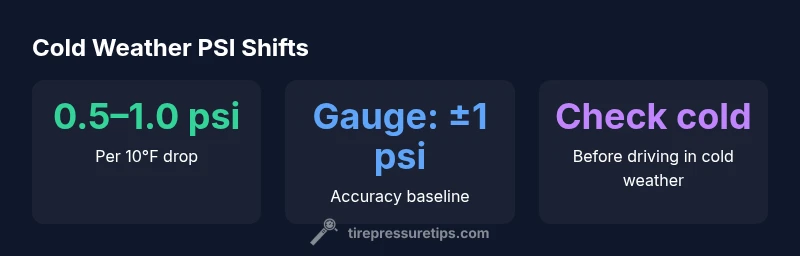
| Temperature drop | 0.5–1.0 psi per 10°F | Varies by tire volume and construction |
| Ambient humidity | Minor impact | Better interpreted with gauge over long-term trends |
| Tire type differences | Higher variance | Winter tires may differ from all-season tires |
Frequently Asked Questions
What is a cold weather tire pressure chart?
A cold weather tire pressure chart maps ambient temperature to approximate psi changes, helping you adjust tire pressure for winter driving. It translates how much pressure you should add or remove as temperatures fall or rise.
A chart shows how temperature affects PSI and gives you a practical target to keep tires properly inflated in winter.
How often should I check tire pressure in winter?
In winter weather, check tire pressure at least once a week and after any temperature swing of several degrees. If you drive short distances, readings can drift quickly, so regular checks are important.
Check your tires weekly during winter, especially after cold nights or big temperature changes.
Does TPMS replace manual tire pressure checks?
No. TPMS alerts you when pressure falls significantly, but it does not tell you the exact cold-inflation PSI or account for ambient temperature. Manual gauge checks remain essential in cold weather.
TPMS helps, but you still need to measure with a gauge to know if you’re at the right cold PSI.
How should I adjust for different tire types using the chart?
Different tires respond to temperature differently. Use the chart as a guide, then consult the tire manufacturer’s specs for the exact cold-inflation range, and consider load and speed rating when adjusting.
Tires are not all the same; use the chart plus manufacturer specs for best results.
Is it safe to drive with slightly underinflated tires in winter?
Moderate underinflation can increase rolling resistance and reduce grip on slick surfaces. It’s safer to bring tires to the chart-recommended cold PSI.
Driving with the chart-recommended pressure is safer and more predictable in winter.
Should I recheck pressure after a warm-up drive?
Yes. After a warm driving cycle, tires heat up and the pressure rises. Recheck with the gauge after they’ve cooled to determine if you’re still at the target cold PSI.
Recheck after your tires cool to ensure you’re still at the right cold pressure.
“Winter tire pressures are best managed by a disciplined routine that combines gauge checks with temperature-aware targets. The chart empowers drivers to maintain traction and efficiency in harsh conditions.”
What to Remember
- Check cold tires before driving.
- Expect roughly 0.5–1.0 psi change per 10°F drop.
- Use the manufacturer’s cold-inflation spec as the target.
- TPMS is a helpful alert, not a replacement for gauges.
- Recheck after temperature swings and weather changes.
- Apply the chart to different tire types with care.