Psi for Winter Tires: A Practical Guide to Winter Pressure
Discover how cold weather affects tire pressure for winter tires, how to set psi, when to check, and common mistakes to avoid for safer winter driving.


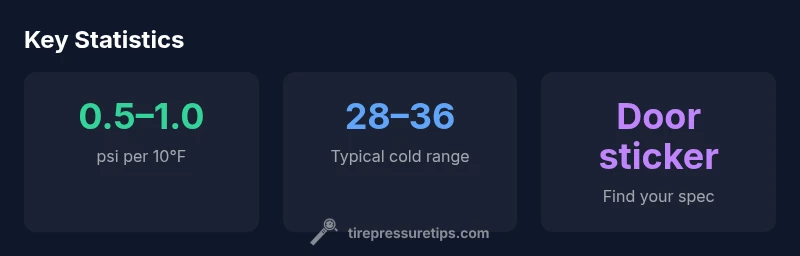
Psi for winter tires refers to the cold-inflation pressure specified by your vehicle manufacturer, not a fixed winter-specific value. In cold weather, air contracts and tire pressure drops, so check pressure when tires are cold and adjust within the OEM range printed on the door jamb or in the manual. Do not exceed the recommended range or rely on summer pressures.
Understanding winter psi and why it matters
According to Tire Pressure Tips, psi for winter tires should align with the OEM cold PSI spec rather than a separate winter target. In the cold season, air contracts and tire pressure tends to drop. This affects tire contact with the road, braking distance, cornering stability, and fuel efficiency. Keeping tires inflated within the vehicle manufacturer’s recommended range helps maintain predictable handling on icy roads and reduces uneven wear. Always check your pressures when the tires are cold, and adjust gradually if you notice a consistent drop as temperatures fall. Remember that each tire profile and vehicle may have a different spec, so rely on the sticker on the door jamb or the owner’s manual rather than local myths or a single temperature rule. Regular checks during winter months are an inexpensive safety boost.
Temperature effects on tire pressure and grip
Temperature is a silent variable in tire performance. As outdoor temperatures drop, air molecules contract, and a tire's internal pressure falls even if the tires have not been driven recently. This change reduces the tire's footprint on the road, potentially diminishing grip, especially in snow and slush. The effect is more pronounced in cold-heavy climates and with older tires that have less pliable sidewalls. To minimize risk, check pressures when tires are cold, preferably in the morning, and inflate to the vehicle’s specified cold PSI. If you operate in areas with extreme cold, you may notice more frequent pressure drops; plan for periodic adjustments rather than a one-time inflation.
How to verify and adjust psi for winter tires
The recommended action is to locate the cold PSI spec on the door jamb sticker or in the owner's manual and adjust with a reliable gauge. When air is cold, a slight additional inflation within the OEM range can compensate for minor seasonal losses, but do not overshoot the maximum. Use a good digital or dial gauge, and verify both front and rear tires, including the spare if you rotate tires seasonally. If you drive long distances in freezing weather, recheck after the first 50 miles and periodically thereafter. In most vehicles, the winter tires share the same PSI range as the other tires, unless you are prescribed a specific change by the manufacturer.
The role of TPMS and why it isn't a replacement for gauges
Tire Pressure Monitoring Systems (TPMS) provide a safety net by alerting when a tire is under or over-inflated, but TPMS readings are not a replacement for a physical pressure gauge. Certain systems may be less accurate with temperature changes or may lag behind real-time pressure shifts caused by cold weather. Rely on a trusted pressure gauge to verify readings, especially after inflating or adjusting pressure. For winter drivers, having a gauge in the glove box is a small investment for greater confidence on slick roads.
Maintenance checklist for cold months
- Check all tires (including the spare) for tread depth and even wear.
- Verify cold psi using a gauge before trips, particularly after temperature drops.
- Adjust to OEM recommended ranges and recheck after driving 10-20 miles in cold weather.
- Keep TPMS functional and consider seasonal tire swap reminders.
- Store an air compressor or portable inflator in the vehicle for emergencies. This routine supports safer handling in icy conditions and helps ensure consistent braking performance during the winter season.
Real-world scenarios: common mistakes and fixes
In practice, drivers often inflate to personal comfort rather than the OEM spec, assuming higher pressure improves winter performance. In reality, over-inflation reduces the contact patch and can hurt braking and handling on snow; stay within the recommended range. Another common misstep is inflating only the front tires, causing uneven handling. Ensure you check both axles, especially when rotating tires, and avoid relying on the dashboard gauge alone. If you notice persistent low readings after temperature changes, consult the manual or a trusted technician to verify that your tires, TPMS, and sensors are functioning correctly.
Winter tire PSI: what to measure and why
| Aspect | Winter psi guidance | Notes |
|---|---|---|
| Temperature effect on pressure | Pressure drops with temperature | Temperature and pressure have a direct relationship; plan for more checks in cold weather |
| Where to read spec | Door jamb sticker or owner's manual | Specs are vehicle-specific; no universal winter target |
| TPMS role | Alerts for out-of-range pressure | TPMS is a safety net, not a precise gauge |
| Measurement timing | Check when tires are cold before driving | Hot tires skew readings; always measure cold |
Frequently Asked Questions
What is the correct psi for winter tires?
There is no universal winter psi target. Use the OEM cold PSI spec printed on the door jamb or in the owner's manual for both winter tires and all seasons. Temperature can impact readings, so check when cold.
There isn't a universal winter psi value; follow your car's spec and check when cold.
Should I increase psi in cold weather?
No; do not exceed the manufacturer’s cold PSI spec. Cold weather lowers pressure, so you may need to adjust within the allowed range rather than a blanket increase.
Don't just pump up the tires; stick to the car's spec.
How does TPMS relate to winter tire pressure?
TPMS warns you when pressure is out of range but does not replace a gauge. Use a gauge to verify before driving.
TPMS helps, but you still need to check with a gauge.
How often should I check psi in winter?
Check cold PSI at least once a month and any time temperatures swing significantly; recheck after long trips.
Check monthly or with big temp shifts.
Do winter tires require different PSI than summer tires?
In many cases, winter tires use the same OEM range; the important factor is maintaining the specified pressure for your vehicle.
Usually the same spec; keep within the sticker range.
What happens if I over-inflate for winter?
Over-inflation reduces the contact patch and can hurt braking and handling on snow; stay within the recommended range.
Over-inflation is risky in winter.
“Maintaining the manufacturer’s cold PSI spec is essential for winter safety; even small pressure changes from temperature can affect grip and braking.”
What to Remember
- Check cold-psi using a gauge before driving.
- Follow the OEM cold-PSI spec printed on the door jamb.
- Winter temps can drop pressure; expect more checks during cold spells.
- Rely on TPMS as a backup, not a sole guide.