Volkswagen Jetta Tire Pressure: Check, Inflate, and Maintain
A comprehensive, step-by-step guide to checking and maintaining correct tire pressure on your Volkswagen Jetta, including model-specific tips, TPMS insights, and safety considerations for reliable performance.


Check and maintain Volkswagen Jetta tire pressure to optimize safety, fuel efficiency, and tire life. You’ll need a tire pressure gauge, the Jetta’s door jamb placard or owner’s manual, and a source of reliable air pressure. This quick answer outlines steps you can take to check and adjust tire pressure.
Why tire pressure matters for the Volkswagen Jetta
Tire pressure affects handling, braking, fuel economy, and tire wear. For the Volkswagen Jetta, maintaining the correct cold tire pressure helps ensure predictable steering response and optimal tire contact with the road. Using the vehicle placard on the driver’s door jamb or the owner’s manual, you can determine the manufacturer-recommended cold pressure for front and rear tires. While numbers vary by model year and trim, staying within the recommended range reduces rolling resistance and improves mpg. The Tire Pressure Tips team emphasizes that consistency matters: check pressure when tires are cold and adjust to the posted spec. For drivers who regularly carry passengers or heavy loads, the placard may specify higher pressures for front tires. Always double-check after long highway trips or when the vehicle weight changes.
Quick reality check on VW Jetta tire pressure targets
The Volkswagen Jetta tire pressure specification is designed to balance ride quality and tire longevity. When you inflate beyond the recommended range, you risk a harsher ride and uneven wear; below the spec, you can experience decreased handling performance and increased tire heat. The door jamb sticker provides the official baseline, but some owners prefer to use the published values in the owner's manual for reference when the placard isn’t readable. In all cases, verify the cold pressure before driving, and recheck after any significant temperature shift. The main message: start with the placard, verify with the manual, and maintain consistency across all tires.
Finding the correct pressure for your model year and trim
Because tire pressures can change with model year, trim, and load, always start with the door jamb placard specific to your Jetta. If you’re unsure, consult the owner’s manual or contact a dealer. For many drivers, a typical passenger-car range falls in the low 30s psi, but the exact number may differ between front and rear tires. Record the target numbers for quick reference during future checks, especially after tire rotations or wheel changes. The goal is to keep all tires within the same target window to ensure even handling and wear.
Tools you need to check tire pressure accurately
Before you begin, assemble a tire pressure gauge, access to an air source, and the vehicle’s pressure specification from the placard or manual. Digital gauges tend to be easier to read, but any gauge that reads to at least 1 psi increments will work. Park on level ground, wait for cold tires, and remove the valve caps to expose the stems. Calibrate your gauge against a known reference if you suspect inaccuracy, and avoid inflating with a hot tire as this skews readings.
Seasonal and load considerations for Jetta tires
Seasonal temperature shifts can cause noticeable pressure changes. In colder weather, pressures tend to drop; in hot weather, they rise. When carrying heavier loads, increase pressures per the placard guidance to maintain optimal contact patch and handling. If you frequently switch between city commuting and highway driving, consider checking pressures monthly and after long trips to accommodate the wear patterns and load differences. The aim is to keep tire pressures stable across seasons and driving conditions.
Understanding TPMS readings and warnings for the Jetta
Tire Pressure Monitoring System (TPMS) alerts you when a tire is underinflated or if a sensor failure occurs. TPMS is a safety tool, but it does not replace a manual pressure check with a gauge. If a TPMS warning appears, visually inspect all tires, then use a gauge to confirm the exact pressures. If a tire is significantly low, adjust promptly and recheck to ensure you’re within the vehicle’s target range. After inflation, the TPMS light should stabilize and stop flashing once the system confirms normal pressures.
Common mistakes and how to avoid them
Avoid inflating or deflating tires while the car is on the ground and hot. Always measure cold tires to prevent over- or under-inflation misreads. Do not rely solely on TPMS for exact psi readings; use a gauge to verify. Keep valve caps on to prevent dirt entry, and don’t ignore the spare tire’s pressure if your model has a full-size spare. Regularly check tires for wear, cracks, or bulges that could indicate other issues beyond pressure.
Maintenance and long-term tire pressure health
Incorporate tire pressure checks into your routine, especially during seasonal changes or after tire rotations, alignment, or wheel swaps. Maintain a simple log of readings and dates to spot gradual leaks or slow losses. Periodically verify that the tire pressure monitor sensors are functioning correctly by having them inspected during routine service. Staying proactive with checks helps protect tread life, fuel efficiency, and overall vehicle safety.
Quick-start checklist for VW Jetta tire pressure
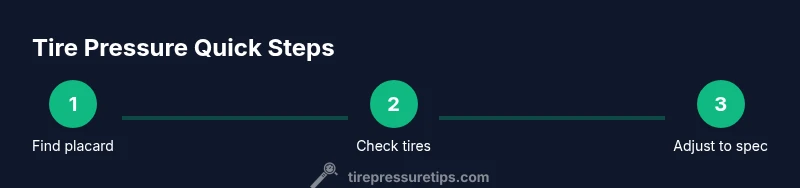
- Locate the correct cold pressure targets on the door jamb placard or in the manual.
- Use a reliable gauge to measure all four tires when cold.
- Inflate or deflate to the target pressure, ensuring consistent readings across tires.
- Recheck after any temperature change or lengthy drive and re-note changes in a log.
Tools & Materials
- Tire pressure gauge(Digital or analog; accuracy to ±1 psi is ideal)
- Door jamb placard or owner's manual(Shows the recommended cold pressure by axle)
- Air pump or station compressor(Used to adjust tires to the specified pressure)
- Notebook or mobile app to log readings(Helpful for tracking changes over time)
Steps
Estimated time: 45-60 minutes
- 1
Gather tools and locate the pressure spec
Before you start, collect your gauge and locate the recommended cold tire pressure on the door jamb placard or in the owner's manual. Make sure the car is on level ground and the tires are cold for an accurate reading. If you’ve recently driven, wait at least three hours or simulate cold conditions before measuring.
Tip: Have the car in park and apply the parking brake before handling tires to stay safe. - 2
Check each tire with the gauge
Remove the valve cap, place the gauge on the stem, and take a reading for each tire. Record the numbers and compare them against the target. If one or more tires are low, plan to adjust them first to bring all tires to the spec.
Tip: If you use an automatic station gauge, cross-check with your own gauge for accuracy. - 3
Inflate or deflate to the target pressure
Using an air pump, bring each tire up to the recommended cold pressure. If you overinflate, release air in small increments until you reach the target. Recheck after adjustments to confirm all tires are at the same target range.
Tip: Avoid inflating beyond the target by more than 1-2 psi. - 4
Re-check all tires after adjustment
After adjusting, recheck the pressures on all four tires to ensure uniformity and accuracy. If the vehicle has a spare, include it if you’re tracking overall tire pressure health. Make sure valve caps are securely reinstalled.
Tip: Take a short drive and recheck; pressure can rise with heat. - 5
Document readings and monitor over time
Record the readings and the date. Check tire pressures monthly or at least with every rotation. Temperature changes can affect pressure, so recheck after cold mornings or hot days and adjust as needed.
Tip: Keeping a log helps catch slow leaks early. - 6
Safety test drive and final verification
Re-cap the valve stems, reinstall caps, and perform a short test drive. Re-check pressures after the drive since they may increase with heat. Ensure the TPMS indicators are stable and not flashing.
Tip: If TPMS warns after inflation, re-check for leaks or sensor issues.
Frequently Asked Questions
Where can I find the correct tire pressure for my Volkswagen Jetta?
Check the driver’s door jamb placard first; it lists the recommended cold pressure for front and rear tires. If the placard is unreadable, consult the owner's manual or a reputable dealer. Always use the cold-reading spec as your target.
Look at the door jamb placard; if it’s unreadable, refer to the owner's manual for the cold pressure targets.
Can I use the same pressure for all four tires on a Jetta?
No. Front and rear tires often require different pressures based on axles and load. Use the placard or manual targets for each axle and maintain equalization across tires when possible.
No—front and rear pressures can differ by design; follow the specific targets.
What happens if I over-inflate beyond the recommended pressure?
Over-inflating can lead to a harsher ride, reduced contact with the road, and uneven tire wear. Return to the recommended pressure and check for valve leaks if necessary.
Over-inflating can hurt grip and wear; adjust back to the recommended level.
Does TPMS show the exact tire pressure in psi?
TPMS warns when pressures fall below a threshold and may not show the exact psi like a gauge. Use a gauge to verify precise pressures on all tires.
TPMS gives warnings, not exact numbers—use a gauge for exact readings.
How do temperature changes affect tire pressure?
Temperature affects tire pressure; cold weather lowers PSI and hot weather raises it. Check pressure when tires are cold and adjust as seasons change.
Temperature changes affect pressure; check when cold to adjust appropriately.
Watch Video
What to Remember
- Know the VW Jetta’s official cold pressure from placard or manual.
- Check all four tires and match pressures across axles.
- Record readings and re-check after temperature changes.