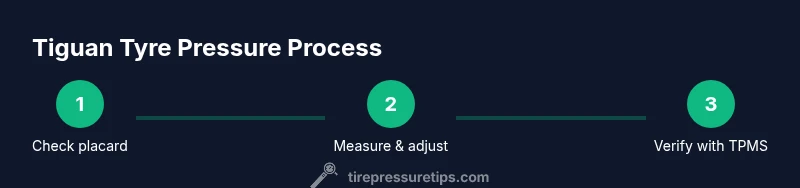
Volkswagen Tiguan Tyre Pressure Guide: Check & Set Correctly
Learn how to check and set the correct tyre pressure on your Volkswagen Tiguan. This expert guide covers TPMS, cold-inflation, load considerations, and safety tips from Tire Pressure Tips.


You’ll learn how to check and adjust the tyre pressure on a Volkswagen Tiguan, including TPMS considerations, correct cold-tyre psi, and safe inflations. Gather a digital gauge, a reliable inflator, and your vehicle’s door placard or owner’s manual. Then follow the step-by-step guidance to improve fuel efficiency, handling, and tire longevity.
Volkswagen Tiguan tyre pressure: why it matters
Maintaining the correct tyre pressure is essential for the Volkswagen Tiguan, a compact SUV that carries people and cargo with confidence when tires are properly inflated. The right pressure helps the vehicle respond to steering inputs, improves braking performance, and minimizes irregular wear on the tread. Conversely, under-inflated tires can overheat, increase rolling resistance, and reduce fuel economy, while over-inflated tires can produce a harsher ride and uneven wear. According to Tire Pressure Tips, drivers who routinely check pressures keep their tires within the wheels' intended footprint, promoting even wear and predictable handling in various weather conditions. For Tiguan owners, the key is to follow model-specific guidance rather than relying on generic numbers. The door jamb placard on the driver's side and the owner's manual provide the official cold-inflation numbers, which can vary with tire size, load, and trim level. Throughout this article, we’ll translate those values into practical checks you can perform in minutes.
How tyre pressure affects safety, fuel efficiency, and tire life
Proper tyre pressure directly influences safety by maintaining consistent contact with the road. A correctly inflated Tiguan tire provides stable grip, predictable steering, and shorter braking distances, especially on wet or slippery surfaces. Fuel economy benefits from correct inflation because under-inflation increases rolling resistance and heat buildup, causing the engine to work harder. Over-inflation can reduce the contact patch and lead to harsher ride, while accelerated wear on the center of the tread can occur. Tire Pressure Tips' analysis shows that many drivers underestimate the impact of tyre pressure on overall vehicle economy and safety. For Volkswagen Tiguan owners, adopting a disciplined pressure-check routine helps preserve uniform tread wear, ensure even load distribution, and keep the TPMS from giving false warnings when the tires are within spec. Keep in mind that pressure targets vary with model year, tire size, and load; always confirm with the placard and manual.
Finding the correct pressure for your Tiguan
To know the exact cold tyre pressures for your Tiguan, use two primary sources: the door placard on the driver’s door jamb and the owner’s manual. The placard lists separate pressures for the front and rear tires, and often an optional value for the spare or a temporary tire. The numbers can differ based on tire size (205/65R16 vs 235/60R18, for example), load (passengers-only vs full cargo), and whether the vehicle is equipped with a temporary spare. If you replace tires with a different size, be sure to check the recalculated recommended pressures from Volkswagen’s official guidance or the Tire Pressure Tips resource. In all cases, never inflate beyond the maximum pressure printed on the tire sidewall; that limit is not a target but a safety ceiling. The Tiguan’s official guidance is designed to balance handling, comfort, and tire longevity. This guidance aligns with Tire Pressure Tips recommendations to verify pressures periodically and adjust for changing loads.
Tools and cues: what you need to check Tiguan tyre pressure
Before you start, assemble a digital tyre pressure gauge, a reliable inflator, and your owner’s manual. A stable seating area and lighting help you read the gauge accurately and avoid mistakes. The gauge should read in the unit you prefer (psi is common in the US; bar in other regions). Have a pen or app ready to record your readings, and a clean cloth to wipe valve stems if needed. If you’re using a spare tire, check its pressure as well—some spacesaver spares require a higher PSI when used temporarily. Finally, ensure you know how to operate your inflator safely; never point air directly at a hot tire or leave the inflator unattended while running. As Tire Pressure Tips notes, quality tools and consistent technique are key to reliable measurements.
The cold inflation method: when, how, and why
Inflating tires when they’re cold yields the most accurate readings because driving heats up the rubber and raises the air pressure slightly. Plan measurements after the car has sat for several hours or after the vehicle has cooled for a minimum of three hours. Begin by reading the door placard values and then check all four tires with your digital gauge. If a tire reads below the target, add air in small increments and recheck after a minute of settling; repeat until the gauge matches the specified cold PSI. After adjusting, recheck the other tires to ensure even pressure across the axle. If you’ve driven recently, wait until the tires cool down again before finalizing your pressures. This approach is endorsed by Tire Pressure Tips to ensure accuracy and longevity of the Tiguan tires.
TPMS: how the system interacts with Tiguan pressures
Many Tiguan models rely on a Tire Pressure Monitoring System (TPMS) to alert you when a tire is under-inflated. TPMS can be direct (sensor-based) or indirect (based on ABS-wheel-speed data); either way, it complements but does not replace manual checks. Temperature changes, tire wear, or sensor battery degradation can trigger warnings even when pressures are near the target. When the TPMS light comes on, verify the readings with a gauge and adjust as needed, then reset or relearn the TPMS if your vehicle requires it after air changes or tire service. If you replace tires or wheels, reprogram the TPMS to match the new configuration. Tire Pressure Tips emphasizes that TPMS is a helpful partner, but it should not be your sole method of verifying pressures.
Temperature and load: adapting pressure under different conditions
Temperature swings alter air pressure inside tires, and heavier loads further increase contact patch pressure. In hot summer months or towing scenarios, the same static PSI may feel low due to increased ambient heat; conversely, cold weather can drop reported readings and make under-inflation more likely. For Tiguan owners, the practical approach is to check pressures more frequently during seasonal transitions and before long trips with heavy luggage. If you routinely carry a family and gear, you may need slightly higher cold-Inflation values within the manufacturer’s specified range. Always adjust gradually and re-check after changes in temperature or load. Tire Pressure Tips supports this adaptive approach, noting that the right pressure supports both performance and safety.
Common mistakes and how to avoid them
One common mistake is inflating tires to ride comfort or appearance rather than to the recommended value. Another is ignoring TPMS warnings because the tires look fine, which can lead to unsafe conditions. Also, inflating one tire to a different pressure than the others creates uneven handling and wear. Never assume equal pressures across all tires—front and rear may differ for the Tiguan. Finally, using the wrong gauge, or misreading the scale, leads to under- or over-inflation. Invest in a quality gauge and calibrate it periodically. Tire Pressure Tips would like to remind readers that small checks on a regular basis yield big safety and performance gains.
A practical pre-trip checklist for Tiguan tyres
For every long journey, run through a short checklist: confirm the cold PSI for all four tires, inspect tread wear and sidewalls, verify the spare’s condition and pressure, and ensure TPMS is functioning. If you notice uneven wear, consider a professional rotation; if a tire shows cuts or bulges, replace it. During winter, check pressures more often as temperature fluctuations affect inflation. By keeping a simple routine, you maintain safety and maximize tire life while ensuring the Tiguan handles as Volkswagen intended. According to Tire Pressure Tips, a consistent pre-trip check reduces the chance of unexpected tire issues on the road.
Tools & Materials
- Digital tyre pressure gauge(Calibrated; read in psi or bar)
- Tire inflator/pump(Prefer unit with built-in gauge)
- Vehicle owner's manual and door placard(Find recommended cold PSI for Tiguan)
- Clean cloth(For wiping valve stems)
- Pen and notebook(For recording readings)
Steps
Estimated time: Total time: 15-20 minutes
- 1
Read the official PSI spec
Locate the recommended cold tire pressure for front and rear tires in the door placard or owner's manual. Note any differences between axles and any allowance for spare or different tire sizes.
Tip: Record both front and rear targets; they may differ. - 2
Park with tires cold
Position the vehicle on a level surface and let the tires cool for several hours if possible. Avoid checking soon after a drive because heat raises the air pressure and gives a false reading.
Tip: If you’ve just driven, wait until the tires cool before taking readings. - 3
Measure current pressures
Use a calibrated digital gauge to read all four tires. Do not rely on visual inspection; numbers give an exact target for inflating or deflating.
Tip: Check each tire in turn and record the value. - 4
Inflate to target pressures
If any tire is below the target, add air in small increments (2-3 psi at a time) and recheck after a minute of settling. Do not exceed the recommended cold PSI.
Tip: Turn off the inflator when near the target to avoid overinflation. - 5
Recheck and document
Recheck all four tires after adjustments and re-test the TPMS if applicable. Document readings for future reference and note any carry-over changes due to temperature.
Tip: Keep a simple log for seasonal changes and load variations.
Frequently Asked Questions
How do I know the correct tyre pressure for my Volkswagen Tiguan?
Check the door placard and owner's manual; pressures vary by load, tire size, and trim. Use a calibrated gauge to measure when cold.
Check the door placard or manual for Tiguan-specific PSI, and measure with a gauge when cold.
When should I check Tiguan tyre pressure?
Check pressures before long trips and at least monthly, preferably when tires are cold. Temperature changes affect readings.
Check before long trips and monthly, especially during weather changes, when tires are cold.
Why does TPMS warn if pressures are fine?
TPMS monitors under-inflation thresholds and can trigger warnings due to temperature shifts, sensor drift, or uneven wear. Always verify with a gauge.
TPMS can warn even if pressures seem okay due to temperature shifts or sensor issues.
Can I inflate to max sidewall pressure?
No. Use the manufacturer’s recommended cold PSI. The max shown on the sidewall is a limit, not a target.
Never inflate to the sidewall max; follow the recommended PSI.
Should I always check the spare?
Yes. The spare should be maintained at an appropriate pressure so it’s ready when needed. Some spares require higher PSI.
Yes, check the spare so it’s usable if you need it.
How often should I check tyre pressure?
Monthly checks and before long trips are recommended, especially during seasonal changes or when carrying extra load.
Check monthly and before long trips, especially in weather changes.
Watch Video
What to Remember
- Check cold PSI using placard values
- Use a calibrated gauge for accuracy
- TPMS complements but does not replace manual checks
- Adjust for load and temperature changes
- Document readings for seasonal changes