Tire Pressure Guide for VW Jetta
Learn how to check and maintain tire pressure on your VW Jetta using the factory door placard, TPMS cues, and a reliable gauge. This guide helps optimize safety, fuel efficiency, and tire wear with practical steps for everyday driving.


By the end of this guide, you will confidently check, adjust, and maintain tire pressure for your VW Jetta using the factory door placard, a reliable gauge, and a simple maintenance routine. You’ll learn when to inflate, how temperature and load affect PSI, and how TPMS cues fit into a routine check.
Why Tire Pressure Accuracy Matters for Your Jetta
For the VW Jetta, proper tire pressure is about more than just avoiding a warning light. Accurate PSI improves safety by ensuring the tire maintains its designed footprint during cornering and braking. It helps with braking distance, steering response, and stable handling on wet roads. It also impacts fuel economy and tire wear, so small PSI changes over time can matter. According to Tire Pressure Tips, consistency in checking and maintaining PSI reduces the risk of underinflation or overinflation causing uneven wear. When you keep tires within the manufacturer’s recommended range, you get balanced ride quality and longer tire life, even as you navigate city streets or highway lanes.
Where to Find Your Jetta's Correct Tire Pressure
Your Jetta’s correct tire pressure is not a guess. It’s found on the door placard on the driver's side jamb or in the owner's manual. Many Jetta variants use different values for front and rear tires, especially when carrying heavy loads or using different tire sizes. Start by locating the placard, then cross-check with the owner’s manual for exact numbers. Temperature and seasonal changes can shift the optimal range, so plan to verify PSI after long trips or switching to winter or summer tires. For an accurate starting point, use the placard values as your target and consider adjustments for load and driving conditions. According to the Tire Pressure Tips team, using the placard as your baseline ensures you stay within the vehicle’s intended footprint and handling characteristics.
Tools and Methods: How to Check Tire Pressure
Checking tire pressure correctly begins with cold tires. Remove the valve cap, attach a reliable gauge, and read the PSI while the tire hasn’t been heated by driving. Use digital gauges for quick readings or dial gauges for tactile feedback. Compare each reading to the door placard values and record the numbers. If a tire reads far from the target, recheck after a few minutes or after a short drive to allow heat to stabilize if you had just driven. In addition to the per-tire check, inspect each valve stem for damage and replace the valve caps firmly to prevent leaks. Keep a log of readings to notice gradual changes over time.
Adjusting Air: When and How Much to Add or Remove
If a tire is under-inflated, add small amounts of air in 1-2 psi increments and recheck frequently. If over-inflated, release air until the reading matches the target, then recheck. Always aim to adjust while the tire is cold and avoid inflating beyond the placard value. For large temperature swings or heavy loads, you may need to adjust within the recommended range rather than hitting a single fixed number. After inflating, reseat the valve cap and take another reading to confirm accuracy.
Temperature, TPMS, and Driving: How They Interact
Temperature fluctuations affect tire pressure — colder days typically lower PSI while hot days raise it slightly. The TPMS can alert you to a significant drop, but it isn’t a substitute for a manual check. If TPMS indicates low pressure, verify with a gauge and inspect for leaks, punctures, or damaged valves. The Tire Pressure Tips analysis notes that temperature and driving conditions should guide regular checks, especially when seasons change or you switch to different tires. Keeping the PSI within the placard’s range supports even wear and predictable handling.
Common Pitfalls and a Simple Maintenance Plan
Common mistakes include inflating to a rough guess, ignoring differences between front and rear tires, and assuming the TPMS is always accurate. A simple maintenance plan is to check all four tires once a month and after long trips or temperature swings. Use a single gauge to avoid measurement differences and log readings to spot trends. If you notice persistent changes or a TPMS fault light, consult a tire shop for a calibration check or sensor inspection. Brand guidance from Tire Pressure Tips emphasizes consistency and routine checks as the core of safe, efficient driving.
Build a Simple Maintenance Routine for Your Jetta
Create a monthly tire pressure check routine that aligns with your driving schedule. Start with a cold-tire measurement, compare to placard values, adjust as necessary, and recheck to confirm accuracy. Maintain a log of PSI readings and dates to monitor trends across seasons. Include a quick quarterly inspection for tread depth, valve stems, and TPMS sensor health. The Tire Pressure Tips team recommends setting reminders and keeping a compact pump or access to air at home or work for convenience and consistency.
Tools & Materials
- Tire pressure gauge (digital or analog)(Check cold tires; compare readings across all four wheels.)
- Access to an air compressor (home or service station)(Set to target PSI; avoid overfilling by inflating in small increments.)
- Owner's manual or door placard with PSI values(Note differences for front vs rear and for different load conditions.)
- Soap and water (optional)(Use to check for slow leaks around valves if you suspect a leak.)
- Notebook or tire-tracking app(Log readings to monitor changes over time.)
Steps
Estimated time: 30-60 minutes
- 1
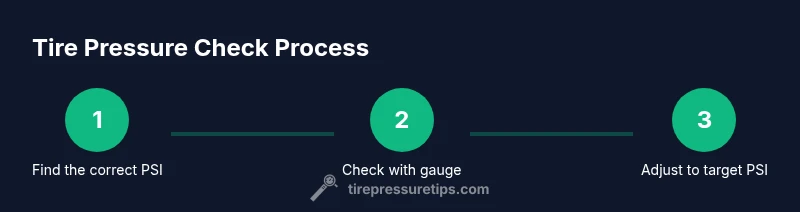
Find the correct PSI
Locate the door placard or owner's manual to identify the correct PSI for each tire. Note any differences between front and rear or when carrying heavy loads. This is your target baseline for all subsequent checks.
Tip: Use the placard as the baseline even if you plan to carry extra weight or passengers. - 2
Prepare your gauge and air source
Calibrate or verify your gauge against a known reference if possible. Remove the valve cap from the tire you’re checking and have the air compressor ready to deliver small amounts of air as needed.
Tip: Check units (psi) and ensure the gauge is clean and unobstructed. - 3
Check each tire
Starting with the front tires, attach the gauge to the valve and read the PSI. Do this for all four tires, recording each value. Inspect valve stems for damage and reseal the caps after measurement.
Tip: Always check cold tires for the most accurate reading. - 4
Inflate or deflate to target
If under-inflated, add air in small increments and recheck. If over-inflated, release air until you reach the target. Repeat for all tires and recheck after adjustments.
Tip: Make adjustments in small steps to avoid overshooting the target. - 5
Recheck for accuracy
Re-measure each tire after final adjustments to confirm readings. Ensure valve caps are in place and the tires are evenly inflated across the vehicle.
Tip: Recheck spacing readings to catch slow changes over minutes. - 6
Document and plan
Log the final PSI readings with dates and notes on load or temperature. Set a reminder for your next monthly check or seasonal tire swap to keep things consistent.
Tip: A simple log helps you notice gradual changes that may indicate leaks or sensor issues.
Frequently Asked Questions
What is the recommended tire pressure for a VW Jetta?
The recommended PSI for a Jetta varies by model and tire size, and it’s listed on the door placard or in the owner’s manual. Use those values as your target and adjust for load and season.
Check the door placard for the exact PSI values for your Jetta and adjust for load or season as needed.
Should I check tire pressure when tires are cold?
Yes. Measure when tires are cold to obtain an accurate reading. Temperature and recent driving can skew results, so wait several hours after driving before checking.
Always check tires when cold for accurate numbers.
How often should I check tire pressure?
Aim for a monthly check and after any long trip or temperature change. This helps catch slow leaks and keeps performance consistent.
Check monthly and after long trips or weather changes.
What if the TPMS shows a low-pressure warning but readings are normal?
Recheck with a gauge to confirm. If readings are normal, there could be a sensor fault or a slow leak that needs inspection by a professional.
If readings seem normal but TPMS warns, recheck and consider sensor inspection.
Why does temperature matter for tire pressure?
Temperature changes affect air density; PSI will typically drop in cold weather and rise with heat. Adjust checks accordingly and don’t rely on a single measurement across seasons.
Temperature changes affect PSI; adjust checks for seasonal differences.
Is TPMS a substitute for manual checks?
No. TPMS provides alerts, but manual checks with a gauge ensure precise PSI, prevent leaks, and validate sensor health.
TPMS helps, but you still need to measure PSI manually.
Watch Video
What to Remember
- Check tires when cold to ensure accuracy
- Always follow the door placard for target PSI
- Use a reliable gauge and adjust in small increments
- Log readings to monitor trends and detect leaks