Where Are Tire Pressure Sensors Located? A Practical Guide
Discover where tire pressure sensors (TPMS) live, how direct vs indirect TPMS differ, and practical steps to verify sensor health in everyday driving.


According to Tire Pressure Tips, learn exactly where tire pressure sensors live on modern vehicles and how to identify each type. This guide covers direct TPMS sensors inside each wheel, indirect TPMS via wheel speed data, and the common locations around the rims and spare. You'll also learn quick checks to verify sensor health and function.
What are tire pressure sensors and TPMS?
Tire Pressure Monitoring Systems (TPMS) are designed to help you maintain safe tire pressures and prevent premature wear. Direct TPMS uses sensors mounted inside each wheel to report real-time pressure data, while indirect TPMS uses wheel-speed calculations to infer pressure changes. According to Tire Pressure Tips, understanding these two approaches helps you interpret dashboard alerts more accurately. In practice, most modern cars rely on direct TPMS, but the principles apply to older models that use indirect sensing as well. This section introduces the core concepts and typical sensor architectures, so you know what to look for when you inspect or service tires.
Key points to remember:
- Direct TPMS provides actual pressure readings from sensors in the wheel.
- Indirect TPMS infers underinflation using wheel-speed signals.
- Sensor health depends on battery, seal integrity, and proper mounting.
Where are tire pressure sensors located on most vehicles?
On a typical passenger car, direct TPMS sensors live inside the wheel, mounted just behind the valve stem on the valve assembly or within the wheel itself. Indirect TPMS, if present, does not have a dedicated sensor in the wheel; instead, it analyzes ABS wheel-speed signals to detect deflation. The Tire Pressure Tips team notes that sensor placement is designed to minimize exposure to road grime while maximizing signal reliability. In practice, direct sensors can be damaged by curb hits or improper tire mounting, while indirect systems rely on the ABS data stream and may need recalibration after tire changes.
Direct TPMS vs indirect TPMS: differences and locations
Direct TPMS sensors are small battery-powered devices embedded in each wheel’s inner rim area, typically behind the valve stem. They transmit pressure data via RF to a receiver in the car’s computer; a dashboard warning light appears when pressure falls below the recommended threshold. Indirect TPMS relies on wheel-speed sensors and ABS data to infer underinflation by comparing rotational speed with nominal values. Location differences: direct sensors are physically located in each wheel; indirect has no wheel sensor, but uses the vehicle's CAN bus data. For cross-check, when you rotate tires, you may need to relearn the system to map sensor IDs to wheels. The Tire Pressure Tips team emphasizes that being aware of the type helps you choose the right tool for maintenance.
Common sensor locations by wheel and spare tire
Direct TPMS sensors sit behind the valve stem on each wheel, often integrated with the valve stem hardware. The most common arrangement is four sensors, one per wheel, with a possible fifth in the spare if equipped. Some OEMs place sensors in the wheel rim area rather than the valve stem; others attach sensors to the wheel behind the brake rotor. If your vehicle uses a run-flat spare or a non-rotating spare, you might still have an enclosed sensor area behind the stem. Visual inspection should avoid touching the sensor body. A clean, dry wheel well reduces RF interference and prolongs sensor life.
How to verify sensor health and diagnose issues
Start with a cold tire measurement using a trusted gauge. Compare to the vehicle’s recommended pressure (found in owner’s manual or door jamb placard). If a TPMS warning persists, use an OBD-II scanner with TPMS capability or a dedicated TPMS tool to pull sensor IDs and status. Look for a failed battery (the most common direct TPMS failure) or corrosion on the sensor contacts. If the wheel has been dismounted recently, the sensor integrity should be checked for physical damage. After any service, perform a relearn if required by your vehicle manufacturer. In many cases, minor culprits like a sticky valve core or a dirty sensor can trigger false alerts.
How to access sensor data: tools and steps
Tools you’ll typically need include a digital tire pressure gauge, an OBD-II scanner with TPMS capability, and your vehicle’s service manual. Optional tools include a TPMS relearn tool and a spare sensor health kit. Start by identifying whether your vehicle uses direct or indirect TPMS. Then, use the scanner to pull TPMS IDs and check current readings for all four wheels. If a reading disagrees with the gauge, recheck in a cold state and inspect for sensor damage. After any tire service, ensure proper relearn or calibration per the manufacturer’s procedure. This careful data access helps prevent misdiagnosis and unnecessary tire work.
Safety and maintenance tips
Always work on a cool tire to prevent heat-related readings from skewing data. When inspecting sensors, avoid contact with brake components and sliding components that could bend or damage the sensor body. If you notice corrosion, battery swelling, or broken seals, replace the sensor rather than attempting a makeshift repair. After wheel maintenance, verify that all tires—including the spare if equipped—are properly releveled and that the TPMS has been relearned if required. Routine checks can prevent sudden PSI drops and improve fuel efficiency over time.
Real-world examples and pitfalls
Many real-world cases involve TPMS activation after tire rotation. If you don’t relearn the sensors, the system may misassign IDs and trigger false warnings. Temperature changes can temporarily reflect pressure variations of a few PSI, which is normal, but large swings indicate a leak or sensor fault. Some cars include a dedicated spare TPMS sensor; others do not. Keep in mind that battery-powered sensors degrade with time; even a few years of use can cause inaccurate readings. The Tire Pressure Tips team recommends documenting sensor IDs when you rotate tires and scheduling a sensor health check during routine maintenance.
Authoritative sources and practical references
For further reading on tire safety and TPMS, consult official guidelines such as NHTSA’s tire safety pages. These resources explain the role of sensors, recommended pressures, and maintenance best practices. While online guides vary by make and model, the core principles—accurate readings, proper relearn procedures, and routine verification—remain consistent across most vehicles. (Source references: Tire safety pages from the National Highway Traffic Safety Administration; official TPMS guidance often cited by automakers.)
Tools & Materials
- Vehicle owner's manual(Locate TPMS type and sensor count for your model)
- Digital tire pressure gauge(Use cold tires for accurate readings (psi/kPa))
- OBD-II scanner with TPMS capability(Read TPMS IDs and live data)
- Notebook or digital device(Record sensor IDs and positions)
- TPMS relearn tool (optional)(Needed for some makes after tire service)
Steps
Estimated time: 60-90 minutes
- 1
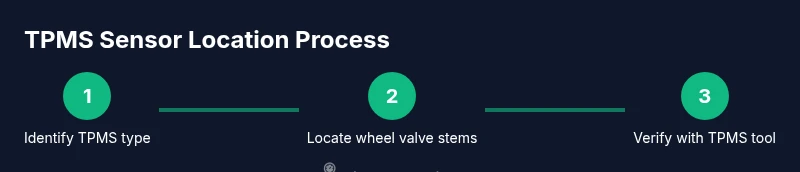
Identify TPMS type
Check your owner's manual or dealer materials to confirm whether your vehicle uses direct or indirect TPMS. This determines how you will approach locating sensors and performing data checks.
Tip: Knowing the type prevents wasted time chasing the wrong data source. - 2
Inspect wheel areas for direct sensors
With the wheels visible, look behind the valve stem and around the rim for the small, battery-powered sensor bodies. Do this with the car safely parked and the tires cold.
Tip: Avoid prying or poking at the sensor; damage can cause leaks or inaccurate readings. - 3
Confirm spare tire TPMS status
Many cars omit a TPMS sensor in the basic spare; some include a sensor in a full-size wheel. Check the spare area and any access panel to see if a sensor exists.
Tip: If the spare lacks a sensor, you may still get TPMS alerts from four active sensors. - 4
Read sensor data with a scanner
Connect an OBD-II scanner with TPMS capability or a dedicated TPMS tool to pull the sensor IDs, current pressures, and status indicators for each wheel.
Tip: Write down IDs and confirm they map to the correct wheel positions. - 5
Relearn/initialize after work
If you performed tire service or rotated wheels, follow the vehicle’s relearn procedure to reassign sensor IDs to wheels.
Tip: Some vehicles require a touchscreen menu, others a diagnostic tool; follow the exact steps in your manual. - 6
Verify readings and light status
Inflate or adjust each tire to the recommended PSI, then drive a short distance to confirm the TPMS warning light behaves as expected.
Tip: Confirm readings across all four tires are within spec and consistent with your gauge.
Frequently Asked Questions
What is a Tire Pressure Monitoring System (TPMS)?
TPMS monitors tire air pressure to warn of underinflation. Direct TPMS uses wheel-mounted sensors; indirect TPMS uses ABS data to infer pressure changes.
TPMS uses sensors or wheel-speed data to tell you when a tire is underinflated. Direct TPMS has wheel sensors; indirect uses ABS signals.
Where are tire pressure sensors located on most passenger cars?
Direct TPMS sensors are typically located inside each wheel behind the valve stem. Some vehicles may have a TPMS in the spare; others do not.
Typically, TPMS sensors live inside each wheel behind the valve stem; some cars have a sensor in the spare wheel.
How do direct and indirect TPMS differ?
Direct TPMS provides actual pressure data from wheel sensors; indirect TPMS infers underinflation using wheel speed. Direct systems require sensor batteries, indirect rely on ABS data.
Direct TPMS gives real pressure readings; indirect TPMS infers underinflation from wheel speeds.
How do I relearn TPMS after rotating tires?
Many vehicles require a relearn procedure to map sensor IDs to wheels after rotation. Follow your owner's manual or use an appropriate scanner.
After rotation, follow the relearn steps in your manual or use a TPMS tool to remap the sensors.
Can a TPMS sensor fail, and what happens?
Yes. A failed battery or damaged sensor can trigger false readings or a persistent warning light. Replacement is often needed.
Sensors can fail due to battery or physical damage; this may require replacement.
Do temperature changes affect TPMS readings?
Yes. Temperature can cause pressure changes; readings should be checked when tires are cold for accuracy.
Temperature affects readings; always measure when tires are cold.
Watch Video
What to Remember
- Identify TPMS type before work
- Direct sensors live in wheels; indirect relies on ABS data
- Relearn after tire service to avoid misreads
- Verify with a cold gauge and scanner data
- Document sensor IDs for future maintenance