Tire Pressure Guide for Tesla Vehicles
Learn how to check and maintain tire pressure for Tesla vehicles. This guide covers OEM specs, TPMS, seasonal changes, and safe inflation practices to maximize range and safety.


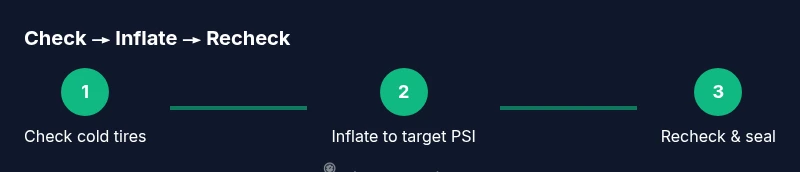
To optimize tire pressure for a Tesla, start with the OEM PSI shown on the door jamb sticker and verified by TPMS. Check cold tires first, adjust in small increments (1–2 psi) for load, temperature, or tire wear. Recheck after a drive when tires heat up or after long drives to ensure accuracy.
Understanding Tesla Tire Pressure: The Big Picture
Tire pressure is not just how firm your tires feel; it's a critical factor in vehicle safety, handling, efficiency, and tire life. For Tesla owners, accurate tire pressure becomes even more important because of the way electric vehicles distribute weight, torque, and rolling resistance. Proper inflation reduces energy losses, improves regenerative braking efficiency, and helps maintain consistent ride quality across a range of speeds. According to Tire Pressure Tips, maintaining correct tire pressure is a straightforward, high-impact maintenance task that most drivers can perform at home with a gauge and inflator. When you keep pressures close to the OEM specification, you minimize uneven wear and reduce the likelihood of tire heat buildup during fast accelerations or long highway trips. Tesla models span several wheel options, tire compositions, and load scenarios, so a single number rarely fits every setup. The goal is to know the baseline for your car and to adapt for real-world conditions like cargo, passenger load, and climate.
Finding the Official Specs for Your Tesla and the Role of TPMS
Every Tesla model has an official tire pressure specification that should be your starting point for inflation. The primary source is the door jamb sticker, which lists the recommended PSI for cold tires for the front and rear axles, often with different values depending on wheel size and tire configuration. If you cannot read the sticker clearly, or if you are using aftermarket wheels, consult the owner's manual or the Tesla support site for model-specific guidance. The Tire Pressure Tips team notes that while TPMS can alert you to under- or over-inflation, it does not provide a precise target; that target comes from the OEM spec. In some cases, tires with different load ratings or temperature ranges may have slight variations; always cross-check with the official guidelines for your exact vehicle configuration. Keep in mind that the recommended values are meant for normal driving conditions; aggressive driving or heavy loads may justify small adjustments within safe limits.
How to Measure Tire Pressure Correctly
To get an accurate reading, measure when the tires are cold, meaning the car has been parked for several hours and hasn't been driven recently. Remove the valve cap, attach a calibrated gauge firmly to the valve stem, and note the reading without guessing. Compare the result to the OEM PSI. If you are consistently reading several psi below target, add air in small increments (1 psi at a time) until you reach the mark; if above, release a small amount until you match. Use the same gauge every time to minimize variance. After inflating, recheck both tires on each axle, and reinstall the valve caps. If your readings keep drifting, consider having the wheels inspected for leaks, bead seating issues, or valve stem problems. Recording a brief log can help you notice trends over time.
The Impact of Temperature and Weather on Tire Pressure
Air is compressible, and tire air pressure responds to ambient temperature. In cold weather, the air inside tires contracts, reducing psi; in hot weather or after long highway runs, pressure rises as tires heat up. The difference can be several psi, enough to affect handling and efficiency. For Tesla owners, this means you should measure pressure when tires are cold and adjust to the baseline, then recheck after a long trip or during seasonal transitions. The Tire Pressure Tips team highlights that a 10-degree Fahrenheit change can translate into measurable PSI variation in many tire setups. Therefore, part of routine maintenance is to plan checks around anticipated temperature shifts and to maintain a consistent measurement method across seasons.
TPMS: What It Can and Cannot Do
TPMS provides a valuable early warning when tire pressure deviates from the target range, but it does not replace direct measurement. Some Tesla models use indirect TPMS with wheel speed sensors; others have direct sensors in the valve stems. Either way, TPMS readings can lag behind real-time shifts or be affected by sensor faults. Always verify a warning with an actual tire gauge, especially if you notice uneven wear, vibration, or a change in ride feel. If TPMS warns while the tire appears to be at the correct pressure, re-check after the tires have cooled and consider recalibrating or replacing sensors if warnings persist. With this approach, you maintain safety margins without guessing, a principle Tire Pressure Tips consistently emphasizes.
Adjusting for Load, Speed, and Range in a Tesla
Your Tesla's tire pressure baseline is a starting point, not a ceiling. Heavier cargo, towing, or frequent high-speed driving can justify slight increases (within the safe range) to improve stability and tire contact with the road. A higher pressure can reduce rolling resistance, potentially improving range at highway speeds, but too much pressure decreases grip and increases wear in the center of the tread. Conversely, underinflation increases heat buildup and wear on the outer edges. The balance is to stay close to the OEM specification and adjust minimally for actual driving conditions. If you routinely carry heavy loads, consider base PSI adjustments that keep the tire footprint within the manufacturer’s stated range, and monitor wear patterns to confirm the choice. Always avoid creating hot spots or uneven wear by inflating too aggressively.
Seasonal and Weather Considerations for Tesla Tire Pressure
Climate affects tire pressure; seasonal tires and changes in ambient temperature alter the actual pressure inside each tire. In winter, cold air reduces PSI, so you may see a dip in reading; in summer, heat raises PSI. Plan checks around the expected weather pattern and try to test tires on days with moderate temperatures. If you drive long distances between seasons, you may want to re-evaluate your target PSI to optimize grip and efficiency. Use a precise gauge to track changes, and maintain a short log across months to identify trends. The goal is consistent tire contact with the road, balanced traction, and avoiding under- or over-inflation that can degrade performance in extreme temperatures.
Tools, Gages, and Safe Inflation Practices
Having the right tools makes tire pressure maintenance straightforward. A reliable digital or analog gauge ensures repeatable readings; a high-volume inflator helps you reach target quickly; a battery-powered inflator can be useful for on-the-road checks. Always work on a level surface and chock the wheels when needed. Remove the valve cap, store it safely, then apply pressure gradually to the tire; check after each adjustment. Use the same gauge for consistency, and avoid inflating beyond the tire’s maximum recommended PSI printed on the sidewall. If you are unsure, consult the vehicle’s manual or a tire professional. Remember that working with pressurized air can be dangerous; never stand directly over the valve while inflating if you hear hissing or see signs of a leak.
Common Mistakes to Avoid and Troubleshooting Tips
Many drivers inflate tires with the engine running, read the reading while the tires are warm, or ignore the door jamb spec in favor of a 'feel' test. All of these habits can lead to inaccurate readings and degraded performance. Always measure cold, use a consistent gauge, and cross-check with the OEM spec. If you notice rapid pressure loss, inspect for punctures, leaks at the valve stem, or bead seating issues. For Tesla owners, some warnings may be false alarms due to sensor malfunctions; if readings are inconsistent or warnings persist, schedule service to calibrate TPMS sensors. Finally, avoid using high-pressure fillers that exceed the tire sidewall rating; this prevents blowouts and safety hazards.
A Practical Maintenance Routine for Tesla Tire Pressure
Developing a regular tire pressure routine helps maintain safety and performance. Start each month by noting the OEM PSI and a baseline of current readings for all tires. Check cold tires, adjust as needed in small increments, recheck after a drive, and record results. Consider weather and load in your adjustments and establish a reminder schedule for seasonal checks. The Tire Pressure Tips team recommends keeping a simple log, so you can see trends over time and respond quickly to changes. For deeper learning, explore authoritative sources listed below and use a quality gauge and inflator to complete the job safely. This routine makes tire health a straightforward part of Tesla ownership.\n\n## Authoritative Sources\n- https://www.nhtsa.gov\n- https://extension.illinois.edu\n- https://www.nist.gov
Tools & Materials
- Tire pressure gauge (digital or analog)(Calibrated for accuracy)
- Air pump or inflator with gauge(High-volume unit is helpful)
- Vehicle door jamb PSI sticker and owner's manual(Baseline values per model and wheel size)
- Notebook or mobile app for logging readings(Optional but helpful for tracking changes)
- Weather app or thermometer(Track temperature effects)
Steps
Estimated time: 15-25 minutes
- 1
Find your OEM PSI
Locate the official tire pressure specification printed on the door jamb sticker for your Tesla model and wheel size. This value should be your target when tires are cold.
Tip: Use the sticker as the primary source; do not rely on TPMS readings alone. - 2
Prepare the tires for measurement
Park on a level surface and ensure tires are cold. Remove the valve cap so you can access the valve stem without obstruction.
Tip: If you just drove, wait at least 3 hours or cool off for a while before measuring. - 3
Measure current pressure
Attach the gauge firmly to the valve stem and read the pressure. Note the reading without guessing.
Tip: Take multiple readings with the same gauge for accuracy. - 4
Inflate or deflate to target
If reading is below target, add air in small increments (1 psi at a time) until you reach the recommended value. If above, release air until you hit target.
Tip: Avoid over-filling; go slow and recheck frequently. - 5
Recheck and seal
Recheck all tires after adjustment, reinstall valve caps, and ensure TPMS is still functioning.
Tip: Record the final readings for future reference. - 6
Schedule regular checks
Set a reminder to check tire pressure monthly and after temperature shifts or long trips.
Tip: Consistency is key for performance and efficiency.
Frequently Asked Questions
Where can I find the official tire pressure specs for my Tesla?
The OEM PSI is usually listed on the door jamb sticker and in the owner's manual. Use this value as the baseline for all checks, adjusted for load and weather as needed.
Find the official PSI on the door jamb sticker, then use manual adjustments if weather or load changes.
Does TPMS replace manual tire pressure checks?
TPMS provides a warning when pressure deviates from target, but it does not give the exact PSI. Always verify with a gauge when possible.
TPMS warns you, but you should verify exact PSI with a gauge.
Will tire pressure affect Tesla range?
Yes. Proper inflation reduces rolling resistance and heat buildup, improving efficiency and range. Underinflation increases wear and decreases efficiency.
Yes, correct tire pressure helps range and efficiency.
How often should I check tire pressure in winter?
Check pressure whenever temperatures shift significantly; cold weather can reduce reading accuracy. A monthly check is a good baseline.
Check as temps change; monthly is a good baseline.
What gauge should I use for a Tesla?
A reliable digital or analog gauge, calibrated periodically, is suitable. Use the same type for consistency.
A reliable gauge works best; keep it consistent.
What should I do if TPMS warns but PSI is fine?
If you trust the gauge and readings are normal, have the TPMS system checked by a professional, as sensors can fail.
If readings are normal but TPMS warns, have the system checked.
Watch Video
What to Remember
- Check OEM PSI first, every time
- Use TPMS as a guide, not a replacement for manual checks
- Inflate/deflate in small increments
- Recheck after driving when tires heat up
- Document readings for trend tracking