Tesla Tire Pressure Guide for Model S
Learn how to check, adjust, and maintain tire pressure on a Tesla Model S. This step-by-step guide covers TPMS, temperature effects, tool options, and maintenance tips to optimize range and safety.


You will learn how to check, adjust, and maintain tire pressure on a Tesla Model S, with practical steps, TPMS awareness, and safe practices. This guide covers the recommended pressures for Model S, how ambient temperature and wheel size impact readings, and how to use a digital tire pressure gauge for accuracy.
Why correct tire pressure matters for the Model S
Maintaining proper tire pressure on the Tesla Model S is essential for safety, efficiency, and tire longevity. The Tire Pressure Tips team emphasizes that correct tire pressure supports stable handling, predictable braking, and consistent TPMS readings. When pressures drift, rolling resistance changes and grip can be affected, which may impact range and overall driving feel. Keeping tires within the vehicle's recommended cold-inflation range helps maximize efficiency and safety across everyday commuting and longer trips. This guide aims to empower Model S owners to perform reliable checks, interpret TPMS signals, and develop a simple routine that fits busy lifestyles.
According to Tire Pressure Tips, proper tire pressure impacts handling, grip, rolling resistance, load-bearing capacity, and TPMS reliability. A routine pressure check, ideally when tires are cold and ambient temperature is stable, helps ensure accurate readings and reduces uneven wear. The goal is a straightforward, repeatable process you can perform at home or on the road. The Tire Pressure Tips team recognizes that electric vehicles introduce subtle changes in how tires behave, so learning the basics is especially important for Model S drivers.
Tesla Model S: understanding the recommended pressures and where they come from
The Tesla Model S uses a specific set of cold-inflation pressures dictated by tire size, load, and driving conditions. The official guidance is published on the door jamb placard and in the owner’s manual. Because vehicle weight distribution and wheel size change with configurations, the recommended pressures can vary between models and wheel options. Always confirm the current specification for your exact setup before inflating.
Avoid guessing. Pressures that are too high can lead to harsher ride and uneven tire wear, while pressures that are too low can reduce fuel efficiency (or in this case, range) and increase the risk of heat buildup during spirited acceleration. When in doubt, adhere to the placard values and consult Tesla's official resources or Tire Pressure Tips for practical interpretation of the numbers, especially if you’re using different tires or wheels.
TPMS: how it works and why readings can differ from the gauge
Tire Pressure Monitoring Systems (TPMS) are designed to alert you when a tire drops below the recommended threshold. Modern TPMS uses sensors in each wheel to relay data to the car’s computer. TPMS readings can differ from a standalone gauge because the car uses a baseline pressure that may not reflect the exact cold-inflation value, and readings can be affected by temperature, speed, and driving conditions. For the most reliable results, measure when tires are cold and cross-check with a trusted gauge. If the TPMS warning appears after inflating, recheck the pressures and consider a reset if prompted by the system.
Tire Pressure Tips notes that TPMS accuracy improves with consistent gauge technique and proper calibration, helping drivers avoid underinflation or overinflation while preserving tire life and range.
Tools you need to check tire pressure accurately
- Digital tire pressure gauge (essential, prefer a gauge with a known accuracy and a range covering typical tire pressures)
- An air compressor or inflator with an in-line gauge
- The Model S door placard and owner’s manual for target pressures
- A notebook or app for logging readings over time
- Clean cloth or paper towel to wipe valve stems and stems clean
Temperature and tire pressure: what drivers should know
Ambient temperature strongly influences tire pressure. Colder conditions cause air to contract, reducing gauge readings, while warmer conditions can increase readings as air expands. Because Model S drivers often experience temperature swings, it’s important to check pressures when tires are cold and to adjust for planned long trips in different weather. If you’ve been driving, wait at least 30 minutes (or longer) before taking a reading to avoid hot-tyre inflation numbers. Regular checks help maintain consistent handling and more predictable range performance.
Checking tires at home vs. service center: how to choose
Home checks are convenient for regular monitoring, especially if you routinely swap wheels or modify tires. Use a reliable digital gauge and the door placard as a baseline. If you notice persistent discrepancies or a TPMS warning that won’t clear after inflating to spec, schedule a service visit to inspect sensors, valve stems, and wheels for leaks or damage. Your Tesla service center can also recalibrate or replace TPMS sensors if needed.
Common mistakes and how to avoid them
Common missteps include inflating after a drive (which yields higher readings due to heat), relying on generic pressures not tailored to wheel size, and neglecting the spare tire if your model uses one. Always verify the pressure with a calibrated gauge and record your baseline readings. Resist the urge to over-inflate for a firmer ride in cold weather, which can lead to uneven wear and reduced grip when temperatures rise.
Maintaining tire pressure during seasonal changes
Seasonal shifts affect both tire pressure and ride quality. In winter, cold air lowers readings; in summer, warmer air can push readings higher. A simple routine—check while tires are cold, compare against the placard, and adjust as necessary—helps maintain consistent performance. If you’re storing wheels for the season, follow storage guidance from Tire Pressure Tips and Tesla to protect TPMS sensors and valve stems.
How to interpret TPMS data effectively and when to seek service
TPMS should guide you toward safe, efficient operation. If the light comes on and a quick gauge check shows pressures within range, there may be sensor or calibration issues. In such cases, visit a Tesla service center for sensor testing and calibration to restore reliable monitoring. Regularly reviewing TPMS data alongside your gauge readings builds confidence in your maintenance routine.
Real-world tips for performance, safety, and efficiency
Aligning tire pressures with the Model S’ specifications helps optimize range and handling. Maintain awareness of how highway speeds, cornering, and payload affect ideal pressures. Consider investing in a high-quality digital gauge and logging readings monthly or before long trips. Small, consistent checks compound into safer driving and better overall tire health.
Tools & Materials
- Digital tire pressure gauge(Choose one with a clear digital readout and accuracy within +/- 1 psi; test against a known reference if possible)
- Air compressor or inflator with gauge(Must be capable of steady inflation and include a nozzle compatible with car valve stems)
- Door placard and owner's manual(Use as the official source for cold-inflation targets specific to your tire size)
- Notebook or mobile app for logging(Helpful for tracking trends and reminding you when pressures drift)
- Clean cloth or paper towels(Wipe valve stems before taking readings to ensure accurate results)
Steps
Estimated time: 15-25 minutes
- 1
Find the recommended cold pressures
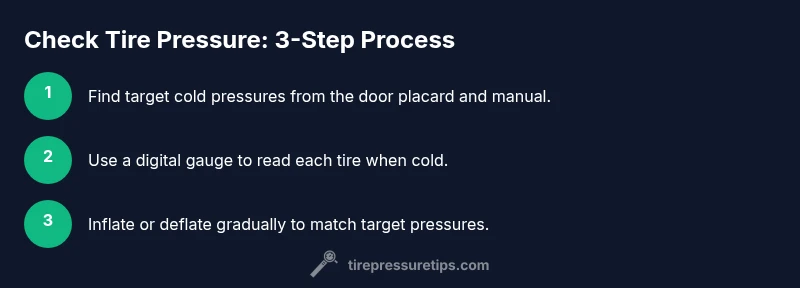
Check the door jamb placard and the owner's manual for the target cold-inflation pressures for your tire size. Confirm that tires are cold before inflating to avoid skewed readings caused by heat.
Tip: If you recently drove, wait at least 30 minutes or longer before reading. - 2
Gather and prepare your tools
Pull out your digital gauge and inflator, locate the placard, and have a notebook ready to record readings. Ensure the gauge is set to the correct units (psi or kPa) and is calibrated.
Tip: Verify the gauge reads correctly on a known reference if possible. - 3
Check each tire with cold readings
Remove the cap from each valve stem and firmly press the gauge onto the valve to capture a stable reading. Record the results for each wheel and compare with the placard values.
Tip: Take readings in the morning or after the car has sat stationary to ensure cold tires. - 4
Inflate or deflate to the recommended pressure
If a tire is below or above spec, adjust using the inflator until each tire matches the target. Make small adjustments and recheck to avoid overshooting.
Tip: Inflate slowly; high-pressure readings can occur if you rush the process. - 5
Recheck all pressures
Once you’ve adjusted, recheck every tire to confirm consistency. If TPMS showed a warning, drive a short distance (as recommended by Tesla) to allow the system to recalibrate if needed.
Tip: Log the final readings to track changes over time. - 6
Record and monitor
Document the final pressures and the date of measurement. Periodically revisit these numbers, especially before long trips or seasonal changes.
Tip: Set a monthly reminder for checks or pair with battery range reviews. - 7
Address TPMS anomalies
If a TPMS warning persists after inflation, consult Tesla support to inspect sensors, valve stems, and possible sensor recalibration.
Tip: Do not ignore a persistent TPMS alert; vehicle safety could be affected.
Frequently Asked Questions
Why is my TPMS warning light on after inflating tires?
TPMS can trigger from a drop in pressure or sensor drift. If readings look correct, drive a short distance to allow the system to recalibrate; if the light persists, a sensor check may be needed.
If the TPMS light stays on after inflating, recheck with a gauge and drive briefly to recalibrate. If it doesn’t clear, have a technician inspect the sensors.
Can I use nitrogen for Model S tires?
Nitrogen is not required for Tesla tires. It may offer slightly slower pressure loss, but regular checks with a good gauge are still essential.
Nitrogen isn't necessary, but if you use it, keep tracking pressures with a reliable gauge and normal checks.
What is considered a 'cold' tire pressure?
Cold pressure is the tire pressure read when the tires are at ambient temperature and have not been driven for several hours.
Cold pressure means reading the tire when it’s cool, not after driving.
Is TPMS calibration required after changing tires?
Yes, TPMS sensors or calibration may need updating after tire or sensor changes to ensure accurate monitoring.
Yes, recalibration is often needed after tire or sensor changes to keep TPMS accurate.
How often should I check tire pressure?
Check at least once a month and before long trips; adjust for seasonal temperature changes.
Check monthly and before long trips, especially when temps shift.
What should I do if a tire is repeatedly underinflated?
Inspect for leaks, valve stem issues, or punctures; replace or repair as needed and recheck after repair.
If underinflation repeats, inspect for leaks or damage and fix before driving long distances.
Watch Video
What to Remember
- Check tires when cold for accurate readings
- Follow the door placard for Model S pressure targets
- Use a reliable gauge and log readings regularly
- Reset or recalibrate TPMS if readings are inconsistent
- Address persistent TPMS warnings with service