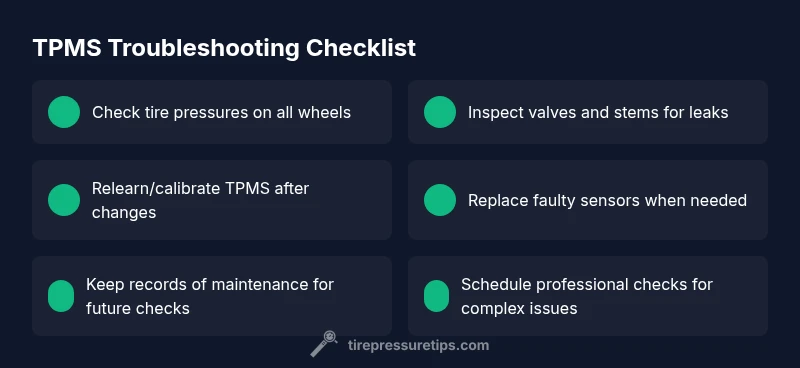
Troubleshooting Tire Pressure Control Sensor (TPMS) Guide
A thorough, urgent troubleshooting guide for tire pressure control sensor (TPMS) issues, with a diagnostic flow, step-by-step fixes, safety tips, and prevention strategies to keep tires properly inflated and on-spec.


TPMS problems usually stem from under- or overinflated tires, a weak sensor battery, or a damaged sensor stem. Quick fixes: inflate all tires to the vehicle’s spec, relearn or reset TPMS after adjusting pressures, and inspect for obvious damage or corrosion. If the light stays on, calibration and sensor replacement may be required, typically by a professional.
What is the tire pressure control sensor (TPMS) and why it matters
The tire pressure control sensor, commonly called TPMS, monitors each tire’s air pressure and warns you if a tire is under-inflated. There are two main implementations: direct TPMS, which uses wheel-mounted sensors to measure pressure, and indirect TPMS, which estimates pressure using ABS-wheel-speed data. Maintaining correct tire pressure improves fuel efficiency, tire wear, and handling. According to Tire Pressure Tips, ensuring accurate pressure readings is the first step in reliable TPMS operation. A healthy TPMS also helps prevent blowouts and sudden flats by catching slow leaks early. Regular checks and recalibrations after tire changes are essential. In addition to the sensor itself, attention to the valve stem and seal integrity is important, as a faulty seal can cause slow leaks that TPMS will eventually flag. As you work through diagnostics, keep in mind that environmental conditions, tire age, and wheel alignment can influence readings and trigger false positives if not accounted for.
How TPMS works and why reading accuracy matters
Direct TPMS uses a metal sensor inside the wheel to measure air pressure in each tire. Indirect TPMS relies on wheel speed sensors and vehicle dynamics to infer pressure deviations from the expected circumference. Direct TPMS provides real-time pressure values, while indirect TPMS is cheaper but can be less precise. For drivers, accurate TPMS readings translate to safer tire pressures, better traction, and optimal fuel economy. Always verify with a handheld gauge on cold tires before diagnosing TPMS symptoms; this eliminates reading errors caused by road heat and recent driving. When readings diverge between tires, inspect each wheel for a slow leak, a damaged valve stem, or a corroded sensor contact, which are common culprits. Regular maintenance—checking pressure monthly and after temperature swings—helps TPMS stay reliable and reduces nuisance warnings. The Tire Pressure Tips team emphasizes responsible inflation as the foundation of TPMS health, since sensors rely on correct baseline pressures to provide meaningful alerts.
Practical signs your TPMS might be failing
If you notice frequent false alerts, intermittent warning lights, or a consistent discrepancy between manual gauge readings and TPMS readouts, your TPMS may be compromised. Direct sensors can fail due to battery depletion, damaged wiring, or corrosion at the sensor mounting. Indirect systems can misreport in cold weather or after a tire change if the relearn procedure isn’t performed. In either case, the first step is to verify actual tire pressures against the vehicle specification plate. If all tires read correctly on a manual gauge, but the TPMS still signals a problem, the issue may be sensor battery health or a miscalibration requiring professional attention. Remember that a failing TPMS can mask a dangerous low-pressure condition, so treat warnings seriously and proceed with a methodical diagnostic approach.
Best practices for diagnosing TPMS without guessing
Approach TPMS diagnostically rather than emotionally. Start with the simplest checks: confirm equalized, correct inflation across all four tires, and inspect valve stems for cracks or damaged cores. If the system still reports a fault, perform a manufacturer-approved relearn or calibration, especially after tire rotation or replacement. Use a reliable scan tool or visit a service center to retrieve fault codes that point to specific sensors or modules. By correlating TPMS fault codes with actual tire pressures, you dramatically reduce pointless sensor replacements and save time and money. The goal is to identify whether the issue is a sensor, a battery, or a procedure gap.
Common mistakes to avoid during TPMS troubleshooting
Avoid inflating tires beyond the recommended limit in an attempt to trick the system. Don’t perform a relearn without ensuring all tires are cold and pressures are at spec, as temperature changes can skew results. Replacing sensors without confirming a weak battery or known sensor damage wastes resources. Finally, neglecting to recalibrate after rotation or replacement often leads to repeated warnings. For safety, do not drive aggressively with a suspected TPMS fault; a well-informed approach protects you and others on the road.
Steps
Estimated time: 60-90 minutes
- 1
Check all tires with a reliable gauge
Begin by measuring each tire when cold using a high-quality gauge. Compare readings to the vehicle’s label on the door jamb or owner’s manual. Record any tire that reads 2-3 psi below or above spec as a potential trigger to the TPMS warning.
Tip: Always check cold to avoid heat-induced pressure changes. - 2
Inspect valve stems and sensor mounting
Visually inspect each valve stem for cracks, dirt, or moisture. Wiggle the sensor mounting if accessible during service to ensure a solid connection. Look for corrosion around electrical contacts and clean if safe to do so.
Tip: Use a flashlight and a mirror to inspect hard-to-see areas. - 3
Perform a TPMS relearn/calibration
Follow the exact procedure for your vehicle to relearn TPMS sensors. This may involve turning the ignition, using the dash menu, or a dedicated relearn tool. Some cars require driving for a specific distance after relearn.
Tip: Consult the owner’s manual or dealer for the exact relearn steps. - 4
Evaluate sensor health or battery status
If warnings persist after successful relearn, the issue could be a dying sensor battery or a damaged sensor. Direct TPMS sensors rely on battery integrity; indirect systems may fail due to sensor data interpretation.
Tip: Battery life varies; consider sensor replacement if readings remain unstable. - 5
Test for slow leaks and seal integrity
Perform a bubble test with soapy water around valve cores and stems to identify slow leaks. Seal or replace the faulty component to stop ongoing leakage that triggers TPMS alerts.
Tip: Only use soapy water; avoid ignition sources near leaks. - 6
Consider professional calibration or sensor replacement
If all else fails, a professional inspection with OEM or dealer-grade tools will confirm sensor health. TPMS calibration or replacement may be required to restore reliable operation.
Tip: Choose OEM-specified sensors for compatibility and reliability. - 7
Document your maintenance and monitor
Record the date of checks, pressure readings, and any replacements. Monitor tire pressure more frequently after adjustments, and re-verify after temperature changes or road trips.
Tip: Regular records help diagnose future TPMS warnings quickly.
Diagnosis: TPMS warning light or inconsistent tire pressure readings
Possible Causes
- highUnder- or overinflated tires (cold measurement)
- mediumDegenerated sensor battery or damaged sensor stem
- lowLoose valve core or corroded sensor contact
Fixes
- easyInflate all tires to the vehicle’s specified cold pressure and recheck with a manual gauge
- easyRelearn or reset the TPMS after adjusting pressures or replacing tires
- mediumInspect valves, stems, and wiring for damage; replace faulty components or entire sensor as needed
Frequently Asked Questions
What is a tire pressure control sensor (TPMS) and how does it work?
A TPMS monitors tire pressure to alert you of underinflation. Direct TPMS uses wheel sensors; indirect TPMS estimates pressure from wheel speed. Both aim to improve safety and fuel efficiency by keeping tires properly inflated.
A TPMS monitors tire pressure to alert you of underinflation. It uses wheel sensors or indirect methods to help you maintain safe, efficient tires.
Why does my TPMS warning light stay on even after inflating tires?
If inflating tires doesn’t turn off the light, the system may need a relearn or calibration, or a sensor may be failing. Check all four tires, perform a relearn per your manual, and inspect sensors for damage before seeking service.
If the light stays on after inflating, relearn the TPMS and check for sensor issues before seeking service.
Can TPMS sensors be replaced without removing tires?
Some direct TPMS sensors can be accessed with the tire mounted, but many require tire removal for replacement and calibration. A professional service usually performs replacement and relearn to ensure reliability.
Direct TPMS sensors often need tire removal for replacement and proper relearn.
How long do TPMS sensors/batteries typically last?
Sensor life varies by model and usage but is commonly several years. If readings become unreliable, battery health should be checked, and sensor replacement considered.
Sensor power can last several years; if readings are unreliable, inspect or replace the sensor.
How often should TPMS be checked during routine maintenance?
Check TPMS whenever you inspect tires—ideally monthly and after temperature changes or tire work. A quick pressure check helps ensure TPMS accuracy and safety.
Check TPMS monthly or after tire work and weather changes to stay safe.
What should I do if TPMS warnings persist after a relearn?
If warnings persist post-relearn, the issue is likely a faulty sensor or wiring. Schedule a diagnostic with a qualified technician who can test sensor health and calibration accuracy.
If warnings persist after relearn, have a technician test the sensor health and wiring.
Watch Video
What to Remember
- Inflate tires to spec before diagnosing TPMS.
- Relearn sensors after pressure changes or service.
- Inspect valves, stems, and wiring for damage.
- Seek professional calibration or sensor replacement when needed.