Troubleshooting the TPMS Light: A Practical Guide
Urgent, practical guide to diagnose and fix the TPMS light. Learn safe checks, relearn steps, and maintenance tips to keep tires properly inflated and your vehicle safe.


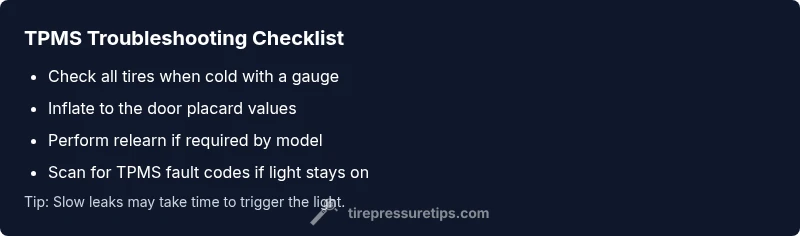
The TPMS light is most often triggered by one underinflated tire or a faulty sensor. Safely pull over, check all tire pressures with a reliable gauge, and inflate any tires below the spec. If pressures are correct, perform the relearn/calibration procedure per your vehicle’s manual; if the light stays on, have the TPMS sensors tested with a scan tool by a professional.
What the TPMS light means
If you’re seeing the TPMS light on your dashboard, it’s a signal to check tire health. In most vehicles, the light comes on when one or more tires fall below the manufacturer’s recommended cold pressure, or when the TPMS sensor detects a fault in the system. The Tire Pressure Monitoring System is designed to help you avoid unsafe driving on underinflated tires, which can reduce fuel efficiency, increase wear, and raise the risk of a blowout. According to Tire Pressure Tips, the most common triggers are underinflation and sensor issues, not dramatic tire failure. Start with a calm, safety-first approach: locate a safe place to check your tires, gather a tire gauge, and be prepared to adjust pressures as you inspect for leaks or damage. The TPMS is not a substitute for regular manual checks, but it is a crucial early warning that helps you protect your wheels and your passengers. If your tire pressures look good but the light remains illuminated, there’s likely a sensor fault or a need for relearn after service.
Common causes of a TPMS light activation
There are several reasons your TPMS light might illuminate. The most frequent is underinflation caused by normal wear, heat, or small leaks. Other common culprits include a dead or weak TPMS sensor battery, sensor failure due to corrosion, or a device that lost calibration after a tire rotation. Temperature changes can also trigger transient readings in older sensors. In some cases, the system can malfunction due to a loose valve stem or a damaged wheel rim causing an improper seal. Recognizing these causes helps you prioritize checks and avoid unnecessary replacements. The Tire Pressure Tips team emphasizes that many lights are fixable with basic checks, not expensive parts.
Safe, quick checks you can perform today
First, locate the tire pressures on the driver’s door jamb placard and compare them with a reliable gauge reading for each tire. Inflate any tire that falls below the recommended cold pressure. Inspect each tire for visible punctures, sidewall damage, or slow leaks around the valve stem. If you rotated the tires recently, confirm whether a TPMS relearn is needed by consulting your vehicle manual or using a TPMS relearn procedure. After inflating, drive a short distance to see if the light resets. If the light returns, the issue may be a sensor fault or a need for professional diagnostics.
How to verify tire pressures and compare to the vehicle placard
Tire pressures should be measured when the tires are cold, ideally before driving or after the car has been stationary for several hours. Use a digital or dial gauge for accuracy. Compare each reading to the door placard or owners manual values. If any tire reads more than 5 psi away from spec, recheck for leaks and correct inflation. Remember that variations between front and rear tires are normal, but consistent underinflation across multiple tires warrants attention. This process also helps you prepare for a safe relearn, if required by your make and model.
Resetting TPMS and relearning: when and how to do it
Some vehicles require a relearn after inflating tires or rotating wheels. Begin with inflating all tires to the correct cold pressure, then follow your owner’s manual relearn steps—these can involve a sequence of buttons or a hidden reset tool in the vehicle’s diagnostic menu. In many cases, a short drive will trigger the system to relearn automatically. If the light persists after a proper relearn, you may have a sensor with a fault, a damaged valve stem, or a system wiring issue that needs professional service.
Maintenance and prevention to avoid the TPMS light coming back
Prevention starts with regular tire pressure checks, especially during seasonal temperature changes. Keep a portable inflator and a reliable gauge in your vehicle, and log tire pressures monthly. Rotate tires as recommended by your manufacturer and verify whether your TPMS needs recalibration after service. If you notice frequent changes in pressure or recurring sensor faults, request a professional TPMS diagnostic to inspect sensor batteries, wiring, and the relearn procedure. Adopting these habits reduces false alerts and extends tire life.
Real-world scenarios: when the TPMS light saves you from trouble
Consider a situation where a tire gradually loses pressure due to a small nail or slow leak. The TPMS light would alert you before the issue becomes dangerous. In another scenario, an aging TPMS sensor battery loses peak performance and triggers false alarms even with correct pressures. In both cases, systematic checks—manual inflation verification, sensor inspection, and proper relearn—allow you to address the root cause promptly. By treating the TPMS light as an early warning, you maintain vehicle safety and optimize fuel economy.
Diagnostic flow you can follow
Use a symptom-to-diagnosis approach: symptom (TPMS light) → potential causes → recommended fixes. Start with the simplest checks (inflation, leaks) and advance to sensor inspection or relearn if necessary. Record readings and steps to share with a professional if the light persists. This method keeps you moving quickly from a potential nuisance to a confirmed repair, preserving tire health and road safety.
Steps
Estimated time: 30-60 minutes
- 1
Safety first and gear up
Pull over safely, engage hazards if on a busy road, and gather a tire gauge and portable inflator. Wear gloves if you have sharp objects nearby.
Tip: Ensure your wheels are cool before measuring pressure. - 2
Check each tire's pressure
Use a reliable gauge to measure cold pressures on all four (and the spare, if you want a full check). Compare against the door placard values. Note any large discrepancies.
Tip: Record readings for future reference. - 3
Inflate to spec
Inflate any underinflated tires to the manufacturer’s cold-recommended pressure. Do not overinflate beyond the max rating on the sidewall.
Tip: Inflate slowly and recheck with the gauge. - 4
Relearn or recalibrate if required
Consult your owner’s manual for the exact relearn procedure. Some cars relearn automatically after a short drive; others need a specific sequence.
Tip: Verify you complete the correct procedure for your model. - 5
Test drive and verify
Take a short drive and observe whether the TPMS light extinguishes. If it remains, proceed to sensor inspection or a professional check.
Tip: A quick 5-10 mile test helps confirm a successful relearn. - 6
Close out with a professional check if needed
If the light stays on, a TPMS fault or sensor issue may exist. A technician can diagnose wiring, battery, and sensor health.
Tip: Request a full TPMS diagnostic and sensor health check.
Diagnosis: TPMS warning light on the dashboard
Possible Causes
- highLow tire pressure beyond the recommended range
- mediumFaulty TPMS sensor or weak battery
- lowUnlearned TPMS after tire rotation or service
- lowDamaged valve stem or seal causing slow leak
Fixes
- easyCheck all tires with a gauge and inflate to the spec
- easyPerform the relearn/calibration procedure if your vehicle requires it
- mediumIf light remains after inflation and relearn, have sensors tested with a diagnostic tool
Frequently Asked Questions
What does the TPMS light mean?
The TPMS light warns that one or more tires may be underinflated or that a TPMS sensor is faulty. Start by checking tire pressures, inspecting for leaks, and ensuring the sensors are functioning.
Your TPMS light means a tire may be low or a sensor could be faulty; start by checking pressures and sensors.
I inflated all tires, but the light came back. What now?
If inflation is correct, perform a relearn per your vehicle manual. If the light persists, there may be a faulty sensor or wiring issue that requires professional diagnosis.
If the light stays after proper inflation, you may need a sensor check.
Can TPMS sensors fail or be replaced easily?
Yes, TPMS sensors can fail or drain their battery. A diagnostic scan can confirm sensor health, and replacement may be needed for defective sensors.
Sensors can fail; a diagnostic check will tell you if replacement is needed.
Do I need a special tool to relearn TPMS?
Many cars allow relearn via the vehicle’s menu, while some require a handheld TPMS tool or dealer procedure. Check your owner’s manual for the exact method.
Some cars relearn automatically, others need a tool or manual steps.
Is the TPMS required by law?
TPMS mandates vary by country and region. In many places, passenger vehicles with factory TPMS are required or strongly encouraged for safety.
TPMS requirements vary by location, but they’re widely encouraged for safety.
How long should tires hold pressure after inflation?
A healthy tire should hold its pressure for weeks under normal conditions. If you notice rapid loss, there may be a leak or a faulty sensor.
Tires should stay up for weeks; rapid loss means check for leaks or sensor issues.
What to Remember
- Check tire pressures with a reliable gauge
- Relearn TPMS after tire rotation or service
- Address underinflation promptly to avoid safety risks
- If light persists, seek professional diagnostic
- Regular maintenance reduces TPMS faults