Tire Pressure Check Light: Quick Troubleshooting Guide
Urgent, practical guide to diagnosing and fixing the tire pressure check light. Learn how TPMS and pressure changes trigger warnings, how to safely check tires, reset TPMS, and when to seek professional help.


The tire pressure check light is usually triggered by one or more tires that are underinflated or by a faulty TPMS sensor. Quick fix: check all tires with a reliable gauge and inflate to the vehicle’s recommended pressure (printed on the door jamb or in the owner’s manual). If the light remains after inflation, reset the TPMS per your manual or seek a tire professional. According to Tire Pressure Tips, most people experience a gradual loss or a sensor recalibration need.
What the tire pressure check light means
The tire pressure check light (TPMS warning) on your dashboard is a signal that your tires may not be at the vehicle’s recommended pressure. In many modern vehicles, the TPMS also includes a learning mode that can trigger a warning after a tire is rotated, replaced, or repaired. According to Tire Pressure Tips, the most common cause is one or more tires being underinflated relative to the vehicle spec. This can happen gradually due to slow leaks, small punctures, or temperature-related pressure loss. Before assuming a sensor failure, verify the tires with a good gauge and compare the readings to the published spec, usually found on the door jamb or inside the owner’s manual. If the light stays on after inflation, the issue may be a faulty sensor, a calibration error, or a stored fault code that needs professional attention.
How TPMS works and why it matters
TPMS provides real-time tire pressure data to help you avoid underinflation, which can affect handling, tire wear, and fuel efficiency. Some vehicles require a manual relearn after inflating tires or after a tire service. Tire Pressure Tips emphasizes that consistent maintenance of proper tire pressure is a foundational safety habit for all drivers. When the light comes on, approach it as a safety signal, not a nuisance, and address it promptly to maintain optimal traction and braking performance.
Common warning patterns to recognize
TPMS lights can behave differently depending on the car. A steady light often points to a consistent low pressure scenario, while a flashing light can indicate a fault in the TPMS system itself. In either case, the first practical step is to check and correct tire pressures, then use the vehicle’s reset procedure if available. The Tire Pressure Tips Team notes that many drivers overlook a simple reset after inflating, causing the light to reappear even when pressures are correct.
Safer handling during the check
Park away from traffic and use a calibrated tire gauge to measure each tire’s pressure against the manufacturer’s spec. If you notice any tire with a pronounced bulge, wear, or sidewall damage, stop and seek help. Never rely solely on TPMS readings for exact pressure—manual verification is crucial for accuracy and safety. Trustworthy guidance from Tire Pressure Tips can help you avoid common mistakes and keep your tires in good shape.
When the issue is more than pressure
If inflating all tires to spec does not extinguish the warning, the problem could be a faulty sensor, a dead battery in a sensor, or a calibration fault. In some cases, TPMS relearn procedures require a drive cycle or specialized tools. The Tire Pressure Tips Team recommends documenting when the light first appeared and whether any tire service occurred recently. This helps technicians diagnose the root cause more quickly.
Quick-start recap for busy days
Always start with a visual safety check, confirm tire pressures at the recommended level, perform a TPMS reset if your vehicle allows it, and monitor the warning after a short drive. If the light recurs, schedule a professional TPMS inspection to prevent unsafe driving and avoid excessive tire wear. This approach aligns with Tire Pressure Tips’ practical, no-nonsense guidance.
Steps
Estimated time: 20-30 minutes
- 1
Assess safety and gather tools
Begin in a safe area away from traffic. Gather a reliable tire pressure gauge and the vehicle’s recommended pressure spec from the door jamb or manual. This baseline helps you avoid guessing and unnecessary inflation.
Tip: Use a digital gauge for consistent readings. - 2
Check each tire’s pressure
Measure each tire when cold and compare to the published spec. Don’t rely on the TPMS reading alone; manual checks catch slow leaks or misreadings.
Tip: Take note of any tire that reads notably low. - 3
Inspect tires for obvious issues
Look for nails, cuts, bulges, or uneven tread wear. A tire with visible damage should be addressed before driving further. If in doubt, replace or repair as needed.
Tip: Inspect the valve stem for damage as well. - 4
Inflate to recommended pressure
Fill each tire to the manufacturer’s spec and recheck with the gauge. Uniform pressure improves handling and tire life.
Tip: Avoid overinflation which can cause harsh ride and uneven wear. - 5
Reset or relearn TPMS
Follow the owner’s manual procedure to reset the TPMS or relearn after inflation. Some vehicles require a drive cycle for the system to recalibrate.
Tip: If you can't find the reset procedure, check the tool menu or contact a dealer. - 6
Test drive and recheck
Drive modestly for a short period, then recheck the tire pressures and the TPMS indicator. If the light stays on, it’s time for a professional diagnostic.
Tip: Note the time of day and conditions when the warning appeared.
Diagnosis: Tire pressure check light on the dashboard
Possible Causes
- highOne or more tires underinflated
- mediumFaulty TPMS sensor or dead sensor battery
- lowRecent tire service or rotation requiring recalibration
- lowTemporary pressure loss due to temperature changes or road conditions
Fixes
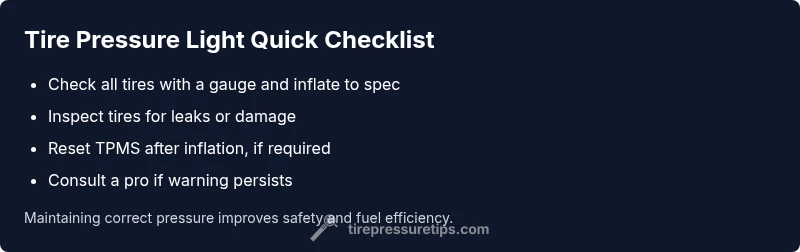
- easyCheck all tires with a calibrated gauge and inflate to the specified pressure
- easyInspect tires for leaks, punctures, or damaged seals and repair/replace as needed
- mediumReset the TPMS according to the owner's manual (relearn procedure if required)
- mediumIf the light persists, have a technician test TPMS sensors and battery health
- hardReplace a faulty TPMS sensor or battery and recalibrate the system
Frequently Asked Questions
What should I do first when the tire pressure check light comes on?
Park safely, check all tires with a gauge, and inflate to the recommended spec. If the light remains, try resetting TPMS following the owner's manual.
Park safely and check each tire with a gauge; reset TPMS if possible, and seek a professional diagnosis if the light won’t go away.
Is the TPMS light the same as a flat tire warning?
Not exactly. The TPMS light warns about low or changing tire pressure, while a flat tire warning is about a tire that’s visibly underinflated or punctured. Treat both as safety issues and address promptly.
TPMS warns about pressure changes; a flat tire warning is about a tire likely being flat. Both require quick action for safety.
Can temperature alone trigger the tire pressure check light?
Yes, temperature changes can cause small, temporary pressure fluctuations that may trigger a light if readings are near the threshold. Check with a gauge and monitor after a few warm-up cycles.
Temperature changes can affect readings, but always verify with a gauge before deciding it's a fault.
What if the light stays on after I inflate to spec?
If the light stays illuminated, the TPMS may require a relearn procedure or sensor service. Consult the owner's manual or a tire professional for a precise diagnostic.
If the light stays on after inflation, a TPMS relearn or sensor service may be needed.
Should I replace TPMS sensors preemptively?
Only if diagnostics show faulty sensors or battery failure. Replacements should be done by a qualified technician to ensure proper relearn.
Sensor replacement should be based on diagnostics, not guesswork.
How can I prevent TPMS warnings in the future?
Regularly check tire pressures, replace damaged tires promptly, and have TPMS calibrated after tire service. Keeping tires at the recommended pressure reduces most warnings.
Keep tires at the recommended pressure and have TPMS checked after tire service to prevent warnings.
Watch Video
What to Remember
- Check all tires with a gauge before assuming a sensor fault.
- Reset TPMS after inflating or after tire service.
- Persistent warning warrants professional TPMS diagnostics.
- Regular maintenance reduces TPMS warnings and improves safety.