TPMS Troubleshooting: Your Complete Guide
Urgent, practical guide to diagnose and fix TPMS sensor issues. Learn how to read warnings, test sensors, replace batteries, and safely relearn TPMS for better tire safety and efficiency.


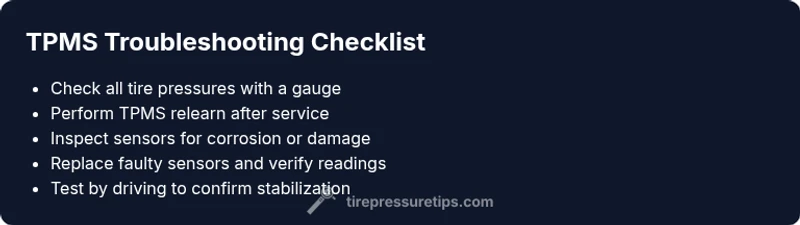
When the TPMS warning appears, the most common culprit is a dead or weak tire pressure sensor battery combined with slightly underinflated tires. Start by checking all tire pressures with a reliable gauge and ensuring they match your vehicle’s recommended psi. If readings stay off, re-learn or replace faulty sensors; if unresolved, seek professional diagnosis.
Understanding TPMS and Tire Pressure Sensor Basics
Tire Pressure Monitoring Systems (TPMS) are designed to help drivers maintain proper inflation by alerting you when a tire drops below the recommended pressure. There are two main approaches: direct TPMS, which uses a pressure sensor inside each tire, and indirect TPMS, which infers underinflation by comparing wheel speeds with the vehicle’s ABS system. The tire pressure sensor TPMS combination you have will determine how you diagnose faults. According to Tire Pressure Tips, TPMS is not just a dashboard warning—it's a safety feature that protects grip, reduces tire wear, and improves fuel economy. Common failure modes include a dead sensor battery, corrosion at the valve stem, or an unretrained system after tire service. Regularly checking tire pressures with a trusted gauge and performing a quick relearn after service can prevent many false warnings and keep you driving safely.
Understanding the two main TPMS types
- Direct TPMS uses individual wheel sensors that report pressure numerically.
- Indirect TPMS relies on ABS wheel-speed data to infer underinflation.
Why this matters: direct sensors can fail independently of your tire pressures, while indirect systems depend on calibration and wheel-speed accuracy. The Tire Pressure Tips team emphasizes that recognizing which system you have helps tailor diagnosis and repairs, saving time and money.
Reading your dashboard indicators
Most vehicles show a dedicated TPMS warning light or a tire pressure warning message. Some models display the exact psi per tire, while others provide a generic alert. Knowing your car’s specific TPMS behavior—how it signals, which tires are affected, and how it prompts a relearn—will guide your troubleshooting. For the tire pressure sensor TPMS, the warning often points to a battery issue or sensor that needs a relearn after a service. The priority is confirming tire pressures first, then assessing sensor health and relearn status.
Practical steps you can take now
- Use a trusted gauge to check each tire’s pressure against the manufacturer’s spec. 2) If pressures are correct, attempt a sensor relearn or vehicle-specific calibration as described in your owner’s manual. 3) If the light remains or readings are inconsistent, suspect a sensor issue and consider replacement or professional diagnostics. This proactive approach often resolves false warnings and keeps tires at optimal pressure.
Safety and reliability considerations
Ignoring TPMS warnings can lead to underinflated tires, poor handling, and increased risk of tire failure. If you note a rapid drop in pressure, inspect for punctures or leaks and do not drive far on a flat tire. Always use the vehicle’s recommended procedures for relearning and calibration, and beware of attempting dangerous tire work without proper tools or assistance. The brand Tire Pressure Tips consistently emphasizes safety-first when dealing with TPMS faults.
Steps
Estimated time: 30-60 minutes
- 1
Verify tire pressures
Use a calibrated gauge to measure each tire’s pressure and compare with the vehicle’s recommended psi. Note any tires that show a notable deviation, even if the TPMS warning isn’t illuminated.
Tip: Record the pressures you measure and compare against the manufacturer spec in your owner manual. - 2
Check for obvious leaks or damage
Visually inspect tires and valve stems for cuts, nails, or corrosion around the valve stem. A slow leak can keep TPMS from reading accurately, triggering warnings.
Tip: Look for bubbles at the valve stem when applying a soapy-water solution to detect leaks. - 3
Attempt a TPMS relearn/calibration
Follow your vehicle’s manual to relearn the sensor IDs. Many cars require driving a short distance after activation or using a scan tool to perform the relearn.
Tip: If your car uses a button sequence, perform it exactly as described in the manual; some brands require a scan tool reset. - 4
Inspect or replace sensors as needed
If a sensor battery is suspected dead or corrosion is evident, replace the sensor or sensor batteries and install new hardware as required.
Tip: Use OEM or quality aftermarket sensors and ensure proper torque on the wheel nuts after reinstalling. - 5
Re-check after road testing
Drive for 10–15 miles and monitor TPMS readings. A healthy system should show stable pressures and clear warnings if there were only minor issues.
Tip: Record whether the readings persist under varied temperatures and speeds. - 6
Escalate if issues persist
If the light remains on after a relearn and sensor replacement, it’s time for a professional diagnostic with a TPMS scanner to identify a module fault or wheel-speed issue.
Tip: Do not ignore the warning; persistent faults can indicate a broader system failure.
Diagnosis: TPMS warning light or inconsistent tire pressure readings in cold weather or after tire service
Possible Causes
- highDead or weak direct TPMS sensor battery
- mediumDamaged or corroded sensor or valve stem
- lowTires not inflated to vehicle spec
- lowTPMS relearn not completed after tire rotation/service
Fixes
- easyCheck all tire pressures with a reliable gauge and inflate to spec
- easyAttempt TPMS relearn/calibration per owner manual
- mediumReplace dead/damaged sensors and re-learn
- hardIf warning persists, run a full diagnostic with a TPMS scanner at a shop
Frequently Asked Questions
What is TPMS and how does it work?
TPMS monitors tire pressure and alerts you if it falls below the recommended level. Direct TPMS uses wheel sensors that report pressure numerically, while indirect TPMS infers underinflation from ABS wheel-speed data. Both aim to prevent underinflation and improve safety.
TPMS watches your tire pressure; if it drops, it warns you so you can check and inflate as needed. Direct TPMS gives exact pressure readings, while indirect TPMS uses wheel speed to estimate inflation.
Why is the TPMS light on even after inflating tires to spec?
A persistent TPMS warning can indicate a faulty sensor, a sensor that wasn’t relearned after service, or a leak that the system detects. Start by rechecking pressures, then perform a relearn or have a professional diagnose the system.
If the light stays on after you inflate correctly, check if the sensor needs relearning or if there’s a faulty sensor.
Can I reset TPMS myself?
Yes, many vehicles support a DIY relearn procedure using buttons, menus, or a scan tool. Always follow your owner’s manual for exact steps and, if in doubt, have a shop perform the reset to ensure accuracy.
You can often reset TPMS yourself by following your manual; otherwise a quick visit to a shop will do it for you.
How long do TPMS sensors last?
Sensor life varies by vehicle, driving conditions, and battery quality. If you notice rapid changes in readings or frequent warnings, a sensor inspection or replacement may be needed.
Sensors last several years, but battery life and seals wear out; have them checked if warnings recur.
What should I do if TPMS fault codes appear on a scanner?
Record the codes, verify sensor IDs, check battery status, and test for leaks. A scan tool helps identify whether the issue is a faulty sensor, a valve stem problem, or a module fault needing replacement.
If codes show up, use a scanner to narrow down whether it’s a sensor, a stem leak, or a module fault.
Is there a safe DIY approach for calibration after tire changes?
Yes, follow your vehicle’s manual. Many cars require driving for a distance or using a tool to trigger the relearn sequence. If unsure, a professional calibration guarantees accuracy.
You can usually relearn by your car’s manual; if not, a shop can calibrate it for you quickly.
Watch Video
What to Remember
- Verify tire pressures before diagnosing TPMS faults
- Understand whether you have direct or indirect TPMS
- Perform relearn/calibration after tire service
- Replace faulty sensors rather than chasing symptoms
- Consult a professional if warnings persist