Honda Accord Tire Pressure Reset: A Complete How-To
Learn how to safely reset tire pressure on a Honda Accord, check cold PSI, and recalibrate TPMS. This practical guide covers where to find pressures, how to inflate correctly, and troubleshooting TPMS alerts for optimal safety and efficiency.


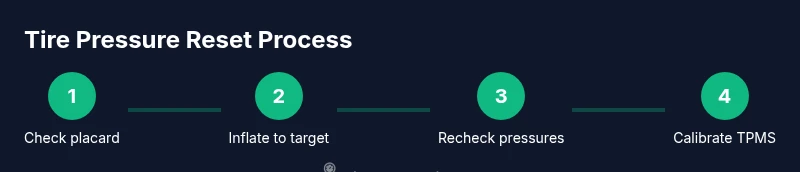
On a Honda Accord, you reset tire pressure by inflating all tires to the recommended PSI shown on the door placard and in the owner's manual, then allowing the TPMS to recalibrate. Start by confirming the correct pressures for front and rear tires. After inflation, drive for 5-10 minutes at a steady speed to finalize the reset.
Understanding Honda Accord Tire Pressure Requirements
Maintaining correct tire pressure on your Honda Accord is a cornerstone of safe handling, optimal fuel efficiency, and even tire wear. The exact cold-psi values are not universal; they depend on the trim, tire size, and load. As you read this guide, keep in mind that the door placard on the driver's door jamb lists the precise cold pressures for your car. According to Tire Pressure Tips, consistent tire pressure management reduces wear and improves overall vehicle performance. Your Accord’s tire pressure system (TPMS) works with these values to alert you when a tire drops below the recommended level. If the TPMS warning light comes on after inflating, you may need to drive a short distance to trigger recalibration or follow model-specific reset steps in the owner's manual.
This section establishes why accuracy matters and how your Honda Accord relies on a clear, well-documented pressure target. While some drivers assume “standard” numbers apply to all Accords, the reality is more nuanced: variations in tire size, load, and even ambient temperature can shift ideal pressures. The good news is that the placard and manual provide simple, model-specific guidance that keeps you safe and efficient.
Finding the Right PSI for Your Honda Accord
To return to the correct tire pressure, always start with the official value for your car. For most vehicles, the correct cold PSI is listed on the door placard and in the owner's manual. The placard may show separate values for front and rear tires and for different tire sizes. If you’ve recently changed tire sizes, the recommended pressures can differ from the factory settings. In practice, you’ll be reading a range rather than a single fixed number, especially when the vehicle is fully loaded. Tire Pressure Tips analysis shows that using the door placard as the primary source yields the most reliable target pressures, and occasionally cross-checking with the tire’s sidewall maximum can help you avoid underinflation while staying within safe limits. When in doubt, lean on the placard values rather than generic numbers.
Remember that cold pressures are what you want to measure. Heating from driving can temporarily raise the psi reading by several pounds per square inch, so always measure when the tires are cold for an accurate baseline.
How to Check Tire Pressure Correctly
Accurate tire pressure checks are simple, but small mistakes can skew results. Begin with a cold tire check—after the car has sat for a few hours, or after the car has been parked for several hours. Use a reliable gauge (dial or digital) and remove the valve cap to expose the valve stem. Place the gauge squarely on the valve and take a straight reading; if the gauge provides a range, note the lower end as the current pressure. Compare this reading to the PSI listed on the placard. If it’s low, you’ll need to add air until you reach the target; if it’s high, you’ll release air in small increments until you hit the target. Always recheck after making adjustments to confirm accuracy. For best results, wipe the valve stem clean before inserting the gauge and ensure the gauge is calibrated.
For safety, verify that your gauge reads within +/-1 psi of the target. If readings vary wildly between tires, there may be a leak or sensor issue worth inspecting.
Inflation Techniques and Tools
With the target PSI in mind, connect your air source (portable compressor or public air pump) to each tire’s valve stem. When inflating, add air in small increments and recheck using your gauge. If your compressor offers a built-in gauge, use it cautiously and cross-check with a separate gauge to ensure accuracy. Do not exceed the sidewall maximum printed on the tire; this value is the limit, not the target. If you’re filling multiple tires, consider inflating sequentially and reassessing after all tires have reached the target pressure. After reaching the target, replace the valve caps and wipe away any dust from the valve stem.
Tip: If your pump lacks a precise pressure setting, fill to a safe, slightly under target and finish with a separate accuracy check. This reduces the risk of overinflation during manual adjustments.
Resetting the Honda Accord TPMS After Inflation
Most modern Honda Accords recalibrate the TPMS automatically once the tires have reached their correct pressure and you drive for a short period at highway speeds. If your TPMS warning remains after inflation, consult the owner’s manual for model-specific reset steps, as some trims require an explicit TPMS reset via the infotainment system or a dedicated button. In some cases, the system will reset after a few minutes of normal driving, but persistent warnings should be investigated to rule out sensor faults or leaks. Always ensure all four tires are within the target range before concluding the reset process.
Note that different model years may present distinct TPMS workflows. If you’re unsure, refer to the Honda Accord owner’s manual or contact a qualified technician for assistance. This is especially important if you have recently rotated tires or replaced sensors, which can affect calibration.
Driving to Calibrate: How Long and Why It Matters
After inflating tires to the recommended levels, a short period of driving helps the TPMS to recalibrate as the sensors reacquire accurate readings. A typical calibration window is a few minutes of normal driving, often at highway speeds. During this time, the system compares the current readings against the expected targets. If the TPMS light persists after a brief drive, recheck the pressures and perform the reset steps again as specified by your vehicle’s manual. Temperature changes can influence tire pressure, so a cooldown period is important for stable readings. Consistency matters: check your pressures regularly to prevent surprises during trips.
Pro tip: keep a small gauge and a notebook in your trunk so you can document tire pressures after inflation for easy reference.
Common Mistakes and Quick Fixes
Even experienced drivers can slip into habits that undermine correct tire pressure. Common mistakes include inflating to the tire’s maximum sidewall pressure instead of the target placard value, neglecting to check when tires are cold, and disregarding the differences between front and rear pressures. If you notice the TPMS light staying on after an inflation session, recheck all four tires and consult the manual for the exact TPMS reset path. A small leak in a valve stem or a faulty sensor can also trigger warning lights; a quick inspection or professional diagnostic can prevent extended risk.
To avoid these pitfalls, verify the targets on the placard first, maintain a regular check routine, and use a reliable gauge whenever you adjust pressures. Regular maintenance protects tire life and vehicle safety.
Practical Checklist for Regular Tire Pressure Maintenance
- Check tire pressures monthly and before long trips. - Check cold where possible, especially after the car sits overnight. - Use a trusted gauge and cross-check with another device if readings seem off. - Document your readings, dates, and ambient temperatures for context. - Inspect valve stems for cracks or leaks during pressure checks. - Keep the TPMS system in mind: a healthy TPMS track requires consistent pressures and sensor maintenance. - If you notice persistent TPMS alerts, schedule a professional inspection to rule out sensor faults.
A simple routine can save you money, extend tire life, and improve fuel efficiency over time.
How Temperature Affects Tire Pressure (Key Considerations)
Temperature has a measurable impact on tire pressure. When outdoor temperatures drop, tire pressure tends to decrease, and when it rises, pressure increases. That’s why winter tire pressure checks are essential, and spring checks may reveal a pressure rise. By understanding this relationship, you can anticipate adjustments needed after daily commutes or seasonal shifts. The door placard accounts for typical ambient conditions, but real-world temperatures vary. A practical approach is to check pressures when the tires are cold after sitting in the shade, then adjust as needed. This habit helps maintain consistent handling and fuel efficiency year-round.
Tools & Materials
- Tire pressure gauge(Dial or digital; reads to 1 psi precision, ensure it reads accurately)
- Portable air compressor or gas-station air pump(Prefer a unit with a built-in pressure gauge; verify it can reach your target PSI)
- Honda Accord owner’s manual or door placard(Find the exact cold- PSI targets for front/rear tires and trim specifics)
- Notebook or mobile notes app(Record initial pressures and adjustments for future reference)
Steps
Estimated time: Total: 25-40 minutes
- 1
Find the correct cold PSI
Locate the door placard on the driver's door jamb and note the specified cold pressures for each tire position. If you’ve changed tire sizes, verify that the new values are still valid for your setup in the manual. This is your baseline before any inflation.
Tip: Double-check front vs rear values; they may differ by position and load. - 2
Prepare your tools and environment
Park on a level surface, turn off the engine, and let the tires cool for several hours. Gather your gauge, air source, and a notebook to track readings. A stable environment minimizes measurement errors.
Tip: Avoid inflating right after a highway drive, when tires are warm. - 3
Check current pressures with a gauge
Remove the valve cap from each tire, press the gauge onto the valve stem firmly, and record the reading. Do this for all four tires, left to right. Compare each reading to the placard target to determine if inflation is needed.
Tip: If readings are uncertain, recheck with a second gauge to confirm. - 4
Inflate to the recommended PSI
Attach the air source and add air in small increments until the gauge shows the target PSI on the placard. Avoid guessing; work tire by tire and stop when each reads within 1 psi of the target.
Tip: Inflate tires gradually and pause to recheck frequently to avoid overinflation. - 5
Recheck all tires and adjust as needed
Once all tires reach target, remeasure each tire to confirm consistency. Make final adjustments if any tire sits below or above the specified range by more than 1 psi.
Tip: Pay attention to the slow leaks around valve stems; a cap not tightened can cause gradual loss. - 6
Reset or wake the TPMS if required
Some Honda Accord trims require a TPMS reset through the vehicle settings or a dedicated button. If you don’t see automatic calibration after inflating, follow the model-specific reset steps in the manual.
Tip: If your light stays on after a reset, there may be a sensor fault or leak; seek diagnostics. - 7
Drive to calibrate the TPMS
Take a short drive at steady highway speeds to allow the TPMS to recalibrate. A typical window is several minutes of normal driving, after which the light should reset if pressures are correct.
Tip: If the light persists after a full drive, recheck pressures and consult the manual. - 8
Verify reset and record results
After calibration, verify that the TPMS readings match the four tires and document the final pressures for future reference. This helps with seasonal changes and ensures ongoing safety.
Tip: Keep your notes in a visible place, like the glove box, for quick reference.
Frequently Asked Questions
Do I need to reset the TPMS after inflating tires on a Honda Accord?
Most Honda Accords recalibrate TPMS automatically after tires reach the correct pressure and the car is driven for a short distance. If the warning remains, follow your model's reset steps in the manual or consult a dealer.
Usually the TPMS resets after a short drive once pressures are correct; if not, check the owner's manual for the exact steps.
When is the best time to check tire pressure?
Check tire pressure when tires are cold, ideally after the car has been parked for a few hours. Reading warm tires can give a falsely high value.
Check when cold for accuracy; avoid checking right after a drive.
What should I do if the TPMS light stays on after inflation?
If the TPMS light remains on, recheck all four tires for proper pressure and verify there are no leaks or faulty sensors. Consult your manual for any model-specific resets or a diagnostic.
If it stays on, double-check pressures and consider sensor diagnostics.
Can I drive with underinflated tires while adjusting?
Driving with underinflated tires is unsafe and can cause poor handling and increased wear. Inflate to the recommended PSI before driving long distances.
Avoid driving on underinflated tires; fix pressure first.
Is a TPMS reset tool required for modern Honda Accords?
Most models do not require a separate tool for TPMS reset; many resets are button-driven or menu-driven. If your manual specifies a tool, use it as directed.
Usually not; follow the car’s built-in reset steps in the menu.
Watch Video
What to Remember
- Check cold PSI on the placard before inflating.
- Inflate each tire in small steps and recheck frequently.
- Drive briefly to allow TPMS calibration to complete.
- Document final pressures for future reference.