Honda Accord Tire Pressure Monitoring System: Troubleshooting Guide
Learn how to diagnose and fix Honda Accord tire pressure monitoring system issues quickly. From common causes to DIY checks and when to call a pro.


The Honda Accord TPMS usually lights up from low tire pressure, a faulty sensor, or a relearn need. Start by inflating tires to the recommended PSI, then perform a TPMS reset in the instrument cluster. If the warning persists, consult a technician to test sensors, batteries, and the control module.
What is the Honda Accord Tire Pressure Monitoring System (TPMS)?
According to Tire Pressure Tips, TPMS is a safety feature that helps you maintain proper tire pressure by monitoring air levels in each tire and alerting you to under- or over-inflation. In the Honda Accord, you’ll encounter both direct TPMS and indirect TPMS variants depending on the model year and trim. Direct TPMS uses wheel-mounted sensors that report actual pressure to the car's computer, while indirect TPMS relies on ABS wheel-speed data to infer pressure differences. The system is designed to warn you when a tire is below the recommended inflation level or when sensors begin to fail. Recognizing how TPMS works empowers you to respond quickly when a warning appears, helping you avoid unsafe driving conditions and protect tire longevity.
Direct vs. indirect TPMS on Honda Accord: what to know
Honda has offered both direct and indirect TPMS configurations over different generations. Direct TPMS provides real-time, tyre-specific pressure readings from sensors installed inside each wheel, which makes it easier to identify which tire is underinflated. Indirect TPMS, used in some trims, uses the ABS wheel-speed sensors to infer a pressure loss based on changes in rotation, and it often requires a reset or relearn after tire service. For Honda Accord owners, the practical takeaway is: if you see a TPMS warning, you should verify pressure first with a gauge, then follow the reset or relearn procedure appropriate for your model. Direct systems are generally more precise, but both aim to alert you before a dangerous tire condition develops.
How TPMS warnings work in Honda Accord models
TPMS warnings on the Honda Accord appear as a dedicated light on the instrument cluster, sometimes accompanied by a message in the driver information display. The warning is triggered when sensor data shows pressure deviation from the recommended value or when the system detects sensor problems. The reset or relearn procedure may be required after inflating tires, rotating wheels, or replacing sensors. If the light stays on after inflating to spec, you may have a failing sensor or a problem with the TPMS control module. In many cases, a simple reset will clear the warning, but persistent warnings call for diagnostic attention.
Quick checks you can do at home
Before you panic, there are practical checks you can perform at home. Start by pulling the vehicle over on a level surface, turn off the engine, and inspect all tires visually for obvious issues such as bulges, cuts, or embedded objects. Using a calibrated tire gauge, verify each tire's pressure against the manufacturer’s recommended spec found on the door jamb or in the owner’s manual. Inflate or deflate to reach the spec, then drive briefly (if safe) to allow the TPMS to relearn. If your tires were recently serviced, confirm that the tire shop performed a TPMS relearn after mounting the tires. Always replace a damaged sensor or tire rather than attempting to drive with compromised equipment.
Diagnostic flow: Common scenarios and decisions
Symptoms include a TPMS warning light, inconsistent readings, or messages in the display. Start by checking pressure; if all tires read near the recommended pressure, the issue might be a sensor fault or relearn requirement. If one or more tires are clearly underinflated, inflate to spec and recheck. If the warning continues, proceed to examine sensor condition, check for sensor battery life, and verify whether a relearn is necessary. When in doubt, follow the car’s on-screen prompts and consult the service manual. Safety comes first—if you notice a slow leak or damaged tire, replace it promptly and have the TPMS recalibrated afterward.
Step-by-step: Most common fix for a stuck TPMS light
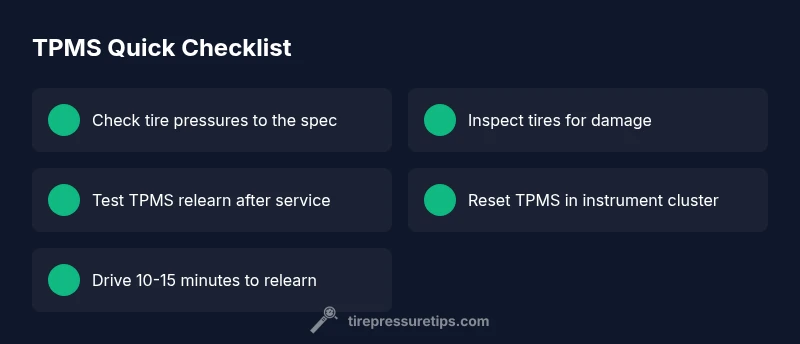
- Park on a level surface and turn off the engine. 2) Check and record each tire’s current pressure. 3) Inflate all tires to the recommended specification. 4) Use the Honda Accord’s menu to perform a TPMS relearn/reset. 5) Drive for 10-15 minutes at steady speeds to allow relearning. 6) Recheck pressures and confirm the warning has cleared. 7) If the light remains, inspect sensors for damage or corrosion and consider sensor battery replacement. 8) If unresolved, seek professional diagnosis.
Tip: A digital tire gauge provides more accurate, repeatable readings than a tool from a gas station pump.
When to replace TPMS sensors or the battery and professional considerations
Direct TPMS sensors are integrated into wheel assemblies; if a sensor fails or the battery dies, the warning will persist regardless of inflation. In such cases, replacing the faulty sensor and performing a relearn is often necessary. Indirect TPMS relies on ABS data and is generally more tolerant of sensor issues but still benefits from a reset after tire service. If the warning remains after replacing sensors or after a relearn, professional diagnostics are advised to check wiring, the control module, and possible software updates.
How temperature and load affect tire pressure on Honda Accord
Tire pressure naturally changes with ambient temperature and driving load. Colder weather can lower tire pressure, triggering a TPMS warning even if tires were properly inflated earlier. Similarly, carrying heavy loads or long highway drives can affect pressure distribution among tires. Regular checks at consistent times (e.g., before daily driving) help you catch slow leaks and prevent nuisance warnings. A proactive approach reduces emergency situations and improves fuel efficiency and handling.
Pro tips and maintenance routines to keep TPMS healthy
Establish a simple routine: check tire pressures monthly, after long trips, and after weather changes. Keep a log of pressures and reset dates. When replacing tires, insist on TPMS relearn and confirm sensor calibration. Use only quality gauges and ensure tires are properly balanced after mounting. Finally, schedule periodic professional inspections for TPMS sensors, batteries, and the control module to prevent unexpected warnings.
Steps
Estimated time: 45-60 minutes
- 1
Prepare safety gear and tools
Park on level ground, engage the parking brake, and gather a calibrated tire gauge, a portable inflator, and a reading notebook. Safety first—turn off the engine and remove any jewelry or loose clothing.
Tip: Keep your gauge clean for accurate readings. - 2
Check each tire’s current pressure
Record the readings from all four tires and compare them with the recommended specs listed on the door jamb or owner’s manual. Note any tires that are clearly underinflated or overinflated.
Tip: Take note of temperature and recent weather, as it can affect readings. - 3
Inflate tires to recommended pressure
If any tire is below spec, inflate to the recommended PSI using your gauge, then recheck to confirm accuracy. Do not rely on pumps that don't display precise numbers.
Tip: Inflate in small increments and recheck multiple times. - 4
Reset or relearn TPMS
Access the Honda Accord TPMS relearn option in the instrument cluster menu or consult the owner’s manual for model-specific steps. Some models require a drive cycle after reset to trigger relearn.
Tip: Follow the exact sequence in your manual for successful relearn. - 5
Test drive for relearn
Take a short drive at highway speeds for 10-15 minutes to allow the system to relearn sensor data. Watch for TPMS warnings during the drive.
Tip: If you hear a rapid beep or the light flickers, stop and recheck pressures. - 6
Recheck and document results
After the drive, recheck tire pressures and confirm the TPMS warning is off. If the light remains, inspect sensors for damage or corrosion and prepare for possible replacement.
Tip: Document the last known good pressure for reference. - 7
Seek professional help if needed
If warnings persist despite correct inflation and relearn, schedule a professional inspection to test sensors, wiring, and the TPMS control module.
Tip: Professional diagnostics may include software updates and sensor reprogramming.
Diagnosis: TPMS warning light on, or inconsistent tire pressure readings across tires
Possible Causes
- highLow tire pressure due to a leak or temperature drop
- mediumDirect TPMS sensor battery dead or sensor failure
- lowTPMS relearn not completed after tire service
- lowTPMS control module fault or wiring issue
Fixes
- easyInflate all tires to the recommended pressure and recheck
- easyReset or relearn TPMS in the Honda Accord settings and drive to relearn
- mediumInspect sensors for damage; replace faulty sensors or batteries and re-learn
- hardIf warnings persist, have a dealer or qualified tech diagnose the TPMS module and wiring
Frequently Asked Questions
What does the TPMS light mean on a Honda Accord?
The TPMS light indicates that one or more tires are underinflated or there is a sensor/system fault. Start by checking tire pressures to the recommended spec, then perform a TPMS relearn. If the light persists, get a professional diagnostic to inspect sensors and the control module.
A TPMS warning means underinflation or a sensor issue. Check pressures, relearn if needed, and see a tech if it stays on.
How do I reset TPMS on a Honda Accord?
Reset procedures vary by model year. Generally, inflate tires to spec, access the TPMS relearn option in the instrument cluster, and follow the on-screen prompts. Some versions require a short drive after reset to complete the relearn.
Inflate to spec, use the TPMS relearn option, then drive a bit to finish the process.
Why is my TPMS light on after inflating tires?
If the light remains after inflating to spec, there may be a sensor fault, a relearn not completed, or a problem with the TPMS control module or wiring. Check each tire for a slow leak and consider sensor inspection or replacement.
The light can stay if a sensor is bad or the system needs a relearn after inflation.
Can I replace TPMS sensors myself?
Direct TPMS sensors are mounted in the wheel and require proper tools and calibration. Replacement is possible for experienced users, but many Honda Accord models require relearn procedures and sometimes programming. If unsure, seek professional help.
Sensors can be replaced, but it’s safer to have a pro handle relearn and programming.
Does temperature affect TPMS readings in a Honda Accord?
Yes. Cooler temperatures can lower tire pressure, triggering a TPMS warning, and warmer days can raise it. Regular checks help ensure accurate readings and avoid nuisance alerts.
Temperature changes can make the TPMS light ping on and off; check pressures regularly.
Watch Video
What to Remember
- Always inflate tires to the recommended pressure.
- Reset TPMS after inflations or rotations.
- Direct TPMS provides precise readings; indirect relies on wheel speed.
- Persistent warnings warrant professional diagnosis.
- Temperature and wear can affect TPMS readings; check regularly.