Tire Pressure Winter vs Summer Chart: Read & Apply
Learn how a tire pressure winter vs summer chart helps you adjust PSI for seasonal temperature changes. This objective guide explains reading the chart, applying it to your vehicle, and avoiding common mistakes for safer driving year-round.


Using the tire pressure winter vs summer chart helps you adjust PSI for seasonal temperature changes. In short, follow the chart to account for ambient temperature, verify pressures after cold starts, and align TPMS readings with your vehicle’s spec. This guide from Tire Pressure Tips shows how to read and apply the chart for safety and efficiency.
Temperature and Tire Pressure: The Core Link
Tire pressure is not a static value; it changes with the air inside the tire as temperatures rise or fall. When outside temperatures drop, the air inside tires contracts, and the PSI can fall accordingly. Conversely, warm weather expands air, pushing the PSI higher. A tire pressure winter vs summer chart is designed to help drivers compensate for these predictable swings so tires sit at the manufacturer-recommended level regardless of season. According to Tire Pressure Tips, understanding this relationship is the first step toward safer handling, better fuel economy, and even tire wear distribution across the tread. By keeping a chart handy, you can anticipate how much pressure to add or release as seasons shift and temperatures fluctuate, without guessing at random adjustments.
What a tire pressure winter vs summer chart typically shows
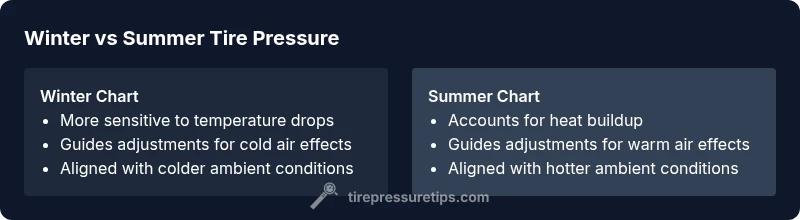
Most charts present two seasonal targets—one for cold-weather conditions and another for warmer months. The winter column usually reflects lower ambient temperatures and their effect on tire pressure, while the summer column assumes higher temperatures and the corresponding pressure increase. Crucially, these charts are vehicle-specific; they should be used in conjunction with the car’s official cold-inflation specification printed on the door jamb placard and the owner’s manual. The chart is a practical supplement, not a replacement for your vehicle’s recommended PSI. Tire Pressure Tips emphasizes that consistency is key: aim to start each season with pressures close to the chart’s target and adjust as needed based on temperature changes and driving conditions.
How ambient temperature shifts affect PSI, and why charts exist
The physics behind tire pressure is simple but powerful: air responds to temperature. In cold weather, tires naturally lose some pressure, reducing contact with the road and potentially impairing braking and steering. In hot weather, pressure can rise, increasing the risk of overinflation, uneven tire wear, and a harsher ride. A winter vs summer chart translates these physics into actionable targets, helping you keep the tires within their intended operating window. The chart also accounts for lifestyle factors like average highway speeds, loaded luggage, and climate extremes, giving you a practical framework rather than a theoretical ideal.
How to read a chart: layout, axes, and legend
A clear chart usually features two main columns labeled by season, with rows for common driving scenarios and vehicle types. The left column might show “Winter” targets, while the right shows “Summer” targets. Look for notes on vehicle load, tire size, and tire type (standard vs run-flat) since those variables influence the exact numbers. Legends explain color-coded targets and any symbols indicating special conditions (e.g., snow tires, all-weather tires). Remember to always validate the chart against your vehicle’s published specifications and remember that seasonal adjustments are guidelines, not guarantees. This makes the chart a practical companion to your regular PSI checks.
Step-by-step guide to applying the chart to your vehicle
- Locate your vehicle’s official tire inflation specs on the door placard or owner’s manual. 2) Identify your typical seasonal environment (cold winters, hot summers, or variable climates). 3) Refer to the chart’s winter and summer columns and select the target range that matches your season. 4) Check current tire pressures when tires are cold, using a reliable gauge. 5) Adjust pressure gradually to meet the chart’s target, rechecking after a short drive. 6) Reassess whenever there’s a significant temperature shift or a noticeable change in load. 7) Recalibrate TPMS if you install new tires or make substantial changes to your vehicle’s configuration. 8) Keep notes of seasonal targets to simplify the next transition.
Practical scenarios: cold climates, heat waves, and trans-season months
In regions with freezing winters, a winter chart target helps prevent under-inflation after cold starts. During heat waves or long highway drives in summer, the chart helps you avoid over-inflation that can lead to a stiff ride and uneven wear. In shoulder seasons—early spring or late autumn—use the chart to bridge the gap between winter and summer targets, monitoring how the day’s temperature drifts as you drive. These scenarios show why a tire pressure winter vs summer chart is more than a static reference; it’s a dynamic tool for year-round safety and efficiency.
Integrating charts with TPMS and maintenance
TPMS provides a helpful safety net, but it isn’t a substitute for manual pressure checks. Use the chart to interpret TPMS alerts and to inform when a threshold has crossed due to temperature changes or load shifts. Regularly calibrate tire pressures using a quality gauge, especially after tire rotation or replacement. While TPMS can alert you to low pressure, a chart-based approach ensures you understand why the pressure changed and how to correct it. Tire Pressure Tips recommends coupling chart guidance with a routine, calendar-based check (e.g., monthly checks, pre-trip checks in extreme seasons).
How to keep your readings accurate year-round
Always measure tire pressure when tires are cold, ideally before driving or after the vehicle has sat for several hours. Use a reputable gauge and compare readings to the target range on the chart. When switching seasons, start at the chart’s recommended target, then observe how the tire reacts to typical daily temperatures. If you notice progressive under- or over-inflation across multiple weeks, revalidate with a professional or your local tire shop. Record your baseline readings for your primary wheels to simplify future checks and ensure consistency across the year.
Comparison
| Feature | Winter Chart | Summer Chart |
|---|---|---|
| Ambient temperature sensitivity | More pronounced pressure changes in cold conditions | Less pronounced, but still present in warm conditions |
| Scenario-based guidance | Cold months: frequent checks, adjust for cold starts | Hot months: verify after long drives and in the heat |
| Vehicle-specific ranges | Always align with manufacturer spec; chart is a guide | Always align with manufacturer spec; chart is a guide |
| TPMS interaction | TPMS readings reflect winter targets when cold | TPMS readings reflect summer targets when hot |
| Best use case | Cold climates with regular temperature drops | Warm climates or variable climates with high heat |
Strengths
- Helps maintain safety by aligning tire pressure with seasonal conditions
- Can improve fuel efficiency and tire wear when used consistently
- Provides a practical, vehicle-specific seasonal framework
- Encourages proactive maintenance and TPMS awareness
- Reduces risk of sudden under- or over-inflation due to temperature shifts
Drawbacks
- Charts require vehicle-specific data; wrong chart use can mislead
- Temporarily inaccurate readings during after-drive measurements
- Can be confusing if you ignore the difference between season targets
- Needs regular updates as tires wear or replacements occur
Use the tire pressure winter vs summer chart as a seasonal companion to your vehicle’s specs.
The chart is most effective when paired with cold-inflation specs and TPMS awareness. It helps you account for temperature-driven pressure changes and supports safer driving year-round. Regular checks and disciplined adjustment are essential for reliable results.
Frequently Asked Questions
What is a tire pressure winter vs summer chart?
A tire pressure winter vs summer chart is a seasonal reference that helps you adjust tire PSI based on ambient temperatures. It complements your vehicle’s official PSI specs and TPMS to maintain safe handling and optimal tire wear across seasons.
A seasonal chart shows how cold and hot weather change your tire pressure and guides you to adjust to the right range.
Do charts apply to all tires and vehicles?
Charts are designed to be vehicle- and tire-specific. They rely on the manufacturer’s recommended cold-inflation PSI and may differ for run-flat tires versus standard tires or for vehicles with heavy loads.
Charts are generally vehicle-specific—check your owner’s manual and door placard for exact targets.
How often should I check tire pressure in winter?
Check tire pressure at least once a month and before long trips, especially when temperatures swing from very cold to warm or after a tire change. In extreme weather, more frequent checks are prudent.
Check monthly and before trips, especially when temperatures swing a lot.
What should I do if TPMS shows a warning in winter?
If TPMS alerts, measure the actual PSI with a gauge when tires are cold. Compare to the chart’s winter target, adjust to the recommended range, and recheck after a drive to confirm stability.
If TPMS warns, measure with a gauge when cold and adjust to the winter target.
Can I use the summer chart in winter and vice versa?
You should not rely on the opposite season’s target. Use the chart corresponding to the current ambient temperature and driving conditions and follow the vehicle’s official PSI specs.
Don’t mix charts—use the one that matches current temperatures and vehicle specs.
What to Remember
- Follow season-specific targets tied to your vehicle’s spec
- Check tires when cold and recheck after temperature shifts
- Use TPMS as a safety net, not a substitute for manual checks
- Adapt the chart as tires wear or when changing tire types
- Document seasonal adjustments to simplify year-round maintenance