Tire Pressure Light in Cold Weather: Troubleshooting Guide
Urgent, practical steps to diagnose and fix a tire pressure warning during cold weather, with TPMS insights, safe inflation tips, and winter maintenance.


The tire pressure light in cold weather usually means at least one tire is underinflated or the TPMS is signaling a fault. Start by verifying the vehicle’s recommended pressures from the door jamb sticker, then check for leaks and top off as needed. If the light stays on, have the TPMS system inspected by a technician.
Understanding the Tire Pressure Light in Cold Weather
The tire pressure warning light, also known as TPMS, signals that one or more tires are running below the vehicle’s recommended pressure. In cold weather, air contracts and tire pressure naturally drops, which can cause the TPMS to illuminate after a chilly night or a cold commute. A warning like this is not just about pressure—it affects handling, braking efficiency, and tire wear. The Tire Pressure Tips team emphasizes that in winter you should treat a TPMS alert as a call to action, not a reason to drive faster to "prove" the tires are fine. Always begin with the simple checks: find the recommended psi on the door jamb sticker, compare it to a cold-reading with a gauge, and inflate to spec if needed. If the light stays on after inflating, the issue may be a slow leak or a faulty sensor, which requires further investigation.
Why Cold Temps Trigger TPMS Warnings
Cold weather affects tire pressure more dramatically than any other factor. As temperatures fall, the air inside each tire contracts, and pressure readings drop even if there is no external leak. This is why you may see a warning in the morning and a normal reading after you drive for a few miles. According to Tire Pressure Tips analysis, many cold-weather TPMS warnings are linked to temporary underinflation rather than permanent tire damage. The fix is usually simple: inflate to the vehicle’s recommended psi (found on the sticker) using a reliable gauge, then recheck after the tires have cooled down. If the warning persists despite correct inflation, there may be a slow leak, a damaged valve stem, or a faulty sensor that needs professional service.
Quick Checks You Can Do Right Now
You don’t need fancy tools to start diagnosing a TPMS warning in cold weather. Here are quick checks you can perform before you leave the driveway:
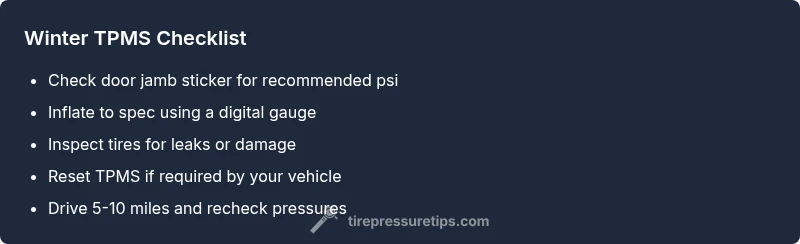
- Locate the recommended tire pressures on the door jamb sticker for each wheel.
- Use a trusted, digital tire pressure gauge to read cold readings before you drive.
- Inflate tires to spec, then wait a few minutes and recheck to confirm uniform pressure.
- Inspect each tire for obvious signs of damage, nails, or slow leaks around the valve stems.
- If one tire remains underinflated after inflation, inspect for a puncture or call for professional help.
If the light remains, the TPMS sensor or its battery could be the culprit; in that case, schedule a diagnostic with a technician.
Diagnostic Flow You Can Follow
Symptom driven checks help isolate the issue quickly. Start with the simplest explanations before jumping to more complex fixes. Record the readings, note any fluctuations, and decide whether inflation or sensor replacement is needed. Safety first: never drive with dangerously low pressures, especially in cold weather where road conditions worsen.
Step-by-Step Fix for Winter TPMS Light
Following a structured approach minimizes risk and gets you back on the road faster. Begin with inflation checks, then verify sensor integrity, and finally consider a TPMS reset or service if needed. Always recheck pressures after any adjustment and drive short distances to “train” the system. If the light reappears, it’s time for professional diagnostics.
Safety, Maintenance, and Prevention in Cold Weather
Winter weather demands proactive tire care. Protect yourself by maintaining correct pressures, inspecting tires regularly, and scheduling TPMS service before failures occur. Keep a gauge in the glove box, and never ignore persistent warnings; a failing TPMS or a punctured tire can lead to unsafe driving conditions.
Quick Recap: Why This Matters
Cold weather amplifies tire pressure changes; staying on top of inflation protects grip, mileage, and safety. Regular winter checks reduce the likelihood of a surprise TPMS warning and help your tires wear evenly.
Steps
Estimated time: 30-45 minutes
- 1
Find the recommended tire pressures
Park on a level surface with the tires cold. Locate the sticker on the inside of the driver door or in the owner’s manual, and note the psi values for front and rear tires. This gives you the target to aim for during inflation.
Tip: Double-check all four tires; don't forget the spare if your system includes it. - 2
Measure and inflate to spec
Using a digital gauge, read the current cold pressures. Inflate each tire to the stated psi, ensuring even inflation across all four corners. Recheck after the tires have cooled to confirm stability.
Tip: Inflate slowly and avoid overinflation; you can re-check after a short drive if you need to verify stabilization. - 3
Inspect for leaks or damage
Visually inspect each tire for nails, cuts, or embedded objects. Check around the valve stems for slow leaks by applying a soapy water solution and looking for bubbles.
Tip: If you suspect a slow leak, avoid driving long distances until inspected by a professional. - 4
Reset or test the TPMS
Some vehicles auto-reset after inflation; others require a manual reset via the dashboard menu or a dedicated button. Consult the owner’s manual for the exact procedure.
Tip: If there is any doubt, have the TPMS system diagnosed by a technician to avoid miscalibration. - 5
Take a test drive and recheck
Drive 5-10 miles to allow the TPMS to relearn the new pressures. Recheck all tires; if the light returns, schedule a service appointment.
Tip: Keep a log of readings and any changes in the TPMS light over the next few days.
Diagnosis: TPMS light stays on after inflating to the recommended pressure
Possible Causes
- highUnderinflation due to cold weather
- mediumSlow leak from puncture or damaged valve stem
- lowFaulty or degraded TPMS sensor or battery
- lowRecent tire rotation or sensor repositioning
Fixes
- easyRecheck inflation on all tires to the door jamb sticker values and re-measure after tires have cooled
- mediumInspect tires for leaks, punctures, and valve stem issues; repair or replace as needed
- hardTest and, if necessary, replace TPMS sensors or battery; reprogram or recalibrate as per vehicle manual
- easyReset TPMS following the vehicle's manual if required; if the light persists, seek professional service
Frequently Asked Questions
Why does the TPMS light come on in cold weather?
Cold weather causes air to contract, lowering tire pressure and triggering the TPMS light. Check all tires, inflate to the sticker values, and monitor for recurring warnings.
Cold weather lowers tire pressure, which can trigger the TPMS light. Inflate to spec and monitor the warning.
Should I reset TPMS after inflating tires?
Some systems reset automatically after inflation, others require a manual reset per the owner's manual. If in doubt, consult your dealer.
Some TPMS reset automatically after inflation; others need a manual reset per your manual.
Is a slow leak the tire fault or the TPMS fault?
A slow leak is a tire issue that can trigger TPMS warnings. Inspect for punctures, valve stem leaks, or bead leaks and repair as needed.
A slow leak is usually a tire issue causing the TPMS warning. Check for punctures or valve leaks.
What if I can’t reach the recommended psi because of a leak?
Do not drive long distances. Inflate to a safe level if possible, then arrange professional repair for the puncture or leak.
If you can’t reach the psi due to a leak, avoid long drives and seek service to fix the puncture.
Do winter tires affect TPMS readings?
Winter tires themselves don’t change TPMS readings, but temperature changes and different tire pressures can affect how quickly the light comes on.
Winter temps can influence TPMS readings due to pressure changes, not because of the tires themselves.
Watch Video
What to Remember
- Check cold tire pressures against the door sticker
- Cold weather can trigger underinflation warnings
- If inflation fixes the light, monitor for recurring issues
- Persisting warnings require TPMS service