Broken Tire Pressure Light Troubleshooting: Quick Guide
Urgent guide to diagnose and fix a broken tire pressure light. Learn common causes, safe checks, TPMS reset steps, and when to seek professional help for reliable retraction of the warning.


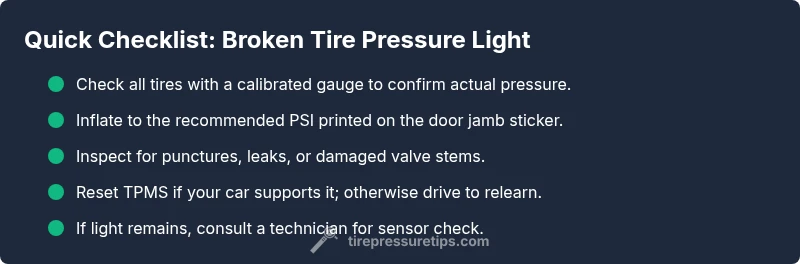
Most often a broken tire pressure light signals a TPMS fault or an actual low tire. Start by checking all tires with a calibrated gauge and inflating to your vehicle’s recommended PSI. Look for punctures or slow leaks, then reset the TPMS if needed. If the light remains after proper inflation, have a technician inspect the sensors and sealing.
What the broken tire pressure light actually indicates
When the dashboard tire pressure light comes on, it usually means one of two things: the Tire Pressure Monitoring System (TPMS) has a fault or at least one tire is under-inflated. The light can also illuminate after a tire service, after replacing a tire, or due to sudden temperature changes that lower tire pressure. Understanding which case you’re facing helps you act quickly and safely. According to Tire Pressure Tips, the quickest path to a safe resolution is to verify actual tire pressure with a reliable gauge and compare it to the manufacturer's recommended PSI, which is listed on the door jamb sticker or in your owner's manual. If you find all tires are at or near the recommended level, your TPMS fault is the likely culprit and may require a sensor reset or replacement. If any tire shows low pressure, you should address that tire first before driving farther.
Common causes behind a persistent tire pressure warning
A tire pressure warning can stay on for several reasons beyond a single low tire. The most common cause is one tire with low pressure due to a slow leak or puncture. Temperature changes can also drop tire pressure, especially in cold weather or after driving long distances. TPMS sensor faults, dead sensor batteries, and issues during tire service (like unplugged sensors or damaged seals) are other frequent culprits. Finally, some vehicles require a TPMS reset after replacing tires or wheels; if the system isn’t reset, the light may stay on even when pressures are correct. By listing the symptoms and inspecting the tires and sensors, you can distinguish between a true pressure problem and a sensor fault. This understanding helps you decide whether to inflate, repair, or seek professional service.
Safe, quick checks you can perform at home
Start with safety and calm execution. Park on a flat surface, turn off the engine, and apply the parking brake. Visually inspect all tires for obvious damage or punctures. Use a calibrated gauge to check cold tire pressure and compare readings with the manufacturer’s recommended PSI. Verify that the valve stems and caps are intact and tightened, and look for slow leaks around the tread and sidewalls. If a tire looks visibly low or damaged, do not drive long distances. After inflating to the recommended level, take a short drive to see if the light resets or remains on. If the warning persists, proceed to the TPMS reset steps or seek professional help.
How to accurately measure tire pressure and reset the TPMS
Always measure tire pressure when the tires are cold to avoid inflated readings that skew PSI. Use a reliable gauge (digital or dial) and record each tire’s pressure. Inflate to the vehicle’s recommended value exactly, not a cushion above it. For most cars, the TPMS will reset automatically after driving at a moderate pace for several minutes; if your vehicle has a manual reset, follow the owner’s manual procedure. After inflation and potential reset, recheck all tires to confirm the warning has cleared. If the light comes back, there may be a more serious issue with the TPMS sensors.
Diagnostic flow you can follow today
Symptom: TPMS light remains on after inflating tires to the recommended level. Diagnosis begins with confirming actual tire pressure, then checking for punctures or leaks. If pressures are correct and the light stays on, suspect the TPMS sensor or battery. Next steps: recheck pressures, reset TPMS, and drive briefly to see if it auto-resets. If the light persists, switch to professional inspection for sensor replacement or calibration. This flow prioritizes simple fixes before moving to sensor-related problems and ensures safety on the road.
When to seek professional help and maintenance tips
While many broken tire pressure light issues are manageable at home, some situations require professional service. If you discover a puncture, slow leak, or damaged TPMS sensor, visit a tire shop or dealership. If the light stays on after you have inflated tires and reset the TPMS, a technician can diagnose sensor faults, calibrate the system, and replace faulty sensors. Regular maintenance helps prevent future warnings: keep tires inflated to spec, check tires monthly, rotate tires according to schedule, and replace damaged sensors promptly.
Steps
Estimated time: 30-45 minutes
- 1
Find the recommended tire pressure
Consult the door jamb sticker or owner's manual to locate the factory-recommended PSI for your tires. This value is your target when inflating and verifying pressure. If the sticker lists different values by front/rear or load, use the higher applicable values for safety.
Tip: Note the exact PSI for cold tires to avoid inflated readings. - 2
Check cold tire pressures with a gauge
Park on a level surface and ensure the tires are cold before testing. Remove the valve stem caps and take measurements from each tire with a reliable gauge. Record the results to compare with the recommended PSI.
Tip: If you don't have a gauge, use a trusted service station to check pressure. - 3
Inflate to the recommended PSI
Add air gradually to bring each tire up to the specified PSI. Avoid overinflation. Recheck after inflation to confirm steady readings across all tires.
Tip: Inflation should be done with the tire warm? No — do this when cold for accuracy. - 4
Inspect tires for damage and leaks
Look for cracks, punctures, or nails in the tread and sidewall. Check valve stems for damage and ensure the valve caps seal properly to prevent air loss. A leaky tire can trigger the warning even if inflation seems correct.
Tip: Tires with slow leaks may require repair rather than patching alone. - 5
Reset or relearn the TPMS
If your car supports a TPMS reset, follow the manual to reinitialize the sensors. Some cars require driving at a steady speed for several minutes to complete a relearn cycle. If the reset is manual, perform it exactly as described.
Tip: Avoid resetting TPMS while the tires are underinflated. - 6
Drive briefly to test the system
Take a short, careful drive to allow the system to recheck pressures and recalibrate. Return to a safe area and re-check all tire pressures again after driving.
Tip: A 5–10 minute test drive is usually enough for many vehicles. - 7
If the light returns, recheck or seek service
If the warning persists after inflation and reset, verify that all tires are airtight and that sensors are operating. A persistent light often means a sensor or battery issue that needs professional attention.
Tip: Document recent service or tire changes to help the technician diagnose. - 8
Schedule routine maintenance
Set a monthly tire pressure check reminder and rotate tires per manufacturer schedule. Regular checks improve safety and fuel efficiency and reduce recurring TPMS warnings.
Tip: Keep a small pencil and notebook or a notes app for quick logs.
Diagnosis: TPMS light stays on after inflating to the recommended PSI
Possible Causes
- highLow tire pressure detected in one or more tires
- mediumTPMS sensor malfunction or dead battery
- lowTemperature-related pressure changes causing frequent fluctuations
Fixes
- easyCheck all tires with a calibrated gauge and inflate to the recommended PSI
- easyInspect tires for punctures or leaks; repair or replace as needed
- easyReset TPMS if your vehicle supports it, following the manual
- mediumIf light remains, have TPMS sensors inspected or replaced by a professional
- easyDrive for a short distance to allow TPMS to recalibrate after inflation
Frequently Asked Questions
What does a broken tire pressure light mean?
A broken TPMS light usually signals a sensor fault or one tire with low pressure. Confirm with a gauge and inspect tires for leaks. If pressures are correct, a TPMS service may be required.
The TPMS light usually means a sensor issue or the tires may be underinflated. Check tire pressures with a gauge and inspect for leaks; if the pressures are fine, you may need TPMS service.
Can I drive with the tire pressure warning on?
If you have verified all tires are at the recommended PSI and there are no visible damages, you can drive cautiously. If you see a clearly low tire or hear air escaping, pull over and inspect immediately.
If your tires look okay and are properly inflated, you can drive but monitor closely. If any tire is clearly leaking, pull over and inspect right away.
How do I reset TPMS after inflating tires?
Most cars reset automatically after driving for several minutes. If your vehicle has a reset button or menu option, follow the manual exactly to relearn the sensors.
Most TPMS systems reset when you drive for a short while after inflating the tires. If your car has a reset option, use the manual steps.
Why would the TPMS light come back after inflation?
If the light returns, there may be a slow leak, puncture, or a faulty TPMS sensor/battery. A professional inspection can confirm sensor health and calibration.
The light coming back after inflation often means a leak or a sensor issue. A technician can diagnose and fix it.
When should TPMS sensors be replaced?
TPMS sensors may fail with battery drain or damage. Replacement is recommended when sensors can no longer provide a reliable reading.
Sensors can fail over time; replacement is advised when readings become unreliable.
Is the broken tire pressure light the same as a tire leak?
Not always. The light can indicate a tire leak or a TPMS fault. Always verify with a physical pressure check to distinguish the cause.
No—TPMS can warn about a sensor fault or a real tire leak. Check your tires with a gauge to be sure.
Watch Video
What to Remember
- Check pressure with a gauge before driving far.
- Reset TPMS after inflation if possible.
- Inspect tires for leaks or sensor damage.
- Seek professional help if the light persists after fixes.