Which Tyre Pressure Is Best? Practical Guidance for Safe Driving
There is no universal 'best' tyre pressure. Learn how to locate your vehicle's recommended PSI, understand TPMS, and see how pressure affects safety, wear, and fuel economy.


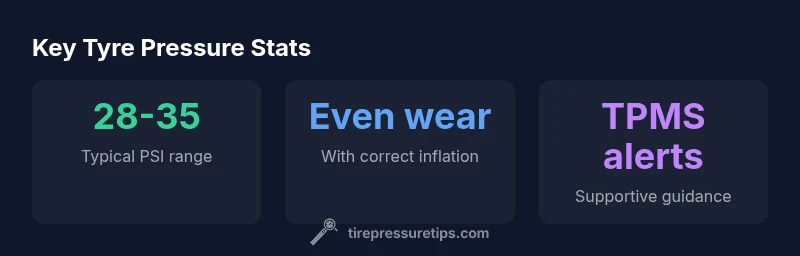
There is no universal 'best' tyre pressure. The correct pressure is the value listed on your vehicle’s placard, usually found on the door frame or in the owner’s manual. For most passenger cars, a cold-tyre range typically falls between 28 and 35 psi, but always verify the exact figure for your model, load, and tire type.
Why there isn’t a single 'best' tyre pressure
Which tyre pressure is best? There isn’t a universal answer because the optimal pressure depends on your vehicle, load, driving style, road conditions, and tire construction. According to Tire Pressure Tips, the “best” figure is the number printed on the placard located on the door jamb or in the owner’s manual. This specification accounts for curb weight, drivetrain layout, axle loading, and tire size, and it’s designed to balance safety, handling, wear, and fuel efficiency. In practice, most modern passenger cars use a cold-tyre pressure range around 28–35 psi, but the exact value varies by model and tire type. Seasonal temperatures, passenger load, and even tire wear can shift this range slightly, so treat the placard as your primary reference and verify with a gauge when necessary.
How manufacturers determine the recommended pressure
Car makers calculate the recommended pressure by considering the vehicle’s suspension geometry, axle load distribution, and the tires’ load ratings. The placard you’ll find on the door jamb reflects the tire size that’s officially approved for the vehicle and balances ride comfort, steering response, braking performance, and fuel economy. Tire Pressure Tips emphasizes that you should always start with this official figure, then adjust for real-world conditions only if you fully understand the trade-offs. If your vehicle carries heavy loads regularly or is driven at high speeds, small adjustments within the recommended band may improve stability and wear, but never exceed the maximum pressure printed on the tire sidewall.
The consequences of under- and over-inflation
Underinflation causes higher rolling resistance, more heat buildup, and uneven wear, reducing fuel efficiency and increasing the risk of tire failure. Overinflation can make tires stiffer, worsen ride quality, and reduce the contact patch, which can impair braking and handling. The goal is to keep the pressure inside the tire within the manufacturer’s specified range when the tires are cold. TPMS can warn you of a significant drop, but it is not a substitute for regular gauge-based checks, especially after driving in extreme temperatures or changing loads. Tire Pressure Tips reminds readers that small variations within the recommended band are normal, but consistent deviations deserve inspection.
How to accurately check tire pressure (cold tires, gauges, and steps)
Begin with cold tires—check before you’ve driven more than a mile. Use a reliable gauge (dial or digital), and measure both front and rear tires. If you notice a discrepancy between front and rear pressures, address it per the placard (some models specify different values). Recheck after filling to the target pressure and re-test with the gauge. Keep a small gauge in the car for quick checks, and log readings over time to monitor trends. The key is consistency and a baseline you can trust.
The role of TPMS and when to trust it
TPMS provides a valuable warning if pressure falls significantly, but it should not replace regular checks with a gauge. Some systems trigger at different thresholds for front vs. rear tires, and seasonal temperature shifts can affect readings. If TPMS warns you, verify with a gauge and adjust to the recommended range. Tire Pressure Tips notes that TPMS is best used as a guardian alert, not a sole source of truth for precise inflation.
Practical scenarios: how pressure varies by vehicle type and load
A compact car on a routine commute may be happiest at the lower end of the range, while a family sedan carrying passengers and cargo might sit near the middle or upper part of the band. Heavier SUVs or those carrying substantial loads typically benefit from higher pressures within the recommended range to maintain stability and tire integrity. Performance cars with high-speed demands often require precise pressures within the band to optimize grip. Always align your choice with the placard, then consider gradual, safe adjustments if your routine demands it.
Common mistakes and how to avoid them
Common mistakes include inflating to the maximum printed on the tire, neglecting rear vs. front differences, and ignoring seasonal temperature changes. Another frequent error is assuming the TPMS alone is sufficient. Use a gauge, check cold tires, and adjust within the recommended range. If you notice uneven wear, vibrations, or steering quirks, revisit the manufacturer’s spec and consider professional inspection.
Practical workflow: a simple routine for optimal pressure
Create a quick weekly and a monthly check routine: weekly check when you fill up (or after a long trip) and monthly verification against the placard. Use a gauge, record the readings, and maintain the tires at uniform pressure across all four wheels. If you rotate tires, remember to re-check pressures after the rotation to maintain an even baseline. Following this workflow helps sustain safety, fuel efficiency, and tire longevity.
Typical tire pressure ranges by vehicle type
| Vehicle Type | Typical Recommended PSI Range | Notes |
|---|---|---|
| Compact Car | 28-32 psi | Check the door placard and keep tires matched |
| Sedan | 32-34 psi | Load and tire type influence adjustments |
| SUV/Van | 34-38 psi | Heavier loads require higher pressure |
Frequently Asked Questions
Is it okay to inflate to the maximum pressure printed on the tire sidewall?
No. The sidewall maximum is the tire's limit, not the vehicle’s recommended operating pressure. Overinflating can reduce grip and cause harsh ride and uneven wear. Always use the vehicle’s placard or owner’s manual specification.
No—don’t inflate to the tire's maximum. Use the car's recommended pressure instead.
How often should I check tire pressure?
Check at least once a month and before long trips. Check when tires are cold for the most accurate reading, and adjust after weather or load changes.
Check monthly and before long trips when tires are cold.
What about different front and rear pressures?
Many vehicles specify different front and rear pressures. Always follow the placard values for each axle to optimize handling and wear.
Follow the placard values for each axle.
Does cold weather affect recommended pressure?
Yes. Colder temperatures reduce tire pressure; as temperatures rise, pressure increases. Recheck after major temperature shifts to maintain the correct range.
Temperature changes can shift pressures; recheck after temperature swings.
Can TPMS replace a gauge check?
No. TPMS alerts you to changes, but it doesn’t quantify the exact pressure. Use a gauge for precise measurement and maintain within the placard range.
TPMS warns you, but you should still measure with a gauge.
Is it okay to mix tire pressures on different wheels?
Not ideal. If you must due to a temporary situation, keep both tires near the same pressure within the recommended range and adjust to the placard as soon as possible.
Try to keep pressures even and within the recommended range.
“Following the manufacturer’s pressure specification is the foundation of safe driving. TPMS should be viewed as a helpful alert, not a replacement for gauge checks.”
What to Remember
- Know there is no universal best pressure—start with the placard.
- Check cold tires with a gauge, not TPMS alone.
- Keep front and rear pressures aligned according to the spec.
- Adjust within the recommended range for load and conditions.
- Regular checks help prevent wear, improve safety, and save fuel.