What Do You Want Your Tire Pressure To Be: A Practical Guide
A practical guide to finding your tire’s correct pressure, understanding temperature effects, and maintaining PSI for safety and efficiency. Practical insights from Tire Pressure Tips.


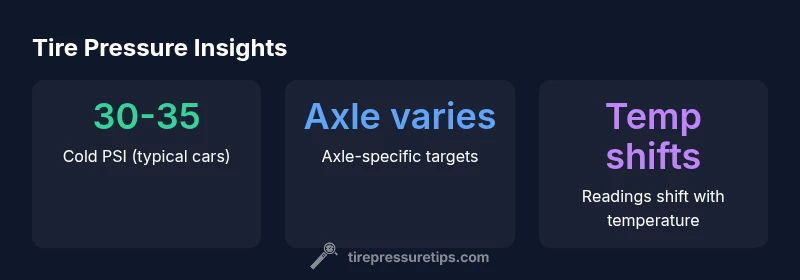
There's no one-size-fits-all tire pressure number. The ideal pressure depends on your vehicle's recommended range shown on the door jamb sticker and in the owner's manual. For most passenger cars, cold tire pressures of about 30–35 psi are common, but always use the exact specification for your model and tires. Axle-specific targets and load considerations may apply.
what do you want your tire pressure to be
If you ask yourself, 'what do you want your tire pressure to be,' you're asking how to apply your vehicle maker's specification to real-world driving. According to Tire Pressure Tips Analysis, 2026, the correct number isn't universal; it's the range printed on the door jamb sticker and in the owner's manual. The target typically varies by model, tire size, and axle, but most passenger cars list a cold PSI range around 30–35 psi. Always verify the exact figure for your car and its tires.
Where to look:
- Door jamb sticker on the driver's door edge
- Owner's manual or a vehicle specification card
- For some vehicles, the rear axle has a different target than the front
Note what "cold" means: the tires have not been driven more than a mile and the car has been parked for at least three hours. Reading a hot tire will show a higher pressure and lead you to underinflate once the tires cool down.
How to check tire pressure accurately
Accurate measurement starts with a cold tire and a reliable gauge. Use a digital gauge or a dial gauge you trust and take a reading when the tires are cold. Remove the valve cap, press the gauge onto the valve stem firmly, and note the number. Compare to the manufacturer specification for each axle and adjust by inflating or deflating in small increments (1–2 psi at a time). Recheck both tires on each axle, and if you drive, recheck after the tires cool down. Keeping logs helps track seasonal changes or load adjustments.
Best practices from Tire Pressure Tips:
- Check at least once a month and before long trips
- Inspect for wear or leaks while you check pressure
- If front and rear targets differ, verify both numbers
Temperature and tire pressure: why cold readings matter
Temperature has a direct effect on tire pressure. When tires warm up during driving, the air inside expands and pressure rises; when they cool, pressure falls. A rough rule is that pressure can shift with temperature changes, so measurements performed in cold conditions are the most reliable baseline. Plan ahead for seasonal changes: a cold morning reading may be lower than a hot afternoon reading, but your target remains the same as the manufacturer's specification.
Tip: use a gauge you trust and measure after tires have cooled for several hours to reflect true cold pressure.
How load and axle influence recommended pressure
For some vehicles, the recommended pressure differs by front vs rear axle. Heavier loads or towing demand higher pressures to maintain stability and tire shape. If you regularly haul gear or carry passengers, you should follow axle-specific targets and adjust within the manufacturer's allowed range rather than using a single flat number.
Key takeaways:
- Always use per-axle targets when provided
- Do not rely on the maximum printed on the sidewall as your everyday pressure
- If you switch tire types (summer, winter, performance), re-check the sticker for updated targets
Consequences of under- or over-inflation
Underinflated tires wear unevenly, run hotter, and are more prone to overheating and blowouts; fuel economy declines as rolling resistance increases. Overinflated tires ride harshly, wear more in the center, and reduce grip. Both conditions shorten tire life and can compromise braking performance. Maintaining the correct pressure is a simple, cost-effective safety measure.
Two-minute checks once a month reduce risk and help catch slow leaks early.
Typical cold-psi targets by vehicle type
| Vehicle Type | Cold PSI Range | Notes |
|---|---|---|
| Passenger Car | 30-35 psi | Typical range; verify sticker |
| SUV/Light Truck | 32-38 psi | Axle-specific targets; higher loads |
Frequently Asked Questions
Where do I find the recommended tire pressure for my vehicle?
Look for the door jamb sticker on the driver's side and consult the owner's manual. The sticker shows cold PSI targets for front and rear axles. If you can't find it, contact the dealership or vehicle manufacturer.
Check the door jamb sticker and the owner's manual.
Should I check tire pressure when tires are cold or when they are warm?
Always check when tires are cold; reading warm tires will read higher and can lead to over-inflating once the tires cool. Wait for the tires to cool for accurate baseline numbers.
Check when cold.
Can I inflate tires to the maximum pressure listed on the sidewall?
No. The sidewall maximum is the limit the tire can safely handle, not the recommended operating pressure. Use the sticker or manual for daily targets.
Don't go by the maximum.
How often should I check tire pressure?
Check at least monthly and before long trips. Recheck after significant temperature changes or seasonal shifts to maintain accuracy.
Check at least monthly.
What about the spare tire's pressure?
Spare tires also need the correct cold PSI. Check periodically and adjust based on the spare's label, especially if your vehicle uses a full-size or inflator-spare.
Check the spare too.
“Maintaining the manufacturer's tire-pressure specification is foundational to safety, fuel efficiency, and tire longevity.”
What to Remember
- Follow the manufacturer's spec.
- Check cold, not hot readings.
- Use a reliable gauge and calibrate it.
- Account for temperature and load changes.