What Tire Pressure Do I Need? A Practical Guide
Learn how to determine your vehicle's correct tire pressure, how temperature affects readings, and practical steps to safely check and maintain efficient tires.


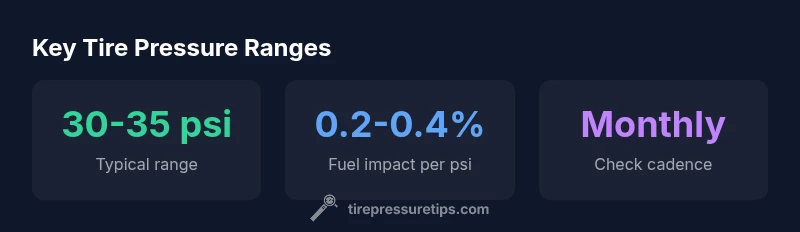
what tire pressure do i need? For most passenger cars, the recommended cold pressure sits around 30-35 psi per tire, but exact figures vary by vehicle. Check the door jamb placard or your owner's manual for your specific spec. For best results, measure when cold and adjust to the exact value specified.
Understanding why tire pressure matters
Your tires are your only contact with the road, and proper inflation is a simple, high-value maintenance task. Correct tire pressure affects safety, handling, fuel economy, and tire wear. When pressure is too low, the tire builds excess heat, flexes more, and wears unevenly—especially along the outer edges. When pressure is too high, the contact patch shrinks, ride quality suffers, and the center tread can wear faster. Vehicle manufacturers specify a cold-psi range for a reason: it balances grip, steering responsiveness, and comfort. In practice, keeping tires within the recommended range yields real-world benefits: improved braking distance in wet weather, more stable cornering, and quieter, longer-lasting tires. The Tire Pressure Tips team emphasizes that this is one of the easiest maintenance tasks with outsized payoff. Start with the door jamb placard, then verify with your owner's manual, and finally invest in a reliable gauge to simplify routine checks.
How to find your exact recommended PSI
Every vehicle has a specific cold-Inflation target printed on a placard—often on the driver’s door jamb—along with separate figures for front and rear tires. If the placard lists a range, use the value in that range that matches your typical load and driving conditions. Do not rely on the tire sidewall maximum as your operating pressure; that number is the maximum, not the ideal everyday pressure. When tires are cold, take a reading with a quality gauge; if you’ve just driven, wait until they cool. After inflating, recheck to confirm you’ve reached the target. Finally, record your readings for quick reference during seasonal changes. If you’re unsure, consult the owner’s manual or your dealer service department. With a few minutes of setup, you’ll know exactly where your tires should sit across a typical month.
Temperature, load, and tire wear: how conditions change your psi
PSI is not static; temperature and load alter readings. Colder ambient temperatures contract air and can drop PSI by a few points, while hot weather or heavy cargo pushes readings higher. Driving dynamics also influence the tire’s internal temperature, causing fluctuations that shift the gap between cold and warm values. Adjusting the target PSI to accommodate seasonal changes helps keep wear even and grip consistent. The practical takeaway is not to chase a single number; instead, stay within the vehicle’s recommended range while monitoring changes as seasons shift. Regular checks with a reliable gauge, paired with TPMS alerts when available, keep you aligned with the manufacturer’s intent and reduce the risk of under- or overinflation.
Cold vs hot: when to check and adjust
Check tire pressures when the tires are cold, ideally after they have sat for at least three hours or before you’ve driven. If you’ve just completed a trip, wait until the tires cool before rechecking. Temperature changes can cause readings to swing by several psi, so use the cold reading as your baseline. When inflating, go slowly and avoid overinflation; after adjusting, recheck to confirm you’ve hit the target. For people who drive in extreme climates, set reminders to check once a month or before long trips. A quick gauge stored in the glove box makes this routine easy and fast.
Common mistakes that waste fuel and wear tires
Common mistakes include inflating all tires to the maximum sidewall of every tire, using outdated gauges, or neglecting to check rear tires that wear differently from the fronts. Relying on TPMS alone without a manual check can miss gradual leaks. Also, assuming the same pressure applies to spare tires or seasonal tires can lead to inconsistent handling. By sticking to the manufacturer’s cold-psi spec, you keep tire wear even and fuel economy optimized.
Practical steps to check and adjust tire pressure at home
Step-by-step:
- Gather a reliable tire gauge and the vehicle’s PSI specification.
- Check pressures when cold; remove caps, attach gauge, read, and compare to the placard.
- Inflate or vent air to reach the target; avoid over or under-inflation.
- Recheck on all tires; record readings.
- Inspect tires for visible wear, cracks, bulges, or embedded objects.
- If your TPMS regularly triggers, schedule a service check to ensure sensors are functioning.
Checking your tires: door placard, manual, and TPMS alerts
Your vehicle’s placard shows the recommended PSI for front and rear tires; some models have separate figures for the spare. If your car has front/rear differences, adjust accordingly. When TPMS alerts you to low pressure, measure with a gauge to confirm and adjust accordingly. Note that TPMS readings can drift as sensors age; a calibration or sensor replacement may be needed to restore accuracy.
The role of TPMS and tires in safety and efficiency
Correct tire pressure is a core safety and efficiency measure. It improves braking performance, cornering stability, and wet-weather grip, while also maximizing fuel economy and tire life. Routine checks reduce the risk of blowouts and premature wear, saving money and enhancing peace of mind. The simple habit of verifying cold PSI every month pays dividends across the vehicle’s lifecycle.
Example PSI ranges by vehicle type
| Vehicle Type | Cold PSI Range | Notes |
|---|---|---|
| Passenger Car (compact) | 28-32 psi | Typical baseline on placard |
| Sedan/Standard | 30-35 psi | Check door jamb placard for exact figure |
| SUV/Crossover | 34-36 psi | Higher payload may require up to the upper end |
Frequently Asked Questions
What is the recommended PSI for my car?
Look for the recommended cold-psi on the door jamb placard or in the owner's manual. If front and rear pressures differ, follow the corresponding values. Do not rely on the tire sidewall maximum as your operating pressure.
Check the door placard or manual for your car’s PSI, and use the correct front and rear values if they differ.
How often should I check tire pressure?
Most drivers should check cold tire pressure monthly and before long trips. TPMS alerts can help, but a manual gauge ensures accuracy.
Check your tires monthly and before long trips with a gauge to stay accurate.
Does temperature affect tire pressure?
Yes. Cold temperatures reduce the PSI, while hot conditions increase it. Check pressure when tires are cold to get an accurate reading.
Temperature changes affect PSI, so measure when the tires are cold.
Can I inflate tires beyond the maximum PSI on the sidewall?
No. The maximum sidewall PSI is the limit, not the recommended operating pressure. Always follow the vehicle’s specified range.
Do not exceed the tire’s maximum; use the vehicle’s recommended pressure instead.
Is TPMS the same as a tire pressure gauge?
TPMS warns that pressure is low, but you should verify with a manual gauge to confirm and correct the pressure.
TPMS alerts you, but you still need to measure with a gauge.
How does overinflation affect tire wear?
Overinflation reduces the contact patch, leading to center-tread wear and a harsher ride. Stay within the recommended range for even wear.
Overinflation can wear the center of the tread and make the ride harsher.
“Maintaining correct tire pressure is one of the simplest, most effective ways to improve safety, efficiency, and tire life.”
What to Remember
- Check cold PSI using the vehicle placard
- Do not inflate to the max sidewall
- Temperature and load affect PSI; check more often in extreme conditions
- Use a reliable gauge and recheck after adjustment
- TPMS helps, but manual checks are essential