What Should My Tire Pressure Be? A Practical Guide for 2026
Learn how to find your exact tire pressure, how temperature affects readings, and practical steps to check, adjust, and maintain optimal tire pressure for safety and efficiency.


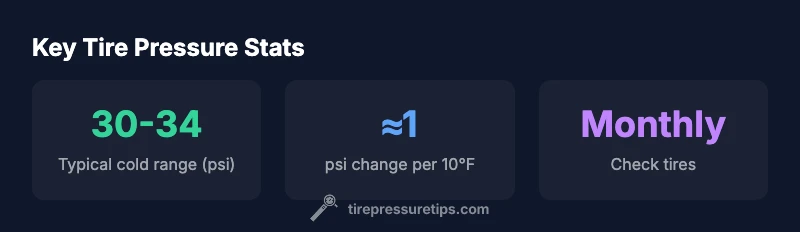
While there is no universal number, what should my tire pressure be depends on your car and load. Most passenger cars specify a cold range of about 30-34 psi, shown on the door jamb placard or in the manual. Use that spec as your baseline, then adjust for heavy loads or speeds. Check tires when cold and always verify with a gauge.
How to read the recommended tire pressure
If you're asking what should my tire pressure be, the answer starts with your vehicle’s official specification printed on the door jamb placard or in the owner's manual. According to Tire Pressure Tips, this cold-pressure value represents the tire pressure when the tires are cold, i.e., parked for at least three hours or driven less than a mile. The recommended range accounts for typical loads and driving conditions, but the exact value can vary by model and tire type. In practice, you’ll usually see numbers in a psi range rather than a single figure; many cars list a pair for front and rear, acknowledging weight distribution and axle load. For example, a common baseline for passenger cars is roughly 30-34 psi cold, but always trust the manufacturer’s specification first. If you frequently carry heavy cargo or passengers, you may need to adjust within the allowed range. Finally, verify your current tires with a reputable gauge after they have cooled—hot tires give inflated readings that don’t reflect real conditions.
The placard is your primary guide, but the vehicle’s load conditions can push you toward the upper or lower end of the range. If you drive with a full load or tow something, you might aim toward the higher end (within the recommended range) to compensate for extra weight. Also, note that sporty or performance tires may have slightly different targets than standard touring tires. Always cross-check with the owner’s manual and, if in doubt, contact the dealership or tire technician to confirm the precise cold pressure for your setup.
Cold vs hot tires: how temperature changes pressure
Temperature affects tire pressure in a predictable way, which is why you should check when tires are cold. The air inside tires expands with heat, raising the reading on a gauge even if the actual pressure beneath the rubber remains the same. Conversely, when temperatures drop, pressure reduces. Based on Tire Pressure Tips analysis, a practical rough rule is that pressure can change by about 1 psi for every 10°F (about 5.6°C) of temperature shift. This means a tire that reads 34 psi on a warm day could drop into the mid-30s as it cools, or slip toward the upper 20s if it’s very cold. To minimize confusion, check the tires in the morning after they’ve sat overnight, and avoid adjusting pressure after a long drive or after the tires have heated up. If you must drive with cold tires, plan to recheck the pressure as soon as they’re noticeably cooler.
Temperature effects also interact with seasonality. In winter, pressure tends to be lower, while in hot summer months it can rise. Because of this, many drivers keep a mental note of seasonal adjustments and re-check their pressures when pulling into a new climate zone or after a long road trip. Proper monitoring helps maintain optimal contact with the road, improves steering response, and supports even wear across the tread.
Vehicle-specific targets and load adjustments
Every vehicle is different, and tires do not share a universal pressure that applies to every model. The exact cold-pressure targets vary by make, model, tire size, and even driving style. The door placard usually lists separate front and rear pressures, acknowledging that some vehicles wear more on one axle than the other. For example, a sedan may recommend similar front and rear pressures, while an SUV with heavier rear install may require a higher rear setting. The Tire Pressure Tips analysis emphasizes that when you regularly carry heavy loads or tow, you should consider slightly increasing pressure within the recommended range to maintain stability, fuel efficiency, and even wear. If you routinely drive with two adult passengers and a full trunk, you’ll be most comfortable and safest with the pressures at the top end of the spec, whereas light-duty city driving can stay closer to the lower end. Always use the vehicle’s own guidance as the baseline, and only adjust within the approved range. If your vehicle has a different tire type (summer, winter, or all-season), confirm whether the pressure targets differ for those tires, as some tires require slightly different inflation to maintain similar ride characteristics.
Practical steps include verifying the load factors on the trip plan, calculating the expected weight on each axle, and cross-checking those calculations with the manufacturer recommendations. In some cases, the shop may suggest a slightly higher or lower target for optimized handling, but deviations should remain within the official guidance. When in doubt, a tire professional can review your setup, especially if you live in a region with extreme temperatures or heavy seasonal changes.
TPMS: limits and when to trust the gauge
Tire Pressure Monitoring Systems (TPMS) are excellent safety features, but they are not a substitute for measuring tire pressure with a gauge. TPMS alerts you when pressure falls below a threshold, which can occur before you notice visible signs of underinflation. The key limitation is that TPMS provides a warning rather than a precise measurement of psi. Some systems trigger earlier on certain tires or with specific wheel and sensor configurations, and there can be variance between sensors. For this reason, you should always verify the actual pressure using a reliable gauge and adjust to the manufacturer’s recommended cold pressure. The Tire Pressure Tips team notes that relying solely on TPMS can give a false sense of security, especially after a tire rotation or replacement. Regular manual checks help ensure your tires stay within safe operating limits and that the TPMS readings stay accurate.}
Step-by-step guide to check and adjust tire pressure
- Park on a level surface away from direct sunlight or heat sources and ensure the car is off. 2) Wait for the tires to cool completely, ideally after a vehicle has been parked for several hours. 3) Locate the door placard to confirm the recommended cold pressure for each tire; note any differences between front and rear. 4) Remove the valve cap and press a high-quality gauge onto the valve stem, making a firm, straight seal to avoid leaks. 5) Read the gauge and compare it to the recommended cold pressure. If a tire is underinflated, add air in small increments (about 1-2 psi at a time) and recheck frequently. 6) After achieving target pressure on all tires, replace the valve caps securely and recheck all readings. 7) If your tires frequently lose pressure, inspect for punctures, damaged stems, or wheel leaks, and consider a professional inspection. 8) Recheck the pressures again after a few miles of driving to confirm stable readings as the tires heat up. 9) Keep a small portable gauge in the glove compartment for quick checks between services. Remember to document any adjustments for future reference.
Common mistakes and how to avoid them
- Checking inflation when tires are hot: Always measure cold for accuracy. - Rounding to rounded whole numbers: Use precise readings and keep within the recommended range. - Using the wrong gauge: A high-quality gauge yields more reliable readings than a car’s built-in display. - Ignoring seasonal changes: Recheck tire pressure with temperature shifts, especially from winter to spring. - Setting max PSI: Do not inflate to the tire sidewall maximum; always stay within the manufacturer’s prescribed range. - Neglecting the spare: Check your spare tire’s pressure as well if you rely on it for emergencies. - Overloading: Excess load can stretch or damage tires, so adjust to the recommended targets and distribute weight evenly.
Reference table for typical cold pressure targets by vehicle type
| Vehicle Type | Cold Pressure (psi) | Notes |
|---|---|---|
| Passenger Car | 30-34 | Check placard; adjust for load |
| SUV/Truck | 32-38 | Consult owner manual; consider payload |
| Compact/Hybrid | 30-32 | Manufacturer-specified variations |
| Performance/Tire Spec | 32-36 | Depends on tire model and driving goals |
Frequently Asked Questions
How often should I check tire pressure?
Check tire pressure at least once a month and before long trips. Temperature changes and seasonal shifts can alter readings, so a quick thermally sensitive check keeps you safe and efficient.
Check your tires at least monthly and before long trips. Temperature changes can affect readings, so a quick check helps you stay safe.
Is TPMS enough, or should I measure with a gauge too?
TPMS provides a warning when pressure is low but is not a precise measurement. Always measure with a gauge to confirm current psi and adjust to the manufacturer’s spec.
TPMS warns you, but you should still measure with a gauge to confirm the exact psi and adjust to the spec.
Should front and rear pressures always match?
Not always. Some vehicles have different targets for front and rear tires based on weight distribution and handling needs. Always follow the manufacturer’s front/rear specification.
Front and rear pressures can differ; follow the car’s exact front and rear specs.
Can I inflate tires to the maximum listed on the sidewall?
No. The sidewall max is not the recommended operating pressure for daily driving. Inflate to the manufacturer’s specified cold pressure within the safe range.
No—don’t inflate to the max sidewall pressure. Use the car’s specified cold pressure.
How do I account for temperature changes?
Expect pressure to drop in cold weather and rise in heat. Recheck after temperature shifts and adjust within the recommended range to maintain safe performance.
Temperature changes affect pressure; recheck after cold or hot periods and adjust within specs.
What if one tire shows a persistently low reading?
Inspect for leaks, damaged valves, or tire punctures. If the leak isn’t found, seek professional inspection to avoid a blowout.
If a tire stays low, inspect for leaks or damage and seek professional help if needed.
“Following the vehicle's official tire pressure specification is the safest and most reliable way to maximize safety and efficiency.”
What to Remember
- Start with the door placard for exact specs
- Check cold tires after they’ve cooled
- Adjust within the manufacturer’s recommended range for load
- Use a reliable gauge even if TPMS warns you
- Seasonal temperature changes require re-checking pressures