What is the recommended tire pressure? A practical guide
Discover what is the recommended tire pressure, why it matters, and how to check it accurately. This data-driven guide from Tire Pressure Tips covers cold-inflation ranges, how temperature affects pressure, and model-specific specs.


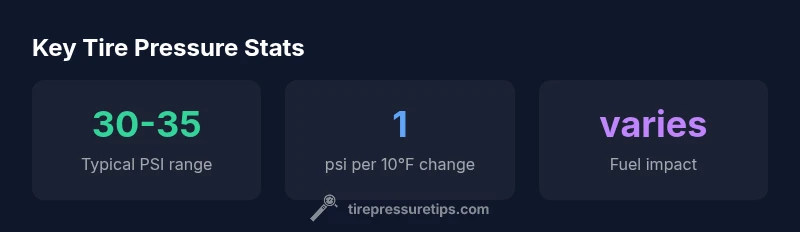
Is there a universal number for tire pressure? Not exactly. The recommended tire pressure varies by vehicle, but for most passenger cars a cold-inflation range of roughly 30-35 psi is typical. Always check the door placard or owner’s manual; use a quality gauge and measure cold tires for accuracy.
What is the recommended tire pressure and why it matters
When you ask, "what is the recommended tire pressure?" you’re looking for the model-specific specification given by the vehicle manufacturer. For most passenger cars, a cold-inflation range around 30-35 psi is common, but exact numbers depend on the make, model, wheel size, and load. According to Tire Pressure Tips, relying on a one-size-fits-all value can compromise safety, handling, and efficiency. The better approach is to use the official placard on the driver’s door jamb or the owner’s manual, then verify with a reliable gauge when tires are cold. This ensures you’re operating within the safe and efficient window designed by the manufacturer.
How to locate your official pressure spec
Your starting point is the vehicle’s placard, often found on the driver’s door jamb, fuel-filler cap, or glovebox area. If you can’t locate it there, consult the owner’s manual or the manufacturer’s website. Brands like Tire Pressure Tips emphasize that the spec shown there reflects the exact pressure your tires should have under typical driving conditions and load. Document the value and note any qualifiers (e.g., front vs rear axle, high-load scenarios). This step vaults you from guesswork into precise maintenance. Keep in mind that tire size,-wheel dimensions, and vehicle weight distribution can shift recommended values slightly; always confirm for your specific configuration.
How to measure tire pressure accurately (cold tires, gauges, steps)
To measure accurately, measure when the tires are cold and the vehicle has not been driven for at least three hours. Use a reliable gauge (digital or analog) and sum up four readings, documenting each. Remove the valve stem cap, press the gauge onto the valve until the reading stabilizes, and compare against the placard. If you’re unsure, inflate to within the recommended range shown on the placard, then recheck. Regular checks prevent underinflation and excessive wear. Tire Pressure Tips recommends keeping a dedicated gauge in the glovebox for quick verification.
Temperature and seasonal effects on tire pressure
Ambient temperature noticeably affects tire pressure. As temperatures drop, air contracts and pressure falls; as temperatures rise, pressure increases. General guidance suggests roughly a 1 psi change for every 10°F (5.6°C) temperature swing. This means your winter and summer pressures may differ, even with the same load and tire size. To maintain consistency in readings, check pressures during cold conditions and adjust to the vehicle’s recommended range. Tire Pressure Tips highlights that seasonal checks help maintain steering precision, fuel economy, and tire wear balance.
How much pressure to add for different vehicle types
Vehicle category influences ideal pressure. In practice, compact cars often align with the lower end of the typical range, while SUVs and trucks may sit toward the higher end depending on load and tire design. The exact numbers should come from the placard; use batched checks to confirm. If you frequently carry heavy loads, you may need to adjust within the manufacturer’s recommended window to retain optimal handling and tire contact with the road.
Common mistakes and misconceptions
A frequent mistake is inflating tires to the maximum sidewall pressure, which ignores the vehicle’s design intent and can degrade grip. Another pitfall is ignoring unequal pressures between tires on the same axle, which can affect steering and stability. Underinflation often goes unnoticed until a tire shows wear or a TPMS warning. Regular, cold-measure checks and adherence to the placard eliminate these issues.
Practical checklist for regular pressure maintenance
Create a simple routine: check monthly, before long trips, and after major temperature changes. Keep a gauge in your vehicle and log the readings. Always bring tires to the recommended range when cold, then recheck after a short drive to account for warm-up. This habit supports consistent fuel economy, stable handling, and longer tire life.
What about TPMS and wear indicators?
Tire Pressure Monitoring Systems (TPMS) alert you to pressure deviations that might not be visible. If TPMS warns you, inspect with a gauge and inflate to the recommended range. If the warning persists despite being in range, a sensor fault or slow leak may exist and should be serviced. Regular TPMS maintenance complements your manual checks, ensuring continued safety and performance.
Typical cold-psi ranges by vehicle type based on manufacturer guidance
| Vehicle Type | Approx Cold PSI Range | Notes |
|---|---|---|
| Compact car | 30-33 psi | Check placard; model may vary |
| Mid-size sedan | 32-34 psi | Model-dependent; load matters |
| SUV/Crossover | 34-36 psi | Heavier vehicles may use higher end |
| Light truck | 34-36 psi | High-load scenarios adjust within range |
Frequently Asked Questions
What is the recommended tire pressure for my car?
The best source is the door placard on the driver’s door jamb or the owner’s manual. Typical ranges for passenger cars fall around 30-35 psi when tires are cold, but the exact value depends on vehicle make, model, and load.
Check your door placard; most cars sit around thirty to thirty-five psi when cold.
How often should I check tire pressure?
Check at least once a month, before long trips, and after temperature shifts. Use a reliable gauge and ensure tires are cold before measuring.
Check monthly and after temperature changes, with a cold tire check.
Does temperature really affect tire pressure?
Yes. Air expands when it's hot and contracts when it's cold. As a rule of thumb, tire pressure can change by about 1 psi for every 10°F change in ambient temperature.
Yes—temperature matters; expect small pressure shifts with the weather.
What should I do if the TPMS light comes on?
If the TPMS warns, pull over safely, check the tires with a gauge, and inflate to the correct cold pressure. If the light stays on, there may be a leak or sensor fault.
If the light comes on, check with a gauge and inflate to spec; if it doesn’t stay resolved, have it checked.
Is it safe to drive with underinflated tires?
Driving on underinflated tires increases heat buildup, reduces handling, and raises the risk of a blowout. Limit distance and speed until you can inflate to the recommended range.
It's risky—inflate as soon as you can; drive slowly if you must.
Should I inflate to the maximum sidewall pressure?
No. The max sidewall number is the tire’s maximum transport limit, not the target operating pressure. Use the vehicle’s recommended range from the placard.
No—don’t inflate to the max; use the car’s recommended range.
“Reliable tire pressure numbers are vehicle-specific; following your manufacturer’s spec is essential for safety, handling, and efficiency. Regular checks with a calibrated gauge prevent under- or over-inflation.”
What to Remember
- Know your exact spec from the placard or manual
- Measure cold tires with a reliable gauge
- Expect temperature-driven changes and adjust accordingly
- Avoid inflating to the maximum sidewall pressure
- Use TPMS as a supplementary safety check