How to Determine the Best Tire Pressure: A Practical Guide
A comprehensive, step-by-step guide to finding and maintaining your vehicle’s ideal tire pressure for safety, wear, and fuel efficiency. Learn how temperature, load, and tire type affect psi and how to verify with TPMS and gauges.


How to determine best tire pressure: You will learn how to locate the manufacturer’s recommended psi, adjust for load or temperature, and verify pressure with a gauge or TPMS. According to Tire Pressure Tips, recommendations vary by vehicle and tire type, and staying within range reduces wear, improves fuel economy, and enhances safety.
Understanding what 'best tire pressure' means
In tire terms, the phrase
In tire terms, the phrase 'best tire pressure' refers to the specific pounds-per-square-inch (psi) level that lets the tire contact the road as designed by the vehicle manufacturer. The goal isn’t a single universal number; it’s the balance between safety, even tread wear, and efficient fuel use for your particular car, tire size, and typical load. The Tire Pressure Tips team emphasizes that the objective is to keep the tire’s contact patch correctly sized so the tire can respond predictably in corners, stop smoothly, and resist underinflation or overinflation. When you start from the official recommendation and adjust for your conditions, you’ll already be on the right track.
Where to find the official recommendation
The best starting point is your vehicle’s placard on the door jamb, along with the owner’s manual. The placard shows separate values for front and rear tires, and often lists the tire size and the corresponding psi range. If the placard is faded or missing, consult the owner’s manual or the tire and vehicle manufacturer’s website. Always prioritize the manufacturer’s figures over third-party guidance. This official range accounts for the car’s suspension geometry, weight distribution, and tire construction. Using this baseline helps ensure balanced handling, even wear, and predictable braking.
Cold vs. warm psi: why temperature matters
Tire pressure changes with temperature. Colder tires read lower psi, while heated tires absorb more air and can read higher. Because most driving starts from cold tires, check pressure when the tires are cold—ideally after the car has sat for several hours or driven less than a mile. If you check after driving, you’ll overestimate the required pressure, risking underinflation when the tires cool down. The difference can amount to several psi and alter handling and wear. Consistently check at the same time of day for reliable comparisons.
How load, speed, and terrain influence inflation
Your load (passengers, cargo) and typical driving conditions (highway cruising vs. city streets, hot climates, or mountain ascents) influence the ideal psi. Heavier loads generally warrant higher pressures within the vehicle’s specified range to maintain tire footprint, cornering stability, and tire durability. Similarly, higher speeds can place more temperature stress on tires, so you may need to adjust within the recommended limits. Always stay inside the manufacturer’s range and avoid wildly different pressures from one axle to the other unless the placard specifies it for load distribution.
Tools and methods for accurate measurement
Accurate tire pressure begins with a good gauge. Digital gauges are easy to read, dial gauges provide a quick estimate, and pencil gauges are affordable but can be harder to read precisely. Use a gauge that shows pressure in psi and is calibrated recently. When taking readings, make sure the tires are cold and inflate only after removing the cap from the valve stem. If you’re measuring in a dusty or breezy environment, wipe the valve stem to ensure a clean seal. For maximum reliability, cross-check with a second gauge or a trusted service station gauge.
Step-by-step approach to determine the best pressure for your tires
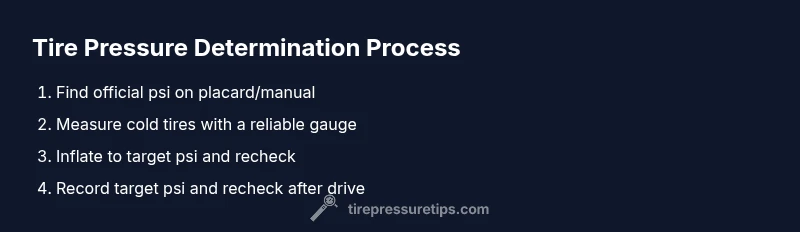
- Locate the official psi range from the placard or manual. 2) Check all tires while cold using a reliable gauge. 3) Compare readings to the recommended range; if any tire is outside the range, plan to inflate or deflate as needed. 4) Inflate to the target psi, then recheck all tires for consistency. 5) Record the target psi for future reference and for seasonal adjustments. 6) Re-check the tires after a 10–15 mile drive to account for heat buildup. This method minimizes guesswork and aligns with standard maintenance routines.
Common mistakes and how to avoid them
- Reading hot tires: Always read cold, since driving raises psi. - Assuming the same psi applies to all tires: Front and rear may have different recommended values. - Ignoring tire size and model: The placard accounts for specific tire dimensions; substitutions can change the correct psi. - Relying solely on TPMS: TPMS is a warning, not a precise gauge; verify with a manual gauge for accuracy.
Maintaining tire pressure as part of a routine
Make tire pressure a monthly habit and before long trips. Temperature swings across seasons can cause noticeable psi shifts, so adjust accordingly. Use a consistent gauge and note down the target psi in a small notebook or app. Regular checks help catch slow leaks from nails, faulty stems, or minor wheel damage before they lead to unsafe driving conditions. Regular maintenance also supports tire wear patterns and fuel economy, which are essentials for safe and economical driving. The Tire Pressure Tips approach emphasizes building a simple, repeatable routine that fits any driver’s schedule.
Interpreting TPMS alerts and when to seek help
TPMS alerts are designed to flag unsafe pressures but aren’t a substitute for direct measurement. If TPMS indicates a pressure deviation or a sensor warning, measure with a gauge, inspect for leaks, and verify the wheel valve stem integrity. If pressure remains outside the safe range after adjustments, consult a tire professional to check the tire for punctures or structural issues. Always address tire pressure anomalies promptly to prevent uneven wear or blowouts.
Tools & Materials
- Tire pressure gauge (digital or analog)(Choose a gauge with a clear scale; measure when tires are cold for consistency)
- Owner’s manual or door jamb placard(Contains official psi ranges by axle and tire size)
- Air compressor or inflation device(Must have a gauge or built-in regulator to control psi precisely)
- Maintenance notebook or mobile note(Record target PSI and readings for future reference)
Steps
Estimated time: 15-25 minutes
- 1
Find the official psi range
Locate the vehicle’s recommended tire pressures for the front and rear tires on the door jamb placard or in the owner’s manual. Note the numbers and any axle-specific differences. This establishes your target range.
Tip: If the numbers differ between front and rear, set each tire to its own recommended value after measuring. - 2
Measure cold tires with a reliable gauge
Before driving, remove the valve cap and place the gauge on the valve stem to take a reading. Do this for all tires to establish a baseline. Cold readings are essential for accuracy.
Tip: If you’ve just driven, wait at least 3 hours or measure after a cool-down period. - 3
Inflate or deflate to target psi
If a tire reads below its target, add air until it reaches the recommended range. If it’s above, carefully let air out until it’s within range. Recheck after adjustments.
Tip: Only adjust in small increments (about 1 psi at a time) and recheck to avoid overshooting. - 4
Recheck all tires
Re-measure all tires after inflation to ensure uniform pressure and that no tire remains outside the target range.
Tip: Check the spare tire too if you carry one on the vehicle—its pressure can be overlooked. - 5
Record the target PSI
Note the final target PSI for each axle and tire size. This makes future checks faster and reduces guesswork during seasonal changes.
Tip: Keep a simple log that includes date, readings, and ambient temperature. - 6
Validate with a quick drive check
Take a short drive (5–10 miles) and recheck the pressures. A minor rise is normal with heat; adjust if readings drift outside the target range after cooling.
Tip: If pressure drifts significantly, inspect for leaks or damaged valves and seek professional help.
Frequently Asked Questions
How often should I check tire pressure?
Check tire pressure at least once a month and before long trips. Temperature changes can cause pressure to drift, so regular checks help maintain safe handling and even wear.
Check your tires about once a month and before long trips, since temp changes can shift pressure and affect safety.
Can TPMS replace a manual pressure check?
No. TPMS provides a warning when pressures are unsafe, but it doesn’t give an exact psi reading. Always verify with a calibrated gauge for precise adjustments.
TPMS warns you of unsafe pressure, but you should still measure with a gauge for exact psi.
Is cold tire pressure the same as hot?
No. Cold readings are lower; hot readings rise with driving. Always measure when tires are cold and adjust according to the official range.
Cold tires read lower pressure; after driving, pressure rises. Measure cold for accuracy.
What happens if I overinflate?
Overinflation reduces the contact patch, can cause a harsher ride, and increases risk of uneven wear and blowouts under impact.
Overinflation reduces grip and can cause uneven wear or a harsher ride.
Should I check the spare tire pressure?
Yes. The spare should be checked periodically because it may be used in emergencies. If your spare is a full-size tire, treat it like the others.
Yes, check the spare too; it’s part of your readiness kit.
Can I rely on a gas station air pump gauge?
Gas station gauges vary in accuracy. Use your own gauge for confirmation and cross-check with a second device if possible.
Gas station gauges can be off; verify with your own gauge.
Watch Video
What to Remember
- Check cold tires first before inflating
- Follow manufacturer-recommended psi ranges
- Use TPMS readings as supplementary, not sole guidance
- Record target tire pressures for easy reference