How to determine tire pressure: A Practical Guide
Learn how to determine tire pressure accurately with a step-by-step method, using a gauge, and TPMS insights. Includes tools, tips, safety, and seasonal guidance from Tire Pressure Tips.


You will determine tire pressure by verifying each tire’s current PSI against the vehicle’s recommended level, using a reliable gauge, and adjusting when tires are cold. This quick method helps prevent under- or over-inflation, improves safety, and supports better fuel efficiency. Read on for the full steps, tools, and safety tips.
Why determining tire pressure matters
Determining tire pressure is a foundational car-maintenance task that directly affects safety, handling, tire wear, and fuel economy. When you know the exact pressure your tires should run at, you reduce the risk of blowouts and improve overall grip, steering response, and braking. The Tire Pressure Tips team emphasizes that inflating to the correct PSI (pounds per square inch) is not a one-time chore but a regular habit that pays dividends in mileage and vehicle life. If you regularly check and adjust pressure, you’ll notice smoother rides and more predictable performance in wet or icy conditions. The habit also helps you spot slow leaks early, which can save you from sudden flats on the road. In short, determining tire pressure is a practical safety measure that every driver can master with a small routine.
According to Tire Pressure Tips, the simplest path to accurate results starts with knowing where to look for the official PSI target and how to measure consistently. Your vehicle’s owner’s manual or the door jamb sticker shows the recommended range, typically between 30 and 35 PSI for many passenger cars. What matters most is maintaining pressure within that range for all four tires, adjusting for load, temperature, and driving conditions.
The goal of this guide is to give you a clear, repeatable process so you can determine tire pressure confidently, even if you’re new to tire care. If you’re scanning for quick wins, this is your reliable starting point. The Tire Pressure Tips team is here to help you stay safe on the road.
Understanding recommended tire pressure and why it varies
Tire pressure is not a single, universal number. It varies by vehicle, tire size, load, and driving conditions. The official target is printed on the door jamb placard or listed in your owner’s manual, and many modern vehicles feature a tire-pressure monitoring system (TPMS) that alerts you if a tire falls below the recommended level. The value you should aim for typically falls within a narrow range, such as 32-34 PSI for a sedan, but always verify the exact number for your model. Factors that influence the recommended pressure include the tire’s construction, the wheel size, and the vehicle’s suspension design. Over time, the permissible pressure range can shift with seasonal temperature changes, so it’s sensible to recheck as the seasons switch. Always inflate to the manufacturer’s specification rather than relying on an emotional estimate or a visual gauge reading.
The Tire Pressure Tips analysis highlights that a small underinflation, even by 1–2 PSI, can reduce fuel efficiency and cause uneven tire wear. Conversely, overinflation can lead to harsher rides and a higher risk of impact damage on rough roads. In practice, use the vehicle’s recommended PSI as your baseline, and adjust only when you have a clear reason (heavy luggage, full passengers, or temperature extremes).
Seasonal changes matter: colder weather lowers tire pressure naturally, while hot weather can increase it slightly as you drive. A routine check schedule helps you catch leaks early and protect tire life. If you rely on TPMS alone, remember that it’s a warning system, not a precise pressure gauge, so you should still verify with a gauge when you suspect pressure changes.
Tools and methods to measure tire pressure
Accurate measurement begins with a reliable gauge. Digital gauges tend to be user-friendly, but analog gauges can be just as precise when used correctly. The tool you choose should displayPSI clearly and hold a stable reading long enough for you to note it. A common mistake is reading pressure after a short pump or immediately after driving, which gives a falsely high result due to heat. The best practice is to measure when tires are cold, ideally after the vehicle has been stationary for at least three hours or has been driven less than a mile.
Kinds of gauges you might consider:
- Digital gauge: Easy to read, often stores last readings, and works well in low-light conditions.
- Dial gauge: Traditional option with a rotating dial—reliable when you use it consistently.
- Pencil gauge: Simple and inexpensive, good for quick checks but requires careful alignment with the valve stem.
No matter which gauge you pick, consistent technique matters. Remove the valve stem cap, place the gauge squarely on the valve stem, and press firmly to seal. Read the measurement without spinning the gauge, and note the value for each tire. If you get a markedly different number from one tire to another, inspect for leaks, damage, or uneven wear that could skew readings.
As Tire Pressure Tips notes, keeping a small log of readings can help you detect slow leaks or gradual pressure loss over weeks or months. You can log the date, tire position, and PSI measurement to track trends and set reminders for periodic checks.
Step-by-step: determine tire pressure accurately
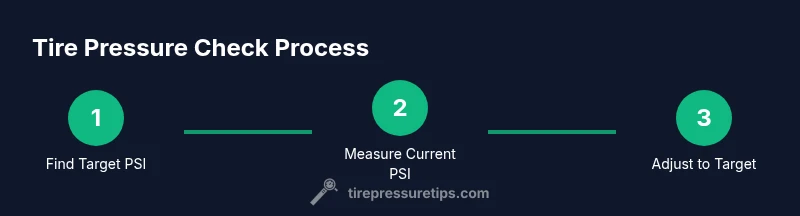
This section provides a concise, repeatable workflow you can follow every time you check tires. Start with the expected target pressure, then verify each tire, and adjust to bring the reading into spec. The steps assume you’re working with a standard passenger vehicle and common PSI targets. If you have heavy loads, a larger family, or winter equipment, adjust to the higher end of the recommended range if specified by the manufacturer.
- Locate the recommended PSI for your vehicle from the door jamb placard or owner’s manual. 2) Use a reliable tire pressure gauge and ensure the tires are cold before measuring. 3) Remove the valve cap, apply the gauge, and read the PSI for each tire. 4) Compare the gauge readings to the manufacturer’s recommended PSI. 5) Inflate or deflate as needed to reach the target PSI. 6) Recheck readings, reinstall valve caps, and record the results.
If you encounter a persistent discrepancy, suspect a slow leak, a faulty TPMS sensor, or damaged valve stem. In these cases, consult a professional technician to confirm the cause and fix it before driving long distances.
Tip: Always recheck after adjustments to confirm stability, and avoid deviating from the target PSI by more than 1–2 PSI unless you have explicit guidance for your load or driving conditions.
How temperature affects tire pressure and when to check
Temperature swings are the invisible factor behind many tire-pressure changes. Cold ambient temperatures reduce air density, causing PSI readings to drop. In contrast, warm days or extended driving heat up the air inside tires, potentially raising pressure. The rule of thumb is that tires lose about 1 PSI for every 10°F drop in temperature, and gain pressure with warming. For this reason, it’s best to check tire pressure in the morning, when tires are cold, and to recheck after long trips to capture any heat-related changes.
Seasonal checks become especially important in areas with dramatic temperature variation. If you’ve stored winter tires, replace or adjust them to the appropriate seasonal PSI, as the tire shape and construction may differ slightly from your summer tires. If you’re unsure, refer to your owner’s manual or contact the Tire Pressure Tips team for guidance.
For TPMS-equipped vehicles, the sensor is calibrated to warn you when a tire is underinflated. Use the TPMS as a guide, but still verify with a gauge for accuracy and to understand how far off your target is.
When following this guidance, you’ll reduce the risk of unpredictable handling, improve fuel economy, and extend tire life—a win for safety and savings.
Adjusting tire pressure for load and conditions
Your vehicle’s load and driving environment directly affect how your tires should be inflated. Heavier loads require higher PSI within the recommended range to maintain surface contact and handling stability. If you regularly haul cargo or carry multiple passengers, consult the placard for the maximum allowed PSI per tire and adjust within that limit. Speed also matters; high-speed driving can heat tires more quickly and slightly affect pressure, so you may need a small adjustment to accommodate sustained high-speed use.
Underinflation leads to excessive tire flex, increased heat, and faster wear on the tire shoulders. Overinflation reduces the contact patch, which can degrade traction and produce a harsher ride. The best approach is to inflate to the mid-to-upper portion of the recommended range when carrying heavy loads, and to the mid-range for typical daily use. Always prefer the manufacturer’s guidance over generic rules.
If your tires show uneven wear or you notice a consistent drop in pressure after retreading, consider professional inspection for possible leaks, punctures, or valve issues. Regular checks help catch these problems early and prevent costly repairs.
TPMS: interpretation and troubleshooting
Tire Pressure Monitoring Systems (TPMS) provide a helpful early warning when a tire drops below the recommended level, but they are not a precise substitute for a periodic gauge check. A TPMS warning is most valuable when it’s combined with a quick physical measurement. If the TPMS indicates a fault—such as a light staying on after inflation or inconsistent readings—inspect the sensors and seals for damage or corrosion. Replacing a TPMS battery or sensor can resolve many warnings, but only after confirming the root cause.
Even with TPMS, environments like cold weather or new wheels can complicate readings. A physical gauge check ensures accuracy and helps you verify whether the TPMS warning is due to the tire or the sensor itself. If TPMS readings don’t align with gauge readings, schedule a technician visit to recalibrate or replace the sensor as needed.
A common pitfall is assuming all four tires require identical PSI, especially if the vehicle is configured with all-wheel drive or variable load. Use the vehicle’s stated targets for each axle as your baseline and adjust each tire’s pressure as needed, while keeping within the recommended range.
Safety tips and best practices for regular checks
Safety should guide every tire-pressure check. Park on a flat, level surface away from traffic. If you’re inflating tires, use a compressor with a built-in gauge or a standalone gauge to avoid over-inflation. Keep your eyes on the gauge while inflating and avoid leaning directly over the tire; this minimizes the risk of a sudden blowout if a tire ruptures. Replace or seal valve caps after completing a check to prevent dirt and moisture from entering the valve stem.
Make time for regular checks: quarterly checks are a reasonable baseline, with a monthly check if you drive in extreme heat or cold or if you carry heavy loads. Document your readings and any changes in tire wear, which can reveal slow leaks or mounting issues. For people who frequently drive in cold-weather regions, maintain awareness of seasonal PSI adjustments and ensure that your tires stay within the safe range.
Finally, use the correct PSI for your car, not the maximum pressure printed on the tire sidewall. The maximum rating is for safety in overload situations, not for daily inflation targets. Following these practices helps you maximize safety and efficiency year-round.
Tools & Materials
- Tire pressure gauge (digital or analog)(Choose one with clear PSI display and a stable seal on the valve stem.)
- Vehicle owner’s manual or door jamb placard(Contains the official recommended PSI for your model.)
- Air compressor or access to pressurized air(Needed to adjust pressure when a tire is underinflated; avoid over-inflation.)
- Notebook or app to log readings(Helpful for tracking trends and leaks over time.)
Steps
Estimated time: 10-20 minutes
- 1
Find the recommended PSI
Locate the vehicle’s suggested tire pressure in the door jamb placard or the owner’s manual. Record the PSI for each tire position (front left, front right, rear left, rear right) since some vehicles use different targets for front and rear tires. This is your target to aim for during inflation.
Tip: If your tires have different wear, prioritize the higher target for safety and performance. - 2
Choose and prepare a gauge
Select a reliable tire pressure gauge and ensure it’s ready for use. Remove the valve cap and inspect the valve stem for damage or dirt. A clean seal between the gauge and valve stem ensures an accurate reading.
Tip: Tap the valve stem gently with a finger to clear debris before attaching the gauge. - 3
Check when tires are cold
Measure each tire’s current PSI when the tires are cold, ideally after the car has sat for a few hours. Hot tires can show artificially high readings due to heat buildup. Do not check immediately after a commute or highway drive.
Tip: If you must check after a drive, wait 15-20 minutes for the tires to cool before re-measuring. - 4
Inflate or deflate to target
Compare the gauge reading to the recommended PSI. Inflate a tire that’s below target or release air if it’s above target, using controlled bursts and rechecking after each adjustment.
Tip: Aim to adjust in small increments (1–2 PSI) and recheck to avoid over-correction. - 5
Recheck all tires
After adjusting, re-measure each tire to confirm it’s at or near the target. Refit valve caps securely to protect the stems from dirt and moisture. If your gauges show significant variation, consider replacing a worn gauge.
Tip: Record the final PSI for future reference, either in a notebook or a mobile app. - 6
Document and monitor
Log the PSI readings and any changes you notice in tire wear, handling, or fuel economy. This baseline helps detect slow leaks or TPMS sensor issues over time.
Tip: Set a reminder to recheck monthly or after long trips and temperature changes.
Frequently Asked Questions
How often should I check tire pressure?
A good baseline is monthly checks and before long trips. Check more often if you drive in extreme temperatures or carry heavy loads. Regular checks help prevent underinflation and improve safety.
Check tire pressure at least once a month and before long trips; check more often in extreme temperatures or heavy loads.
Can I rely on TPMS alone?
TPMS provides warnings, but it’s not a precise tool for exact PSI. Always verify with a gauge to ensure accuracy and to learn how far off your target tire pressure is.
TPMS warns you, but always verify with a gauge for exact PSI.
What if TPMS reads correctly but gauges show different numbers?
Discrepancies can indicate a faulty sensor, a leaky valve stem, or gauge error. Re-check with a second gauge and inspect TPMS components if readings remain inconsistent.
If readings disagree, check with a different gauge and inspect the TPMS system.
Does cold weather affect tire pressure?
Yes. Colder temperatures lower PSI. Check pressures again after temperature changes and adjust to the recommended level as needed.
Cold weather lowers tire pressure; recheck after temperature changes.
Should I inflate tires for heavy loads to the higher end of the range?
Yes, when you routinely carry heavy loads, inflation near the upper end of the recommended range can improve load handling while staying within safe limits.
Inflate toward the higher end if you regularly carry heavy loads.
Is it safe to mix different brands of tires for pressure?
Mixing tires can complicate handling. Inflate all tires to the same target PSI where recommended, and ensure tread depth is even across tires.
Keep PSI consistent across tires; avoid mismatched tires for safety.
What to Remember
- Check PSI when tires are cold.
- Inflate to the vehicle’s recommended PSI, not the tire maximum.
- Use a reliable gauge and log readings for trend detection.
- TPMS is a guide, verify with a manual gauge.
- Seasonal temperature changes affect tire pressure.