Know How Much Tire Pressure to Put: A Practical Guide
Learn how to determine the correct tire pressure for safety, fuel economy, and tire life. This guide explains cold PSI, TPMS, temperature effects, and practical steps to set and verify tire pressure.


You determine the right tire pressure by starting with your vehicle's recommended cold PSI from the door jamb placard or owner's manual, then checking with a gauge on cool tires and adjusting to the target. Temperature, load, and tire type affect the PSI, so factor these in. Also, monitor TPMS alerts for real-time guidance.
Why knowing the right tire pressure matters
Maintaining the correct tire pressure isn’t just about avoiding a flat tire. Proper PSI improves fuel efficiency, reduces tire wear, and enhances handling and braking. When tires are inflated to the manufacturer’s recommended level, you maximize safety and comfort. The Tire Pressure Tips team emphasizes that small PSI differences can compound over miles driven, affecting fuel economy, traction, and even tire life. Start with the placard on the door jamb or in the owner's manual, and verify with a reliable gauge after tires have cooled. Consistency matters; erratic pressures lead to uneven wear and unpredictable handling, especially in wet or icy conditions. A simple check every month can save money and improve safety.
Where to find your recommended PSI
Your vehicle’s recommended cold PSI is usually listed on a placard near the driver’s door, inside the glove box, or in the owner’s manual. Front and rear tires can have different targets, especially on vehicles with staggered axle widths or heavy loads. When in doubt, use the placard values for cold tires and cross-check with the tire sidewall maximum inflation—do not exceed the tire’s maximum rating. If you drive a heavier load or carry frequent passengers, you may need a slightly higher target within the manufacturer’s specified range. The placard values assume tires are cold (not recently driven more than a mile). If you’re using a different tire size than the original equipment, consult the manual or a trusted guide from Tire Pressure Tips to verify compatibility.
How temperature and load affect tire pressure
Tire pressure changes with temperature: roughly 1 PSI for every 10°F (5.5°C) of temperature difference is a common rule of thumb. In autumn and winter, pressure naturally drops as temperatures fall; in hot weather or after highway driving, pressure can rise. A loaded vehicle (heavy cargo or multiple passengers) increases tire deflection and can lower effective pressure on the contact patch. Always measure when the tires are cold, and adjust gradually. If you notice rapid pressure loss, check for leaks or valve stem damage. TPMS can alert you to sudden changes, but it won’t tell you the exact target PSI; you still need to set the correct level yourself.
Common mistakes and how to avoid them
Common mistakes include inflating tires while hot, ignoring rear vs. front tire targets, and using the wrong gauge. Another mistake is relying solely on a vehicle’s TPMS reading without cross-checking with a physical gauge. Always reset TPMS after inflating and ensure valve caps are present to prevent air loss. Don’t inflate beyond the tire’s sidewall maximum, and avoid underinflation which can cause heat buildup and faster wear. For newer cars, some TPMS systems provide per-tire targets; use those values if your manual confirms them. Finally, keep your gauge calibrated—digital gauges tend to be easier to read accurately.
Regular maintenance and schedule
Make tire pressure checks part of your monthly routine and before long trips. Temperature changes, seasonal tires, and differing loads can shift targets. Pair pressure checks with tread depth assessments and visual inspections for cracks or bulges. If you notice persistent pressure loss, seek professional evaluation to check for leaks, damaged valves, or a TPMS fault. Keeping a simple log of pressures over time helps you spot gradual changes that might indicate valve stem wear or slow leaks. A small daily habit, like checking pressure on a coffee break, yields long-term benefits in safety and efficiency.
Quick comparison: manual check vs TPMS readings
Manual checks with a gauge give you the exact target pressure and are essential when temperatures shift or you’ve changed tire sizes. TPMS is a helpful real-time alert system that signals pressure anomalies but doesn’t replace the need for a precise measurement. For best results, use both: rely on the door placard as the baseline, confirm with a gauge when tires are cold, and use TPMS as a secondary check during driving.
Tools & Materials
- Tire pressure gauge(Digital gauges are easiest to read; verify accuracy periodically.)
- Air compressor or access to a gas station air pump(Ensure the nozzle seats properly to avoid false readings.)
- Owner's manual or door jamb placard(Official targets for your vehicle; front and rear may differ.)
- Valve caps(Keep caps on to prevent dust and leaks.)
- Notebook or mobile app to log pressures(Helpful for tracking changes over weeks or seasons.)
Steps
Estimated time: 20-30 minutes
- 1
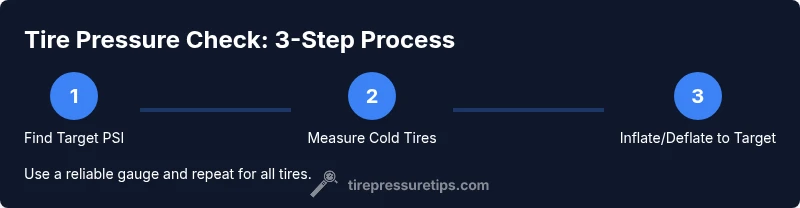
Find your recommended cold PSI
Locate the official cold tire pressure for your vehicle on the door jamb placard or in the owner’s manual. Record front and rear targets if they differ. This is your baseline before inflating.
Tip: Always start with a cold tire reading (before a drive of more than a mile). - 2
Measure tires when cold
Take readings after the vehicle has sat for at least three hours or after driving less than a mile. Remove the valve cap, press the gauge onto the valve stem, and read the pressure.
Tip: If you recently drove, wait several hours for the tires to cool to get an accurate measurement. - 3
Inflate or deflate to target
If the reading is below the target, add air until you reach the recommended PSI. If it’s above, slowly release air while watching the gauge until you hit the target.
Tip: Add air in small increments (1–2 PSI at a time) and recheck. - 4
Re-check all tires
Repeat the measurement for all four tires, and don’t forget the spare if you carry on a jack. Ensure each tire reaches its respective front/rear target. Tighten valve caps afterward.
Tip: Tires on one axle can be higher or lower than the other; follow the placard values precisely. - 5
Check after adjustments and reseating caps
Re-check pressures after 5–10 minutes to confirm stability. Replace valve caps securely to prevent slow leaks.
Tip: If any tire remains stubbornly off-target, inspect the valve stem for damage or consult a technician. - 6
Document and schedule regular checks
Keep a simple log of pressures and dates. Schedule monthly checks or more often in extreme temperatures or for heavy loads.
Tip: Use a consistent gauge and unit (PSI or kPa) to avoid confusion.
Frequently Asked Questions
What is the difference between cold and hot tire pressure?
Cold tire pressure is measured when tires are at ambient temperature, typically before driving. Hot pressure is higher after driving and can mislead you if you inflate to a hot reading. Always set using cold readings from the placard and gauge.
Cold tire pressure is when the tire hasn’t heated from driving. Don’t rely on hot readings; use cold readings for the correct target.
How often should I check my tire pressure?
Check at least once a month and before long trips. Temperature shifts and load changes can alter pressure, so regular checks help maintain safety and efficiency.
Check your tires monthly and before big trips to catch slow leaks and seasonal changes.
Can TPMS replace manual tire pressure checks?
TPMS provides alerts on abnormal pressure but doesn’t replace the need for a precise PSI reading. Use the placard and a gauge for exact targets.
TPMS alerts you of a problem, but you still need to measure with a gauge to hit the right PSI.
What happens if I overinflate my tires?
Overinflation reduces the contact patch and can lead to harsher ride and uneven wear. Stay within the recommended range and avoid inflating beyond the max on the sidewall.
Overinflation can make the ride stiff and wear the center tread faster.
How do temperature changes affect tire pressure in winter?
Cold temperatures lower tire pressure. Check and adjust more often in winter to maintain the correct PSI and safe handling.
Winter weather lowers PSI, so check more often when it’s cold.
Should I adjust pressure for highway driving or extra cargo?
Yes. Heavier loads or higher speeds typically require a slightly higher target within the manufacturer’s range. Check the placard and adjust accordingly.
Yes—loading and speed can shift the ideal PSI; verify targets and adjust.
Is it safe to use the spare tire pressure as a guide?
Spare tires often have different PSI specifications. Treat the spare as its own tire with its own target pressure and inflate accordingly.
Don’t assume the spare uses the same PSI as the other tires; check its label.
What if I can't find the recommended PSI?
If you can’t locate the placard, contact the vehicle manufacturer or consult the owner’s manual. As a fallback, Tire Pressure Tips suggests using a trusted tire shop or guide to verify the proper ranges.
If you can’t locate the pressure value, check the manual or consult a tire expert.
Watch Video
What to Remember
- Know your vehicle’s cold PSI from placard/manual.
- Check tires when cold for accuracy.
- Use a reliable gauge and adjust in small steps.
- Consider temperature and load when setting targets.
- Regularly log pressures and re-check after driving.