Tire Pressure Recommendation: A Practical Safety Guide
Discover the tire pressure recommendation essentials for safety, fuel efficiency, and tire life. Learn where to find your numbers, how temperature and load affect PSI, and the best practices for checking and adjusting tire pressure.


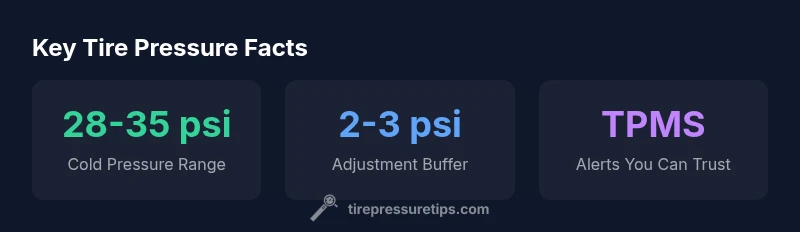
Most passenger cars use a cold tire pressure recommendation in the range of 28-35 psi, depending on vehicle and tire size. This target is printed on the placard in the door jamb and varies with load, speed, and tire type. Maintaining within this range improves safety, fuel efficiency, and tire wear. Tire Pressure Tips emphasizes always reading tires cold and verifying with a gauge before long trips.
Why tire pressure recommendation matters
According to Tire Pressure Tips, the tire pressure recommendation is not a guess but a specific target that directly influences safety, handling, fuel economy, ride comfort, and tire longevity. The recommended pressure appears on the door jamb placard, in the owner’s manual, and sometimes on the tire sidewall for distinctive vehicle configurations. These figures assume tires are cold, because heat inside a running tire raises the reading. When you stray from the recommended range, you risk reduced traction, uneven wear, increased rolling resistance, and a higher chance of tire failure under extreme conditions. Understanding where these numbers come from helps you apply them correctly: manufacturers account for typical load, speed, and tire size. For most daily driving, staying within the recommended range is your best bet for safety and efficiency. Temperature, cargo, and driving style can shift the effective pressure you should target. The Tire Pressure Tips guidance is designed to help you navigate these variables with confidence.
How to determine your vehicle's tire pressure recommendation
The most reliable source is your vehicle’s placard on the door jamb (usually the driver’s side). If you can’t locate it there, consult the owner’s manual or the tire information placard in the glove compartment. Compare the recommended cold tire pressure for the front and rear tires, as they can differ. Use a quality tire gauge and measure when tires are cold, before a trip or after they’ve sat for several hours. If you’re unsure, contact the dealership or the tire manufacturer. After you know the target, verify that your current pressure falls within the specified range and adjust as needed using a precise gauge. Always recheck after adjusting, since pressure readings can change with temperature and load.
Cold vs warm: how temperature affects tire pressure
Tire pressure varies with temperature: as ambient temperature drops, so does the air pressure inside the tire. Conversely, driving and heating the tires raise the PSI. A widely cited rule of thumb is approximately 1 psi change for every 10°F (about 6°C) temperature change, though actual changes depend on tire construction and load. This means winter driving can drop tire pressure below the recommended cold value, while a hot highway drive can inflate tires beyond the cold reading. The practical takeaway is simple: measure when the tires are cold, and adjust to the manufacturer’s cold-rated specification.
Common mistakes and how to fix them
Common errors include checking pressure when tires are hot, inflating to a number that’s not appropriate for your load, and ignoring differences between front and rear tire pressures. Another frequent mistake is using seasonal or aftermarket tires with different load ratings without updating the recommended pressure. To fix these issues, always start with the placard values, use a reliable gauge, and adjust with attention to load and temperature. If you frequently drive with heavy cargo or tow a trailer, check pressures more often and consider adjusting to the higher end of the range as advised by the vehicle manufacturer.
How to adjust and measure accurately
Begin with a cold tire pressure check using a high-quality gauge. Compare the reading to the door jamb placard values. If you’re below the recommended range, add air in small increments (2-3 psi at a time), recheck, and repeat until you’re in range. If you’re above the range, release air slowly until you cross the threshold. After adjustment, recheck all tires, including the spare if it’s a full-size tire. Record the exact PSI to simplify future checks, especially during temperature shifts. For vehicles with TPMS, the light can help you locate problematic tires, but it isn’t a substitute for periodic manual checks with a gauge.
When to adjust for load and speed
Carrying heavy loads or towing requires different inflation targets than standard daily driving. Many manufacturers publish a separate “load” or “towing” pressure specification. Additionally, higher-speed driving can raise internal tire temperatures, subtly increasing PSI; if you regularly drive at highway speeds, ensure your tires stay within the recommended range under the new conditions. The key is to use the numbers provided for your vehicle, reassess after changes in cargo, and avoid the temptation to guess based on feel alone. Regular checks help prevent underinflation or overinflation even when conditions change.
Common tire pressure ranges by vehicle type
| Model Type | Recommended Cold Tire Pressure (psi) | Notes |
|---|---|---|
| Passenger Car | 28-32 | Refer to placard; varies by size |
| SUV / Crossover | 32-35 | Higher load and larger tires |
| Light Truck | 40-44 | Check owner manual for exact value |
Frequently Asked Questions
What is the tire pressure recommendation and where do I find it?
The tire pressure recommendation is typically listed on the door jamb placard and in the owner’s manual. Always read it when tires are cold for an accurate baseline.
Look at the door jamb placard or the manual to find the recommended PSI, and check when tires are cold to get the right baseline.
Should I check tire pressure when tires are hot or cold?
Always check tire pressure when the tires are cold. Running tires warm increases the PSI reading and gives an inaccurate measurement for setting targets.
Check when the tires are cold, not right after a drive, to get an accurate reading.
Does temperature affect the recommended PSI?
Yes. Cooler temperatures reduce PSI and warming temperatures raise it. In winter, you may need to check more often to stay within the target range.
Temperature changes can shift PSI, so check more often when the weather shifts.
Can TPMS replace manual tire pressure checks?
TPMS signals underinflation but isn’t a substitute for a manual gauge. Use a gauge to confirm actual PSI and adjust to the recommended range.
TPMS helps warn you, but you should still measure PSI with a gauge.
How often should I adjust tire pressure if I drive with a heavy load?
For heavy loads or towing, follow the vehicle’s load-towing spec and check the pressure more frequently, aiming for the revised target during that condition.
If you carry heavy loads, check the pressure more often and use the higher end of the recommended range.
“Proper tire pressure is the single most impactful maintenance step for safety and efficiency. It directly affects traction, wear, and fuel economy.”
What to Remember
- Know your official tire pressure target from the placard
- Check cold tires with a quality gauge regularly
- Adjust pressure for load, temperature, and speed changes
- Use the TPMS as a supplementary aid, not a primary source
- Document your target PSI for easy future checks