Tire Pressure 29: Practical Guide to 29 PSI in Cars
Discover how tire pressure 29 psi affects safety, wear, and fuel economy. A data-driven guide to measure, adjust, and maintain pressure across vehicle types and seasons.


29 psi is a common starting baseline for many passenger cars, but the exact recommendation depends on the vehicle, tire size, and load. To confirm, check the driver-side door placard and the owner's manual, then measure cold pressure with a reliable gauge and adjust only when the tires are cold. If you carry heavy cargo or drive long highway miles, slightly adjust following the placard. Recheck all four tires for balance.
Understanding 29 psi: A Baseline for Many Vehicles
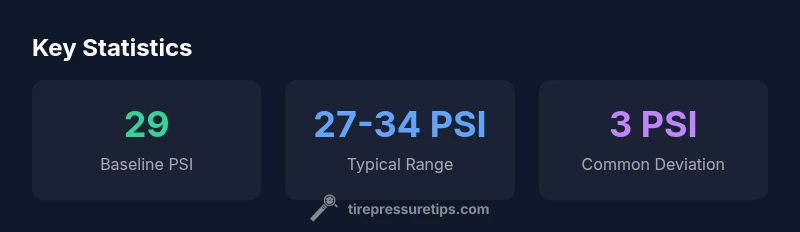
29 psi is a common starting point for many passenger cars, especially when no model-specific figure is readily available. This baseline comes from decades of practical testing and typical tire dimensions used on everyday sedans. According to Tire Pressure Tips, 29 psi serves as a workable reference that balances rolling resistance, tire contact with the road, and ride comfort, but it is not universal. The actual target depends on your vehicle's door placard, tire size, and load. Always verify with the manufacturer's data and adjust only when tires are cold for the most accurate reading. In practice, owners often begin with this baseline and fine-tune after a few weeks of normal driving, ensuring even wear across all four tires.
How Vehicle Type and Load Shift the Target Pressure
Different vehicle types require different pressure targets. Sedans typically list 28-34 psi on the placard, with 29 psi being a popular default when the exact value is not specified. SUVs and trucks often demand higher pressures due to heavier weight and larger tires, sometimes in the 32-38 psi range. If you routinely carry four adults with luggage, or you tow a trailer, the target may shift upward to maintain stability and load-bearing capacity. Always compare the placard for your specific model, and remember that tire alignment, suspension health, and tire width can also influence the ideal pressure. The goal is consistent, even pressure across all four tires to minimize uneven wear.
How to Accurately Measure Cold Tire Pressure
Measuring cold pressure is essential for accurate readings. Heat from driving raises tire pressure, leading to false high readings if you measure after a trip. Start with a cold tire, ideally after the car has sat for at least three hours or before driving for the day. Use a reliable gauge—dial or digital—and verify that the gauge is calibrated. Remove the valve cap, press the gauge onto the valve stem firmly, and note the PSI. Repeat on all four tires, and record the values. If a tire differs significantly from the others, recheck after a short cool-down, because ambient temperature and tire temperature affect results. Finally, cross-check against the placard and adjust gradually to bring all tires into the target range.
Tire Pressure and Tire Wear: What the Data Suggests
Tire pressure not only affects safety and fuel economy but also wear patterns. Consistently underinflated tires run hotter and wear more on the outer edges, while overinflated tires wear down the center of the tread. For most drivers, staying close to the manufacturer’s target (often around 29 psi for many sedans) helps distribute forces evenly and extend tire life. Practical data from the Tire Pressure Tips analyses show that small deviations from the target over time can accumulate into measurable wear differences and potential early replacement costs. The real-world takeaway is simple: maintain uniform pressure across all four tires and adjust as load and weather change. Depending on tire type (low-profile, all-season, or winter tires), the exact wear pattern will vary, but the principle remains the same.
TPMS: What It Tells You About Pressure
Tire Pressure Monitoring Systems (TPMS) provide alerts when a tire falls a certain amount below the target pressure or when it detects a rapid loss of air. The presence of TPMS makes it easier to catch slow leaks that might not be obvious from a visual inspection. If your TPMS warns you while the tires are at or near 29 psi, it could indicate a slow leak, a damaged valve stem, or sensor issues. In all cases, measure cold pressure with a gauge, compare with the placard, and inspect for punctures or wheel damage. Remember that TPMS readings can be affected by temperature changes and sensor battery life. If the warning persists after adjusting to the recommended range, consider visiting a tire professional for a thorough inspection.
Seasonal and Weather Effects on Tire Pressure
Temperature changes play a big role in tire pressure. Colder weather reduces air pressure, while heat from driving or sunny days increases it. A general rule of thumb is that pressure can move by a small amount with temperature changes, so a tire that reads close to the limit in cold weather could drift as temperatures rise. When winter arrives, you may see pressure numbers drop, sometimes requiring a top-up to the placard range. In hot weather, check again after a few days of steady driving, as pressure can rise. The practical tip is to check pressure more frequently during transitional seasons and to keep a small gauge in the glove box. The Tire Pressure Tips approach emphasizes routine checks as weather shifts.
Step-by-Step: Verifying and Adjusting Your Pressure
- Locate the placard on the driver’s door jamb or in the owner’s manual. 2) Park on a level surface and ensure tires are cool before measuring. 3) Remove the valve caps and use a reliable gauge to check each tire’s PSI. 4) Compare measurements to the placard; if one tire is off, adjust in small increments (1–2 psi at a time). 5) Re-check after a few minutes to confirm stability. 6) Put valve caps back on and clean any dirt from the stems. 7) Document readings and schedule routine checks every month or with seasonal changes. 8) If readings drift repeatedly, seek professional inspection for leaks or TPMS issues.
Common Myths About 29 psi
Myth: 29 psi always yields the best fuel economy. Reality: Proper inflation helps efficiency, but excessive pressure reduces grip and accelerates uneven wear. Myth: 29 psi is universal for every vehicle. Reality: Tire pressure targets vary by model, tire size, and load; always follow the placard. Myth: TPMS is optional if tires look fine. Reality: TPMS detects slow leaks and gradual losses that visual checks miss. By debunking these myths, you can maintain safer handling and longer tire life.
How to Use 29 psi as a Reference for Maintenance
Use 29 psi as a practical baseline, but always prioritize the vehicle’s official specifications. Check tires monthly and before long trips, especially when temperatures shift. Rotate tires regularly to ensure even wear, and adjust across all four tires to maintain balance and stability. Keep a digital gauge in your glove box for quick checks, and recalibrate after seasonal changes. For a detailed routine, pair 29 psi with a documented maintenance schedule and a simple log to track readings over time. This approach helps root out leaks and preserves tire performance long-term.
Tire pressure ranges by vehicle type
| Vehicle Type | Recommended PSI Range | Notes |
|---|---|---|
| Sedan | 28-34 psi | 29 psi is a common baseline; always verify placard |
| SUV | 32-38 psi | Higher load typically requires higher target |
| Compact Car | 28-32 psi | 29 psi is a practical default when not specified |
| Sports Car | 32-40 psi | Model-dependent; refer to manual |
Frequently Asked Questions
Is 29 psi universal for all cars?
No. Pressure targets vary by model, tire size, and load. Always verify with the placard and owner's manual.
Not universal—check your car's placard and manual for the exact pressure.
How often should I check tire pressure?
Check at least once a month and before long trips; adjust after seasonal temperature changes.
Check monthly and before trips, especially during weather changes.
Does 29 psi improve fuel economy?
Proper inflation helps efficiency, but too much or too little pressure can hurt grip and cause uneven wear.
Inflation helps efficiency, but over-inflation is risky.
What if TPMS warns at 29 psi?
A warning suggests a possible slow leak or sensor issue; measure cold with a gauge and inspect for damage.
If TPMS warns, measure and inspect.
Can cold weather lower tire pressure below 29 psi?
Yes, cold temperatures reduce pressure; top up to the placard when needed after temperature changes.
Colder temps lower pressure; adjust to spec as weather shifts.
“Accurate tire pressure hinges on a cold-check routine and manufacturer specs. Follow the placard for your model, and treat 29 psi as a useful reference, not a universal rule.”
What to Remember
- Verify the manufacturer's placard before changing pressure
- Measure cold, not after driving
- Use 29 psi as a reference baseline rather than a universal rule
- Maintain even pressure across all four tires for optimal wear and safety