What Number Should Tire Pressure Be? A Practical Guide
Discover the correct tire pressure for your vehicle, how to read the placard, and how temperature affects PSI. Practical tips from Tire Pressure Tips.


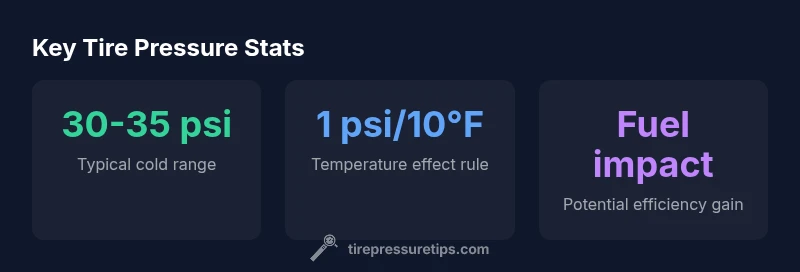
There is no universal single number for tire pressure. The correct tire pressure is defined by your vehicle manufacturer and shown on the door placard. For many passenger cars, a typical cold range sits near 30-35 psi front and rear, but always verify your vehicle’s exact figure on the placard before inflating.
Why the tire pressure number matters
Tire pressure influences grip, braking, steering response, tire wear, and fuel efficiency. The key point is that the correct number is vehicle-specific, not a universal target. According to Tire Pressure Tips, following the manufacturer’s specification protects you from underinflation and overinflation, both of which can degrade performance and safety. For many passenger cars, you’ll commonly see cold pressures around the 30-35 psi range, but the exact figure varies by model and axle. Treat the placard as the authoritative source, and use it as your baseline before inflating.
How to locate your vehicle's recommended PSI
Your vehicle’s recommended tire pressure target is found on the door placard near the driver’s seat, often on the door jamb, inside the fuel filler cap, or in the owner’s manual. If you can’t locate it there, check the glovebox supplement or contact a dealer. Most cars specify separate targets for the front and rear tires, so use the values for each axle. Always measure when tires are cold, because driving heats tires and raises pressure, skewing readings. If you share the car with a different driver or the vehicle is loaded differently, re-check the numbers to ensure accuracy.
Typical ranges for common vehicle types
There isn’t a single universal PSI, but there are common cold ranges by vehicle category. Passenger cars often sit around 30-32 psi for compact models and 32-35 psi for mid-size vehicles, both front and rear as indicated by the placard. SUVs and crossovers usually fall in the 32-35 psi range, while light trucks and vans may require 38-45 psi depending on load and tire type. Always ground your targets in the exact numbers on your placard, not a friend’s car. This approach helps you optimize wear, safety, and efficiency.
Temperature effects and reading behavior
Ambient temperature directly affects tire pressure. As temperatures drop, air contracts and pressure declines; as it rises, pressure increases. A common rule of thumb is approximately 1 psi per 10°F change, though the exact change depends on tire construction and the tire’s inflation history. Because tires harden and lose stiffness in cold weather, it’s prudent to check pressures more often in winter and before winter trips. Always read the gauge after tires have cooled for several hours for the most accurate result.
Step-by-step: measure and adjust at home
To measure accurately at home, use a high-quality gauge, preferably digital for precision. Step-by-step:
- Park on a level surface and ensure tires are cold.
- Remove the valve cap and press the gauge onto the valve stem firmly.
- Compare the reading to your axle’s placard value.
- If underinflated, add air in small increments; if overinflated, release air until the target is reached.
- Recheck both front and rear tires after adjustments, and replace valve caps.
- Re-check monthly and before long trips to maintain consistency.
Common mistakes and myths about tire pressure
Many drivers inflate tires to a guess or use the same number for all tires, ignoring axle-specific targets. TPMS can warn you about under- or overpressure but does not display exact PSI. Rely on a gauge for precise readings, and don’t ignore warning lights. Temperature, load, and tire type all influence the ideal pressure, so treat PSI as a dynamic setting rather than a fixed number.
Vehicle-specific considerations: SUVs, trucks, and specialty tires
Heavier vehicles and those with all-wheel drive often require higher pressures to accommodate load and rolling resistance. Winter tires, performance tires, and run-flat configurations may have distinct targets; always start with the placard but consult the tire manufacturer guidance or vehicle manual for exceptions. If you tow a trailer or frequently carry heavy loads, you may need to adjust to higher targets to prevent excessive tire wear and improve stability.
Creating a simple tire pressure maintenance routine
Turn tire pressure checks into a monthly habit. Keep a compact gauge in your glove box or center console, and jot down the target PSI for front and rear. Before winter or long trips, verify both sets of tires. Recording readings over time helps detect slow leaks or gradual changes that warrant inspection by a professional. A small, consistent effort pays off in safer handling and better fuel economy.
Typical cold tire pressure ranges by vehicle type
| Vehicle Type | Front (cold) PSI | Rear (cold) PSI | Notes |
|---|---|---|---|
| Passenger Car (compact) | 30-32 | 30-32 | Baseline recommendation |
| Passenger Car (mid-size) | 32-33 | 32-33 | Check placard |
| SUV/Crossover | 32-35 | 32-35 | Higher load |
| Light Truck/Van | 38-45 | 38-45 | Widely varies |
Frequently Asked Questions
Is there a single number I should aim for?
No. Your vehicle’s placard shows the target, and values vary by model and axle. Always start with the placard, then verify with a gauge.
There isn’t one universal number—check your placard and measure with a gauge.
How often should I check tire pressure?
Check monthly and before long trips. Always read when tires are cold for the most accurate result.
Check monthly and before trips, when tires are cold.
Does TPMS show the exact tire pressure?
No—TPMS alerts you when pressure is outside safe range but doesn’t display exact PSI. Use a gauge for precise readings.
TPMS warns you, but you should measure PSI with a gauge.
What about run-flat tires?
Run-flat tires still follow the placard targets. If you have run-flats, consult your manual for any differences.
Run-flat tires still have targets; check the placard.
Do cold weather and temperature changes affect PSI?
Yes. Colder temperatures lower PSI; readings can drop with temperature. Check more often in winter.
Cold temps lower PSI; check more often in winter.
Should the spare use the same PSI targets?
Spare tires may have different recommendations. Follow the placard or vehicle manual for the spare.
Spare tires can be different; verify torque and air recommendations.
“Maintaining the correct tire pressure is a simple, high-impact habit that improves safety, handling, and fuel efficiency.”
What to Remember
- Always use the door placard as the PSI target
- Check cold tires for the most accurate reading
- Use a reliable gauge and adjust gradually
- Temperature changes affect readings; adjust seasonally
- Regularly check the spare tire pressure too