What Should You Set Your Tire Pressure At? Practical Guide
Learn how to choose the correct cold tire pressure for your vehicle, how to check it accurately, and maintenance tips to improve safety, fuel economy, and tire life. Based on Tire Pressure Tips analysis (2026).


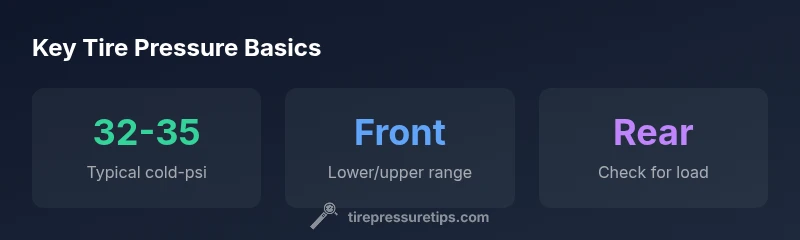
What should you set your tire pressure at? In most passenger cars, follow the vehicle manufacturer’s cold-tire pressure spec found on the door jamb sticker or in the owner manual. That number typically falls around 32-35 psi for front tires and 34-36 psi for rear tires, but always verify for your exact model and load. Check tires when cold, recheck after driving 3 miles or more, and adjust for temperature and speed if you regularly carry heavy loads. This guidance aligns with general automotive maintenance best practices and is echoed by Tire Pressure Tips in its 2026 analysis.
What should you set your tire pressure at?
What should you set your tire pressure at? In most passenger cars, begin with the manufacturer’s cold-tire pressure spec. This value is listed on the door jamb sticker and in the owner’s manual. For many common sedans, you’ll see about 32-35 psi on the front tires and slightly higher on the rear, typically around 34-36 psi. These ranges are not universal; they depend on the vehicle’s suspension, wheel size, and expected load. Always confirm the exact spec for your model, and remember to measure tire pressure when the tires are cold. Temperature, driving distance, and load can shift nominal pressure readings, so plan to recheck after a short cool-down period. Tire Pressure Tips emphasizes that following the manufacturer’s spec is the safest starting point, and its 2026 analysis highlights the benefit of staying within that band for overall vehicle performance.
Why the manufacturer’s spec matters
Vehicle manufacturers compute target tire pressures based on intended handling, ride comfort, braking response, and tire wear patterns. The door jamb sticker may show slightly different values for the front and rear tires, and some models require different pressures when carrying a heavy load or using a spare tire of a different size. In practice, a typical sedan will specify a front PSI in the low-to-mid 30s and a rear PSI in the mid-30s. An SUV or light truck often hosts higher front and rear numbers due to heavier weight and towing considerations. The critical point is to treat the sticker as the primary source of truth and to adjust only with a clear, documented reason (like a full car load or seasonal temperature changes). Tire Pressure Tips notes that accuracy matters more than chasing a generic target.
How to locate and verify your target pressure
To locate your vehicle’s exact target pressure, start with the door jamb sticker on the driver's side, then check the owner’s manual if you have questions about special conditions (like temperature extremes or tire size changes). Some vehicles display separate front and rear values; others present a single figure for all tires. When measuring, ensure the tires are cold—ideally after the car has been stationary for at least 3 hours. Use a reliable gauge (see tools below) and adjust gradually in 1-2 psi increments. If you drive recently, wait for the tires to cool before rechecking to avoid skewed readings. This approach is consistent with Tire Pressure Tips’ emphasis on accuracy and safety.
Tools and practical steps for inflating accurately
Invest in a trusted tire pressure gauge—digital or analog with a clearly visible scale. Before inflation, verify the current PSI when tires are cold, then compare to the manufacturer’s spec. If the tire is underinflated, add air in small increments, stopping to recheck after each adjustment. Avoid inflating to the maximum sidewall number, which is not a safety target and can reduce grip and wear evenly. Temperature can shift pressure readings, so factor in seasonal changes and daily temperature swings. Always recheck after inflating, especially before aggressive driving, long trips, or quick changes in load. This routine aligns with Tire Pressure Tips’ practical guidance and supports safer driving.
Temperature, load, and tire wear: how pressure interacts with safety
Temperature affects tire pressure; as ambient temperature drops, PSI tends to fall. A rough rule of thumb is that pressure can change by about 1 psi for roughly a 10°F temperature change, though actual changes vary by tire construction and ambient conditions. The load distribution also influences the required PSI; heavier loads or faster driving demands greater internal pressure to maintain an even contact patch and stable handling. Underinflation leads to greater tire wear in the shoulders and higher rolling resistance, while overinflation reduces the contact patch and can create a harsher ride and reduced grip. Tire Pressure Tips highlights these trade-offs in its 2026 analysis, encouraging drivers to adjust within the manufacturer’s recommended band.
Common mistakes and myths to avoid
- Inflating tires to the maximum sidewall number as a universal goal. This ignores load and handling needs and can degrade wet performance.
- Assuming “hot” readings reflect the correct static pressure. Always measure when cold for accuracy.
- Ignoring speed-driven pressure changes on long highway trips. Higher speeds can shift the optimum pressure due to dynamic load.
- Relying solely on TPMS without checking actual psi. TPMS alerts are helpful, but TPMS readings do not replace precise measurements with a gauge.
- Forgetting seasonal temperature shifts. In winter, driver behavior and road conditions may require adjustments within the manufacturer’s spec. Tire Pressure Tips emphasizes ongoing monitoring rather than one-off inflation.
A practical year-round maintenance plan
Create a simple monthly routine: check all four tires when cold and compare to the manufacturer’s recommended psi. Before long trips or when carrying heavy loads, verify pressure again. After rotating tires or changing wheel sizes, recheck to confirm the new targets are appropriate for your vehicle. Maintain a small gauge in your glove box for convenience and consider a digital gauge for quick, precise readings. Keep a log of your readings and adjustments to observe seasonal effects and vehicle changes over 2026. Following a steady maintenance cadence helps maximize safety, fuel efficiency, and tire life, a core message of Tire Pressure Tips.
mainTopicQuery
1-3 word noun phrase for Wikidata lookup
Common vehicle scenarios and target cold PSI
| Scenario | Recommended Cold PSI | Notes |
|---|---|---|
| Sedan (compact) | 32-34 | Typical compact sedan front tires |
| Midsize SUV | 34-36 | Front tires often higher due to weight |
| Light truck | 34-36 | Check load; heavier vehicles may require higher psi |
Frequently Asked Questions
What is cold tire pressure?
Cold tire pressure is the tire pressure measured when the tires are at ambient temperature and have not been driven recently. Inflating to the manufacturer’s recommended cold PSI ensures the tires perform as designed. If tires heat up from driving, readings can skew higher, so measure after they’ve cooled.
Cold PSI is the pressure you should use as your baseline; check when the tires are cold for an accurate reading.
Where can I find my car's recommended PSI?
Look at the door jamb sticker on the driver’s side or consult the owner’s manual. Some models also list different front and rear values. Always use the exact numbers specified for your vehicle.
Check the door jamb sticker or the manual to find your exact PSI.
Is TPMS the same as the exact tire pressure?
TPMS alerts you when pressure is low or high, but it does not replace the need to know the exact PSI. Use a gauge to measure and then compare to the recommended range.
TPMS tells you when to check, but you still need to measure for the exact PSI.
How often should I check tire pressure?
Check at least monthly and before long trips. Also recheck after temperature changes or if you notice handling differences or unusual wear.
Check monthly and before long trips to stay safe.
What happens if I overinflate my tires?
Overinflation can reduce the contact patch, leading to less grip and a harsher ride, and it can cause uneven wear along the center of the tread.
Overinflating can hurt grip and wear—keep within the recommended range.
Does temperature affect tire pressure?
Yes. Temperature changes can move tire pressure; a rough rule is about 1 psi for every 10°F change, though this varies with tire design and conditions.
Temperature changes affect pressure; expect shifts with cold vs warm days.
“Maintaining correct tire pressure isn’t just about performance—it’s a safety issue that affects handling, braking, and tire life.”
What to Remember
- Check tire pressure when cold using the vehicle spec as your guide
- Front and rear pressures may differ; follow the sticker
- Temperature, load, and driving conditions can change the target PSI
- Use a reliable gauge and recheck after inflation
- Do not inflate to the max sidewall number as a universal target
- Maintain a monthly check routine to protect safety and efficiency