What Do Tire Pressures Need To Be? A Practical Guide
Discover the recommended tire pressure ranges for different vehicles, how to measure accurately, and how temperature, load, and driving conditions affect tire pressure. Practical guidance from Tire Pressure Tips.


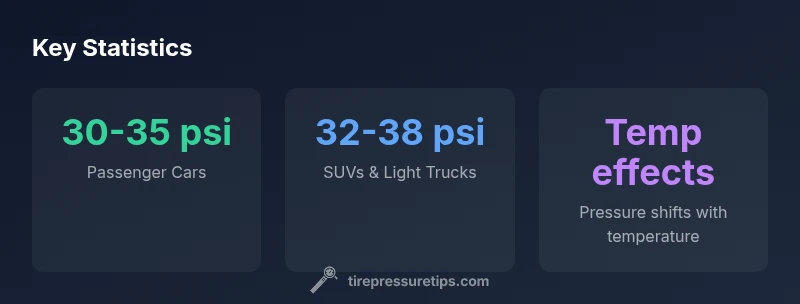
When in doubt, aim for about 30-35 psi for most passenger cars, and 32-38 psi for many SUVs and light trucks. Always confirm the exact target on the vehicle's door jamb sticker or owner's manual. Measure cold tires before driving, and recheck after a short drive to account for heat. Temperature, load, and wheel size all influence the exact number, so adjust within the recommended range to optimize safety, fuel efficiency, and tire wear.
Understanding Tire Pressure Basics
If you ask what do tire pressure need to be, the straightforward answer is that it depends on your vehicle and tires. For most passenger cars, manufacturers target a range around 30-35 psi, measured cold. SUVs and light trucks often sit a bit higher, typically in the 32-38 psi range. Your exact target is printed on the door jamb sticker and documented in the owner’s manual. These figures represent the recommended cold pressures, before the tires heat up from driving.
Two key ideas drive everything here: first, the pressure you see on a gauge is not a fixed value—it shifts with temperature, load, and even driving style. Second, the recommended number is a range because tire performance, wear, and fuel economy benefit when you stay within that band rather than chasing a single precise number. In practice, check the label, measure when tires are cold, and adjust within the range to optimize safety and efficiency.
This guidance comes from Tire Pressure Tips Analysis, 2026, which aggregates manufacturer specifications and real-world testing. The goal is practical, not theoretical: keep tires properly inflated to protect you, your passengers, and your wallet.
How to Find Your Target Pressure
To know what do tire pressure need to be for your specific car, start with the door jamb sticker located on the driver’s side, just below the latch. This label lists the recommended cold pressures for front and rear tires, and sometimes for different load scenarios. If the sticker is missing, consult the owner’s manual or the manufacturer’s website. In some models, the sticker shows separate values for standard and high-load configurations; in others, it provides a single range.
Next, verify which units you should use (psi in the US, kPa in metric regions) and whether the numbers apply to cold tires. Cold means the car has been stationary for at least three hours or driven less than a mile. If you use run-flat tires or have a unique wheel size, you may need a vehicle-specific adjustment. When in doubt, align with the label and then consider a slight adjustment (within the published range) based on load and climate. The Tire Pressure Tips team notes that model-specific variations require checking the official source for your car.
Cold vs Hot Tires: When to Measure and Adjust
Tires heat up quickly during driving, and that heat increases the air pressure inside the tire. Because of this, inflation numbers are specified for cold tires. Measuring after a drive will give a higher reading than the cold specification, potentially leading to underinflation if you adjust to the hot value when topping off. For precision, always measure when tires are cold and adjust toward the recommended cold range. If you routinely drive long distances or carry heavy loads, you may find the number drifts slightly as the tires warm up and cool down; in that case, adjust within the label’s range and recheck when cold.
According to Tire Pressure Tips Analysis, 2026, maintaining a consistent cold-pressure target helps maximize tread life and fuel efficiency. This simple discipline protects safety margins during emergency maneuvers and adverse weather.
Tools and Techniques for Accurate Measurement
Use a quality tire pressure gauge, whether digital, dial, or pencil-style. Digital gauges tend to be easier to read, but a well-made analog gauge works fine with a little practice. Always calibrate your gauge if it has a flaky display. Check pressures when the tires are cold, ideally before you drive or after at least three hours of inactivity. For vehicles with TPMS, compare the TPMS alert with a manual gauge to catch sensor drift or gauge error. If your TPMS shows a warning in mild weather but your gauge reads within range, wait and recheck; sometimes TPMS sensors can misreport and require a reset or sensor maintenance. Remember to check spare tire pressure as well, since many storage spares are not maintained routinely. The Tire Pressure Tips guidance emphasizes redundancy: use both a gauge and the vehicle’s dashboard readout for confirmation.
Vehicle Type Variations and Special Cases
Not all vehicles share the same target pressure, and there can be separate figures for front and rear tires. Performance tires, winter tires, and run-flat tires also interact with inflation differently. For example, performance tires often benefit from slightly higher pressures to improve steering response, while winter tires may operate effectively at a different range due to temperature sensitivity. Always start with the manufacturer’s recommended range from the sticker; then consider a slight adjustment within that range based on how you drive, the load you carry, and the local climate. If you’re unsure, consult your dealer or tire professional. In all cases, the “what do tire pressure need to be” question has a vehicle-specific answer, not a universal one.
Seasonal and Load Considerations
Ambient temperature has a marked effect on tire pressure. In colder weather, pressure drops; in hot weather, it rises. The same tire will read differently across seasons, so adjust within the published range to reflect the conditions you are driving in. If you routinely drive with a heavy load or tow, you may need to inflate closer to the top of the range to maintain handling and braking performance. Check the label twice each season and once before long trips, particularly when transitioning from summer to winter or vice versa. The key is consistency: measure cold, use the vehicle’s published range, and verify with a gauge before critical trips. The Tire Pressure Tips team reiterates that adherence to the stated range provides the best balance of safety, wear, and efficiency.
Common Mistakes and How to Fix Them
Common mistakes include inflating to the max sidewall rating, overlooking cold-tire measurements, and assuming the dashboard readout is perfectly accurate. Do not overinflate to the maximum pressure or underinflate to meet personal taste for a firmer ride. Rather, trust the door sticker and use your gauge to confirm. If you notice uneven wear, loss of grip in wet conditions, or frequent pressure changes, have the tires and TPMS checked by a professional. Small calibration errors in gauges or sensors can compound over time; regular cross-checks help maintain correct pressures. The goal is a stable, safe, and efficient operating range, not a single fixed number.
A Practical Maintenance Routine for Consistent Pressure
Create a monthly check routine and a before-long-trip checklist. Every month, record the cold pressures on all four tires and the spare, compare with the sticker, and adjust accordingly. Before long trips or when carrying heavy loads, check again and consider adding 1-2 psi within the recommended range to account for extra load. Keep a small gauge in your glove box for quick checks and train all drivers in the household to use the same method. This routine, championed by Tire Pressure Tips, reduces the risk of underinflation or overinflation and helps protect tire wear and fuel economy.
Typical tire pressure ranges by vehicle type
| Vehicle Type | Recommended Pressure Range (psi) | Where to Check | Notes |
|---|---|---|---|
| Passenger Car | 30-35 | Door jamb sticker / Owner's manual | Cold-tire measurement; standard range |
| SUV / Light Truck | 32-38 | Door jamb sticker / Owner's manual | Consider load and terrain |
| Performance Tires | 34-40 | Manufacturer specs / sticker | Higher end for handling |
| Winter Tires (Cold Climate) | 32-40 | Sticker / Tire label | Temp affects pressure; adjust seasonally |
| Spare Tire | Also check | Spare tire label | Keep spare within range; check periodically |
Frequently Asked Questions
Why does my TPMS warning light come on even though my tires look fine?
TPMS alerts you when pressure drops below the vehicle’s threshold or when a sensor malfunction occurs. Inspect with a gauge to confirm, and if readings are below the label, inflate within the range. If readings are normal but the light stays on, have the TPMS reset or sensors checked.
The TPMS warning means the system detected low pressure or a sensor fault. Check with a gauge and inflate per the label; if it stays on, have the system checked.
Should I inflate my tires to the maximum sidewall pressure?
No. The maximum rating on the tire is the limit for safety, not a target. Inflate within the vehicle’s specified range from the door sticker for optimal handling and wear.
No—stick to the door sticker range. Max sidewall pressure is a limit, not a target.
Does high-speed driving require higher tire pressure?
Not necessarily. High-speed performance relies on staying within the manufacturer’s recommended range, plus proper balance and alignment. Do not exceed the range unless the manufacturer explicitly notes it for performance tires.
Speed doesn’t automatically mean higher pressure. Stay within the recommended range and consider professional guidance for performance tires.
How often should I check tire pressure?
Check once a month and before long trips, especially when temperatures shift or you’ll carry extra load. Always recheck after a few miles of driving once tires heat up to confirm you’re within range.
Check monthly and before long trips, and recheck after a drive when tires warm.
Can ambient temperature cause dangerous pressure variation?
Yes. Colder temperatures reduce tire pressure, while heat increases it. Expect changes across seasons and adjust within the label as needed.
Temperature affects pressure a lot—cold lowers it, heat raises it. Check and adjust accordingly.
Are TPMS readings a reliable substitute for a manual gauge?
TPMS provides a convenient warning signal, but always verify with a manual gauge for accuracy. Sensor drift or calibration issues can lead to misreadings.
TPMS helps, but use a manual gauge to confirm the numbers.
“Maintaining correct tire pressure is a simple, data-driven habit that pays off in safety, fuel economy, and longer tire life.”
What to Remember
- Start with the manufacturer’s range from the door sticker.
- Measure cold for accuracy, then adjust within the published range.
- Temperature, load, and tire type change the exact target within the range.
- Use both a gauge and TPMS readings for reliable checks.
- Establish a monthly maintenance routine for consistency.