Vios Tire Pressure: Check, Maintain, and Optimize
A practical, step-by-step guide to checking and maintaining tire pressure for the Vios, understanding TPMS basics, and avoiding common mistakes with practical tasks from Tire Pressure Tips.


By following this guide, you will accurately check and adjust the tires on your Vios to the manufacturer’s specification, improve safety, fuel economy, and tire life. You’ll learn how to locate the correct PSI, the right tools, and a step-by-step process that accounts for TPMS. Ensure tires are cold and use a reliable gauge for precise readings.
Why Vios Tire Pressure Matters
Maintaining the correct tire pressure on your Toyota Vios is not just about numbers on a sticker. Proper inflation influences safety, fuel economy, vehicle handling, and even tire wear. When tires are underinflated, they flex more at the sidewalls, generating heat and leading to uneven wear and reduced cornering stability. Overinflation reduces the contact patch with the road, diminishing grip and ride comfort. In both cases, you’re more likely to experience tire failure or a blowout, especially at highway speed or during sudden maneuvers.
According to Tire Pressure Tips, keeping tires inflated to the manufacturer’s recommended PSI can reduce rolling resistance and mechanical stress on tires, delivering steadier steering and more uniform wear over time. For Vios owners, this means paying attention to the sticker on the door jamb and the owner’s manual, as pressure targets can vary with load, trim level, and even climate. The goal is not a single fixed number for every situation but a range that protects safety and performance in typical daily use. Regular checks are essential because tire pressure changes with temperature, miles driven, and road conditions.
And remember: TPMS alerts are not a substitute for manual checks. The tires can be within the TPMS warning range yet still be underinflated due to gradual loss or a slow leak. A quick, monthly check helps catch leaks early and keeps your tires in their optimal operating zone.
Understanding Vios Tire Pressure Specs
Tire pressure for the Vios is expressed as PSI (pounds per square inch) or kPa, depending on your region and gauge. The key concept is that the right pressure is not a fixed number for every driver; it depends on load, driving style, and road conditions. The door jamb sticker on your Vios lists the recommended front and rear tire pressures for standard operation, while the owner’s manual may note different targets for high-load scenarios, cold weather, or frequent highway driving. Always start with the manufacturer’s values and adjust for your typical usage. If you carry a roof box, passengers, or heavy cargo, you may need to adjust within the recommended range. Use this guide to develop a repeatable routine: check cold tires, verify targets, and recheck after any adjustment for accuracy.
Where to Find the Recommended PSI for Your Vios
Your Vios tire pressure targets are most reliably found in two places: the door jamb sticker and the owner’s manual. The door sticker gives you the standard front and rear tire pressures for normal passenger use, while the manual may outline variations for different trims, wheel sizes, or load conditions. If you recently replaced wheels or tires, verify whether the new setup requires a different target within the same general range. Use a reliable gauge to read the numbers and keep a small notebook or digital log of your readings to notice slow leaks over time.
When you map out your routine, start with the cold-tire measurement and compare it to the sticker values. If the numbers don’t align with what you observe on your vehicle’s performance—like increased vibration, uneven wear, or reduced fuel efficiency—recheck and consider a professional inspection. The goal is consistent front and rear pressures within the recommended range to ensure balanced handling and fuel economy.
The Role of TPMS in Tire Pressure Management
Tire Pressure Monitoring System (TPMS) provides a real-time alert when a tire falls below a safe threshold. However, TPMS does not replace manual checks. A tire can be within the TPMS warning range yet still be underinflated, especially if a slow leak is developing or you recently adjusted pressures. Regular physical verification helps you catch slow leaks, damaged valves, or a sagging spare tire.
For Vios owners, TPMs are particularly helpful for catching underinflation on cold mornings before city driving or highway trips. If TPMS alerts occur frequently, inspect each tire, check for punctures, and confirm all valve stems and caps are secure. If you’ve replaced an OEM sensor or seen a TPMS fault indicator, understand that sensor power and calibration impact readings. In some cases, a simple reset or recalibration by a qualified technician is all that’s needed.
How Temperature Affects Tire Pressure and What to Do
Temperature is a major driver of tire pressure. Colder weather causes PSI to drop, while hot days can push pressures higher as tires heat up during driving. The same tire can read differently across seasons, which is why many drivers check pressure more frequently in winter and before long trips in any season. A practical rule is to check pressures when tires are cold and outside temperatures have stabilized for the day. If you notice a sudden change after a trip, re-check after the tires have cooled and adjust if needed to the target range. This proactive habit helps protect tire wear and grip, especially on wet or icy roads.
Common Scenarios and Solutions
Over time, drivers encounter common situations: wheels replaced with different sizes, seasonal cargo shifts, or a spare tire that isn’t regularly checked. When you switch tire types or adjust the vehicle load, revisit the recommended PSI and re-check all four tires and the spare. If you notice frequent underinflation on one tire, inspect for leaks, damaged valves, or a bent rim. Defective TPMS sensors can also misreport pressures, leading you to inflate incorrectly if you rely solely on the gauge reading. Practically, keep a simple checklist: door-jamb PSI, gauge reading, air pressure adjustment, and a final cross-check on all tires. A minor, systematic approach reduces risk and ensures consistent handling.
Maintenance Routine: Check Schedule and Records
Create a simple maintenance routine to track tire pressure checks. A monthly target works for most drivers, with a pre‑trip check before longer drives or when carrying heavy loads. Maintain a log noting the date, all four tire readings, ambient temperature, and any adjustments you made. Over several months, you’ll notice trends such as progressive leaks or sensor quirks, which helps you decide when to schedule service. If you keep good records, your Vios stays safer, more fuel-efficient, and the TPMS system remains accurate. This routine also supports your overall tire health by catching problems early.
Real-World Examples and Checklists
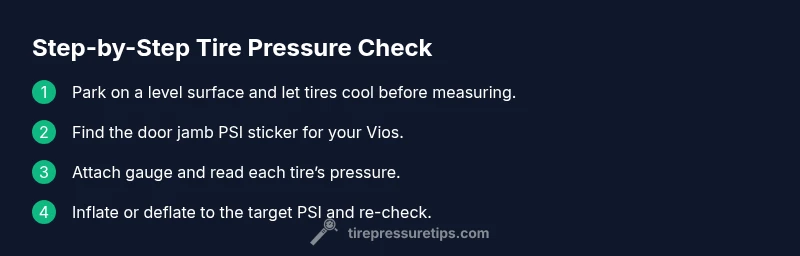
To put theory into practice, create a simple on‑board checklist and adapt it to your driving environment. Example checklist: park on a level surface, ensure the tires are cold, read each tire with a single gauge, compare to the sticker, adjust, and re-check. If you’re unsure about a reading, perform a secondary check with a different gauge. In cold weather, check more frequently; in warm weather, verify after long drives. Keeping a small notebook or digital log makes it easy to spot patterns and stay within the safe pressure range for your Vios. A disciplined approach minimizes tire wear and improves safety on every trip.
Tools & Materials
- Tire pressure gauge (digital or analog)(Ensure it can read up to at least 60 psi; calibrate if necessary.)
- Portable air compressor or access to air pump(Prefer a unit with a built-in gauge; be prepared to refill if over-inflated.)
- Owner's manual and door jamb PSI sticker(Use model-specific figures; check for load and speed variants.)
- Clean cloth or rag(For wiping the valve stem and stem cap.)
- Soapy water for leaks(Only if you suspect a slow leak.)
Steps
Estimated time: 15-25 minutes
- 1
Park on a level surface and let tires cool
Shut off the engine, engage the parking brake, and wait for the tires to cool if you’ve been driving. Measuring when tires are cold minimizes readings distorted by heat. If you’ve just driven, wait at least 15-20 minutes for a meaningful read. A cold-start check is essential for accuracy and repeatability.
Tip: Use a dedicated space away from direct sunlight to avoid heat buildup. - 2
Find the recommended PSI for your Vios
Locate the door jamb sticker on the driver’s door or door frame and consult the owner’s manual for any trim-specific variations. Front and rear tires may have different targets. Record these targets to guide your adjustments during this session.
Tip: Note whether the sticker shows separate values for single and multiple occupants or cargo. - 3
Remove the valve stem cap and inspect
Unscrew the valve cap and inspect for dirt, corrosion, or damage. A clean valve stem ensures a reliable seal with your gauge. Keep the cap safe so you can reinstall it immediately after measurement.
Tip: If the stem is damaged, avoid inflating; instead, replace the stem or consult a professional. - 4
Attach gauge and read current PSI
Place the gauge on the valve stem firmly and read the pressure. If you use a digital gauge, wait for the number to stabilize. If you use a analog gauge, note the last stable reading. Record all four tires for your log.
Tip: If readings vary between tires, check each valve for leaks or caps that aren’t sealing properly. - 5
Inflate or deflate to the recommended PSI
Add air to underinflated tires or release air from overinflated tires to reach the target PSI. Re-check after adjustments to confirm accuracy. If your gauge reads quickly rising and falling, stop and re-measure with a different gauge to verify.
Tip: Avoid inflating beyond the recommended range; overinflation can reduce grip and cause a harsher ride. - 6
Repeat for all tires and recheck TPMS
Measure all four wheels and the spare if applicable. If the TPMS light remains on after adjustments, inspect for leaks or sensor issues and consider a professional check. Consistency across all tires is key for balanced handling.
Tip: Document the final readings in your vehicle log for future reference.
Frequently Asked Questions
Why is my Vios TPMS light on even when tires look fine?
TPMS alerts can trigger before you notice underinflation or if a sensor is faulty. Readings can be affected by sensor calibration or leakage. Verify with a manual pressure check and inspect valve stems and caps for damage before seeking service.
TPMS can alert for slow leaks or sensor issues even if tires look fine; do a manual reading to confirm, then inspect the stems and sensors.
How often should I check tire pressure on a Vios?
Check at least once a month and before long trips, and whenever you notice a TPMS alert or a change in drive feel. Regular checks help catch slow leaks early and maintain consistent handling.
Check at least monthly and before long trips, especially if you’ve noticed changes in handling or TPMS alerts.
Can I check tire pressure with a car tire gauge at home?
Yes. A reliable gauge you can use at home makes regular checks quick and easy. Ensure you read the numbers accurately and re-check with a second gauge if you doubt the result.
Yes—use a good tire gauge at home and double-check readings if you’re unsure.
Is it safe to drive if TPMS is on and I can’t inflate now?
If TPMS is on, proceed with caution to a safe location or service center. Try to reach the recommended PSI soon; driving with underinflated tires can increase risk of blowouts and poor handling.
Drive cautiously to a safe spot or service center and adjust pressure as soon as possible.
Should I inflate to the max PSI listed on the sidewall?
No. The maximum PSI on the sidewall is a limit for safety, not a target. Always inflate to the manufacturer’s recommended PSI for your vehicle and load.
No—don’t use the max sidewall PSI as a target; use the recommended level from your door sticker or manual.
What should I do if a tire constantly loses air?
A tire that loses air steadily usually has a leak, valve issue, or rim damage. Inspect with soapy water to locate leaks and consult a professional if leaking persists.
If air keeps leaking, inspect for leaks and consider professional help to prevent unsafe driving.
Watch Video
What to Remember
- Check cold tires for accurate readings.
- Follow the door jamb sticker for PSI targets.
- Use a reliable gauge and recheck after adjustments.
- Address TPMS alerts promptly and inspect for leaks.