Tire Pressure Too High: Urgent Troubleshooting Guide
Urgent, step-by-step troubleshooting for tire pressure too high—how to diagnose causes, perform safe fixes, and prevent recurrence with TPMS tips and maintenance routines.


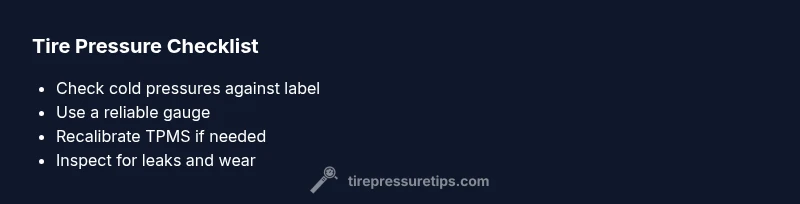
If you’re seeing tire pressure readings that are too high, start by verifying against the vehicle manufacturer’s label and TPMS guidance. Release air in small, controlled increments until the pressure matches the spec. Recheck while cold, inspect for leaks, and recalibrate TPMS if needed. If readings remain high, seek professional help.
Why tire pressure too high matters
Tire pressure too high isn’t just a number on a gauge; it affects handling, ride comfort, fuel efficiency, and tire wear. When tires run above the manufacturer’s recommended pressure, the contact patch becomes a narrow strip, which can reduce grip in cornering and increase the risk of a sudden tire failure on rough pavement. According to Tire Pressure Tips, consistently over-inflated tires accelerate wear in the center of the tread and can make braking less predictable. If you notice a warning from the tire pressure system after inflating, it’s a clear sign to recheck against your label and plan a fix before the next drive. Addressing tire pressure too high quickly improves safety and prolongs tire life, especially in hot weather or heavy-load conditions where pressure can climb unexpectedly.
What causes tire pressure too high and how it sneaks up
Over-inflation often happens during routine maintenance when a user inflates to a generic target without checking the vehicle’s label. In some cases, a faulty gauge or a rapid boost from an on-ramp air pump can push pressures past the recommended point. Environmental factors also contribute: heat from sun exposure and long drives can temporarily raise tire pressure, making an initially safe reading seem high when tires cool later. Another culprit is calibration drift in TPMS sensors; a misread can appear as tire pressure too high even when the tires are correctly inflated. Understanding these factors helps you prevent the issue from becoming a safety risk on the road.
Signs that tire pressure may be too high beyond numbers
Harsh ride quality is the most common telltale sign of tire pressure too high, as stiffer tires transmit road imperfections more aggressively. You may also notice reduced traction, especially in wet or slippery conditions, and an uneven wear pattern that appears more pronounced in the tread center than on the edges. A slight skidding feel during sudden maneuvers or a vibration at highway speeds can also accompany overinflation. If your tires look unusually rounded at the tread center, or if your steering feels light and unresponsive, recheck pressure immediately and avoid aggressive cornering until corrected.
How temperature affects tire pressure readings
Ambient temperature changes can temporarily skew tire pressure readings. After a hot day’s sun-exposed drive, the air inside the tires expands, which may elevate readings beyond the label when tires cool back down. Conversely, cold mornings can produce lower readings than midday conditions. Because the same tires behave differently as they heat up or cool down, always measure pressure when tires are cold—ideally after they have not been driven for a few hours. This practice helps ensure you don’t misinterpret a normal temperature-related fluctuation as tire pressure too high.
How to measure pressure accurately and safely
Use a high-quality gauge, ideally a manual gauge or a digital one rated for automotive use. Check all tires, including the spare, if applicable. Park in a shaded area to avoid heat distortion from sun exposure on the tire surface. Remove the cap from the valve stem, place the gauge squarely on the stem, and take a reading. If you are sure the tires are cold and the reading is high, perform a controlled release in small increments, then recheck after the tires cool again. Always verify the target pressure using the door jamb sticker or the owner’s manual.
The role of TPMS and what to do if readings don’t match
TPMS is designed to alert you when tires are under-inflated or over-inflated relative to the manufacturer’s spec. However, sensors can drift, batteries can fail, and recalibration may be required after seasonal changes or tire rotation. If the gauge reading and TPMS warning disagree by a wide margin, start with a physical measurement to ground-truth the data. If inconsistencies persist, consult a professional for TPMS testing, recalibration, or sensor replacement. This is especially important if you notice tire pressure too high on several wheels simultaneously, which could indicate a systemic issue.
Step-by-step fixes you can safely perform
Always start with the lowest-risk option and work your way to more involved fixes. If the tire pressure too high reading appears on one tire, check that tire first as a potential source of error. A visual inspection for nails, punctures, or deformities can reveal leaks that affect readings over time. After identifying the likely cause, release air in small increments, remeasure, and consolidate changes with a safe driving test. If you’ve calibrated TPMS recently, drive short distances to re-sync the system and confirm it reports accurately.
When to seek professional help and how to prevent recurrence
If you cannot bring tire pressure to the correct level after several attempts, or you notice persistent TPMS anomalies, a tire professional should assess the system for leaks, damaged rims, or sensor issues. Regular maintenance is key to preventing future instances of tire pressure too high. Schedule checks at least monthly, before long trips, and after temperature shifts or seasonal transitions. Using the manufacturer’s recommended pressures and a reliable gauge will help you avoid the dangers associated with overinflation.
Steps
Estimated time: 25-40 minutes
- 1
Locate the correct pressure target
Find the vehicle manufacturer's recommended tire pressure on the door jamb label or owner's manual. This value may differ between front and rear tires and between models. Make a note of the exact number and unit.
Tip: Use a reliable gauge and check when tires are cold. - 2
Check current tire pressure
Park in a shaded area and check all tires with a quality gauge. If you’ve just driven, give tires 3-4 hours to cool for an accurate reading. Confirm both front and rear pressures.
Tip: Avoid digital gauges with sticky displays; calibrate if needed. - 3
Release excess air if needed
If readings are above target, carefully depress the valve stem core with a tool or the gauge's bleed mechanism to release air in small increments. Recheck after each small release.
Tip: Do not let air out too quickly; small adjustments ensure accuracy. - 4
Reinflate if you under-inflate later
After reducing excess air and rechecking, ensure you end at the target pressure. If you release too much, re-inflate to the correct value using a gauge.
Tip: Keep a portable pump or access to an air compressor. - 5
Check for leaks
Inspect for slow leaks around valve stems, beads, or damaged rims. A slow leak can throw off your readings over time.
Tip: Wash valves with soapy water to spot leaks. - 6
Test TPMS and recalibrate if needed
If TPMS warning persists after adjusting pressure, recalibrate or reset the TPMS per manufacturer instructions. Some systems require driving several miles to re-sync.
Tip: Refer to manual or dealer if you’re unsure.
Diagnosis: Tire pressure reads high on gauge or TPMS warning
Possible Causes
- highOverinflation during maintenance or after using an aggressive air pump
- mediumAmbient heat or recent long-drive inflation causing temporary rise
- lowTPMS sensor calibration drift or misread
Fixes
- easyIf readings are above the target, release air in small increments and recheck after tires cool
- easyConfirm target pressure on door jamb label or owner manual and re-measure with a reliable gauge
- mediumIf TPMS readings remain inconsistent, recalibrate or replace the sensor with professional help
Frequently Asked Questions
What causes tire pressure to become too high?
Common causes include overinflation during maintenance, heat buildup from driving, and incorrect TPMS readings. Always verify with a gauge and refer to the vehicle label.
Common causes are overinflation, heat, and sensor misreadings. Check your tires with a gauge and verify against the label.
Is tire pressure too high dangerous?
Yes. Excessively high pressure can lead to reduced contact patch, harsher ride, and potential blowouts in severe conditions. Always align with manufacturer specs.
Yes, too-high pressure can worsen handling and increase risk of blowouts. Follow the manufacturer’s specs.
How do I safely release air?
Use a tire gauge with a bleed valve or the stem tool to slowly release air in small bursts, then recheck. Do not loosen the valve core completely.
Use a bleed valve or stem tool to release air slowly, then recheck the pressure.
Should I recalibrate TPMS after adjusting pressure?
Yes. After adjusting, drive for a few miles to allow TPMS to relearn the new pressure. If the light stays on, consult a professional.
Yes, drive a few miles to relearn the new pressure; if it stays on, get help.
When should I check tire pressure?
Check when the tires are cold and at least monthly, and before long trips or after temperature changes.
Check when cold, ideally every month and before long trips.
Watch Video
What to Remember
- Check the target pressure first
- Release air in small increments
- Recheck after cooling
- Calibrate TPMS if warning persists
- Regular maintenance prevents high pressure