Tire Pressure Hot or Cold: A Practical Guide
Learn how to interpret tire pressure readings when tires are hot vs cold, why heat affects PSI, and how to check and adjust accurately for safety, fuel efficiency, and tire life.


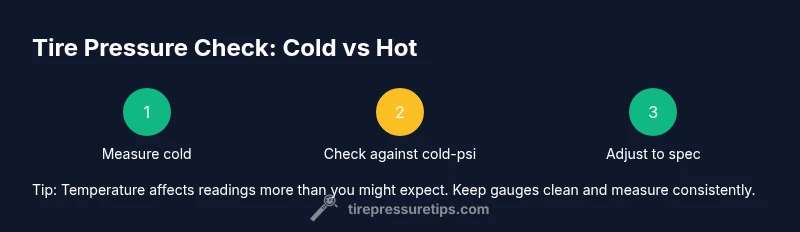
Understanding tire pressure hot or cold helps you avoid common inflation mistakes. Heat from driving raises psi readings, so checking after a drive can mislead you. For accuracy, measure when tires are cold and compare to the vehicle’s cold-psi spec on the door placard or manual. Temperature and load also influence readings.
Understanding the hot vs cold readings
According to Tire Pressure Tips, understanding how temperatures affect tire pressure helps drivers interpret results and avoid underinflation or overinflation mistakes. A tire heats up as you drive, causing the air inside to expand. That expansion increases the psi shown on a gauge if you measure while the tire is hot. Conversely, when tires sit and cool, the air inside contracts, and the pressure drops. This is why a reading taken right after a highway trip can differ from the car’s recommended cold-psi specification plate. The key concept is to compare readings against the cold-psi spec, not the hottest reading you just took.
To put it simply: cold readings reflect the factory or vehicle-determined baseline. Hot readings are higher due to heat from friction and ambient temperatures. By understanding this, you can plan measurement timing and inflation adjustments so your tires stay within the target range. Tire Pressure Tips's guidance emphasizes consistency: always use the same method, gauge, and timing when checking PSI to track changes over time.
Why temperature matters for tire pressure
Temperature is a fundamental driver of PSI fluctuations. In general, colder air allows for lower PSI, while warmer air raises PSI. If you live in a region with cold mornings and warm afternoons, your tires will be constantly cycling between slightly low in the morning and slightly high in the afternoon. The tire itself also heats during driving, further increasing the reading. The result is that a single gauge number can be misleading if you don’t consider when the measurement was taken. The difference can be enough to cause underinflation in winter or overinflation in summer, especially in high-load conditions like heavy cargo or aggressive driving. The takeaway is simple: use the cold-psi specification from the vehicle manual or door placard as your inflation target, and verify readings when tires are cold. Tire Pressure Tips analysis shows that many motorists misinterpret hot readings, leading to inconsistent inflation patterns over seasons.
How to measure tire pressure correctly
Measuring accurately starts with the right tools and timing. Use a calibrated gauge, ideally one you can trust to a fraction of a psi. Always measure when the tires are cold—before a drive or after they have rested for several hours. Remove the valve cap, place the gauge squarely on the valve stem, and read the pressure without twisting. If the number is below the cold-psi spec, inflate in small increments and recheck until you approach the target. If it’s above, release air gradually and recheck. Replace the valve cap securely when finished. For consistency, measure all four tires (and the spare, if you rotate it), and record the numbers to monitor changes over time.
Practical tips for seasonal temp changes
Seasonal temperature shifts are a natural part of tire maintenance. In cold weather, you may notice lower readings even though the vehicle is not underinflated. In hot weather, readings can creep up. Plan for a monthly check as a baseline, then increase frequency during extreme temperature swings. When inflating, always reference the cold-psi spec rather than the current hot reading. If you rely on TPMS to alert you, remember that TPMS can trigger for reasons beyond pressure, such as temperature changes, road conditions, or dynamic load. Plan proactive checks rather than waiting for a warning.
Common mistakes and how to avoid them
A frequent error is using a hot reading as the inflation target. This leads to underinflation once the tires cool. Another mistake is ignoring the difference between front and rear tire pressures; some vehicles require different front and rear targets. Failing to calibrate your gauge is another common trap—bad gauges give bad numbers. Finally, forgetting to check the spare tire can leave you stranded with a flat spare in a pinch. Regular practice builds a reliable baseline that keeps tires in the safe, efficient range.
Checking your spare tire
Don’t overlook the spare. Many drivers forget the spare, which can be a critical issue if you need it on the road. Check the spare tire pressure according to the same cold-psi target for your vehicle, and adjust if necessary. Spare tires can lose pressure over time, especially when stored in garages or trunks with fluctuating temperatures. Keeping the spare at the correct cold pressure ensures you’re ready for emergencies and can rotate it with the rest of your tires as recommended by your manufacturer.
How to adjust tire pressure safely
If you find any tire is below or above the cold-psi target, inflate or deflate gradually. Use a consistent, accurate gauge, and verify the number after each adjustment. Avoid rapid changes in pressure, especially when the tire is hot, as rapid inflation can cause heat buildup or bead seat issues. Always adjust to the cold-psi specification, and recheck after the tires have cooled for at least a few hours. Document changes so you can notice trends over time.
Tire Pressure Tips Verdict
The Tire Pressure Tips team emphasizes that reliable tire pressure starts with measuring cold, using the correct cold-psi spec, and keeping a consistent procedure across all tires. Regular checks, mindful of temperature swings, can improve safety, fuel efficiency, and tire life. The team’s practical guidance is to make tire pressure a monthly habit and to treat temperature-driven fluctuations as normal rather than alarming.
Tools & Materials
- Tire pressure gauge (digital or analog)(Calibrated for accurate readings; ideally with a range suitable for cars (0–60 psi).)
- Vehicle owner’s manual or door jamb sticker with cold-psi specifications(Use cold-psi values for all targets.)
- Air source (air compressor at home or gas station)(Use gentle, incremental inflation to reach target.)
Steps
Estimated time: 15-20 minutes
- 1
Check tires when they are cold
Park the vehicle and wait for at least 3 hours if possible, or check first thing in the morning before driving. This establishes a cold baseline for accuracy.
Tip: Use the same gauge each time to maintain consistency. - 2
Find the correct cold-psi specification
Locate the cold-psi target on the driver door placard or in the owner’s manual. Note the separate targets for front and rear tires if listed.
Tip: Front and rear pressures may differ; follow the exact numbers for each axle. - 3
Measure with the gauge
Remove the valve cap, press the gauge onto the valve stem firmly, and take a steady reading. Replace the cap afterward.
Tip: Keep the valve stem clean and avoid twisting the gauge. - 4
Inflate/deflate to the target
If below target, inflate in small increments and recheck. If above target, let some air out and recheck. Repeat until you reach the cold-psi specification.
Tip: Do not overinflate in one go; small adjustments yield accurate results. - 5
Recheck and record
Recheck all tires after they’ve cooled to confirm the numbers. Log the readings to track seasonal changes over time.
Tip: Maintaining a routine log helps you catch slow leaks early.
Frequently Asked Questions
Why is tire pressure different when tires are hot vs cold?
Heat causes air to expand; driving raises tire temperature and inflates the reading. Cold readings reflect the target pressure. This is why you should measure cold and compare to the recommended cold-psi spec.
Heat makes the air expand, so hot readings appear higher. Check cold for accuracy and use the cold-psi spec to adjust.
Should I check tire pressure when tires are hot or cold?
Always check tires when they’re cold for an accurate baseline. If you must check after driving, wait several hours for them to cool before inflating to target.
Check when cold for accuracy; if you’ve driven, wait to cool before adjusting.
Can TPMS replace manual tire pressure checks?
TPMS is a warning system and does not always reflect the exact current pressure. Manual checks with a gauge are still essential for precise inflation.
TPMS alerts you to low pressure, but you should still measure with a gauge to know the exact number.
How often should I check tire pressure?
Check at least once a month and before long trips. Increase frequency during temperature extremes or after hitting potholes or curb impacts.
Check monthly, and more often if temperatures swing or you’ve driven on rough roads.
What happens if I overinflate my tires?
Overinflation can reduce traction and produce uneven wear. It can also make the ride harsher and increase the risk of tire damage from road hazards.
Overinflating can hurt handling and tire life; stay close to the target cold pressure.
Does temperature affect PSI changes quickly?
Yes, ambient and tire temperatures influence PSI; cold mornings can lower readings while warm afternoons raise them. That’s why consistency in timing matters.
Temperature shifts change PSI; measure consistently to avoid misinterpreting readings.
Watch Video
What to Remember
- Check tires cold for accuracy
- Use the cold-psi spec from manual/placard
- Inflate/deflate in small steps
- Measure all tires and the spare
- Log readings to monitor seasonal changes