Check Tire Pressure When Tires Are Cold: A Practical Guide
Learn how to check tire pressure accurately when tires are cold, interpret PSI readings, and maintain optimal tire health with practical steps from Tire Pressure Tips.


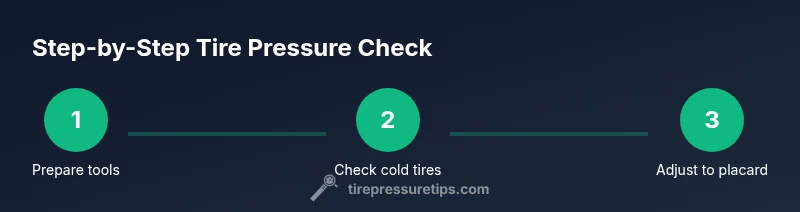
Check tire pressure when tires are cold to obtain an accurate reading. You should use a reliable gauge, measure all four tires (and the spare if applicable), and adjust to the vehicle's recommended PSI. Do this monthly or before long trips. Keep a small gauge in your glove box for on-demand checks. If your tires aren't cold, wait at least three hours or drive only a short distance to avoid artificially inflated readings.
Why Checking Tire Pressure Impacts Safety and Efficiency
Maintaining correct tire pressure is not just about avoiding a flat tire; it directly affects vehicle handling, braking distance, fuel economy, and tire wear. Underinflated tires generate more heat, wear the shoulders, and reduce grip, especially in wet conditions. Overinflated tires reduce the contact patch, causing tramlining and a harsher ride. According to Tire Pressure Tips, consistent pressure checks are a simple, cost-free way to keep your car safer and more efficient. By understanding the relationship between PSI, load, and temperature, you can spot gradual leaks, slow leaks, or unusual wear patterns before they become costly repairs. Think of tire pressure as a daily maintenance item, like checking oil or coolant levels.
Cold vs Warm Tire Readings: Timing Matters
Tire pressure changes with temperature. When you drive, tires heat up, and the air inside expands, giving you a higher reading than the cold-start value. For accuracy, measure when tires are cold, ideally after the car has rested for at least three hours or after the vehicle has been parked for the same period. If you must measure after a run, account for heat by subtracting about 1 PSI for every 10 degrees Fahrenheit of temperature rise, though this rule varies by tire and ambient conditions. Regularly checking in cold conditions helps you track genuine changes in pressure due to wear, leaks, or punctures rather than weather or road heat.
The Right Tools: Gauges, Pumps, and Reference Guides
The main tool is a reliable tire pressure gauge. There are three common types: digital, dial, and stick gauges. Digital gauges give a precise readout, while dial gauges can be easier to read with gloves on. Keep a separate gauge for the car and, if possible, a spare one in your glove box to avoid borrowing that crowds out. You should also have access to an air source—either a service station compressor or a portable pump—to adjust pressure. Finally, reference your vehicle’s door placard or owner's manual for the exact recommended PSI; this baseline is critical for setting targets accurately. Always calibrate gauges occasionally to maintain accuracy.
How to Measure Pressure Accurately: A Simple Procedure
Begin by turning off the engine and letting the tires cool. Remove the valve cap, press the gauge onto the valve stem firmly, and read the pressure quickly to avoid air loss. Record the four readings and compare each to the vehicle's recommended PSI. If any tire is below target, add air in small increments, recheck, and repeat until all four readings match the placard. If a tire overreads, release air slowly until you reach the target. Maintain a log of readings to identify slow leaks or changes over time.
Reading the Numbers: What PSI, kPa, and Temperature Mean
PSI is the common unit in the United States, but some gauges display kPa or bar. When reading, focus on the difference from the recommended PSI rather than chasing a single value. Temperature can influence readings; as tires cool, the pressure drops roughly 0.5 PSI for every 10-degree Fahrenheit decrease, though this varies by tire construction and load. If your gauge uses metric units, convert using 6.895 kPa per PSI to compare with the placard. The important part is consistency—use the same units and gauge for each check.
Common Reading Errors and How to Avoid Them
Don’t check after a long drive; warm tires can show inflated readings. Don’t squeeze the tire when mounting the gauge; air may escape and distort the measurement. Don’t ignore the difference between a worn gauge and a fresh one; a 0.5 PSI mismatch matters when you're close to the target. Always remove the valve cap to a clear, dry surface, wipe away dust, and ensure the valve stem is straight. Finally, remember that your vehicle’s load distribution and wheel alignment can affect readings by a small amount.
Temperature Effects and Seasonal Changes on Tire Pressure
Seasonal shifts can cause pressure to fluctuate. In winter, the air inside tires contracts and the pressure can drop several PSI over the course of a few weeks. In hot weather, pressure rises as air expands. These fluctuations don’t necessarily indicate a leak; they reflect ambient temperature. To stay accurate, check pressure at a consistent temperature and adjust to the placard marking when the vehicle is at its typical load. If you store a car for winter, check the spare tire too, as a cold spare may drop below recommended levels after sitting.
Underinflation vs Overinflation: Risks and Remedies
Underinflated tires wear on the outer edges and heat unevenly, increasing the risk of blowouts, especially at highway speeds. Overinflation reduces grip and increases the likelihood of a damaged rim from potholes. The cure is straightforward: bring tires to the recommended PSI using a gauge and a portable pump. If you must drive with an underinflated spare, avoid long trips until you can inflate to spec. Remember that correct pressure improves fuel economy and tire longevity.
TPMS and Manual Checks: Complementary Approaches
Tire Pressure Monitoring Systems (TPMS) provide a quick alert when pressure drops below a threshold, but TPMS accuracy can lag behind actual readings. Use TPMS as a warning sign, not the primary measurement. Always confirm with a manual gauge, especially if you suspect a sensor fault or have recently rotated tires, replaced wheels, or replaced tires. Some TPMS sensors can be slow to respond in cold weather, so manual checks remain essential.
Routine Maintenance: Scheduling and Records
Make tire pressure checks part of your regular maintenance routine. Set a monthly reminder and before long trips, road trips, or winter/summer transitions. Keep a small notebook or digital log of readings, adjustments, and any notes about leaks, punctures, or repairs. This habit helps you detect gradual drops in pressure that could indicate small slow leaks or damaged stems. In addition to checking four tires, remember to inspect the valve caps for damage. A missing or loose cap can allow air to escape and mislead readings.
Special Scenarios: Spare Tires, SUVs, and Road Conditions
Spare tires can also lose pressure over time; check the spare on a regular basis. SUVs and trucks may have higher recommended PSI values; always consult the placard for your vehicle's exact target. Road conditions, such as back roads and rough pavement, can cause wheels to heat differently; drive on smooth roads to get more accurate measurements after corrections. In all scenarios, use the same gauge and measurement process for consistency.
Tools & Materials
- Tire pressure gauge (digital or dial)(Prefer a gauge with a readable scale to 0.5 PSI accuracy.)
- Air source (service station compressor or portable pump)(Allows precise adjustments to reach the placard PSI.)
- Vehicle manual or door placard showing recommended PSI(Found on driver’s door jamb or in owner’s manual.)
- An extra tire gauge (optional but handy)(Keeps a spare reliable gauge in your glove box.)
Steps
Estimated time: 15-25 minutes
- 1
Gather tools and locate the target PSI
Collect your gauge, air source, and the vehicle placard. Confirm the recommended PSI for each tire and the spare if applicable. This ensures you aim for the correct target from the start, avoiding repeated adjustments.
Tip: Keeping all tools in a dedicated kit reduces delays during a check. - 2
Ensure tires are cold before measurement
If possible, perform checks after the tires have cooled for at least three hours or after a car has sat idle. This prevents readings inflated by heat buildup from driving or sunny parking.
Tip: If you must measure after a drive, note the temperature and drive distance to interpret readings accurately. - 3
Remove valve caps and apply gauge
Take off the valve cap and firmly place the gauge on the valve stem. Read the measurement immediately to limit air loss and record each tire's value.
Tip: Wipe the stem area dry to prevent debris from skewing the reading. - 4
Compare readings to target and adjust
If a tire is below target, add air in small increments (2-3 PSI at a time) and recheck. If above target, release air gradually until the PSI matches the placard.
Tip: Make small adjustments and recheck to avoid overshooting the target. - 5
Inflate or deflate all four tires evenly
Aim to bring all tires to the same target per the placard and ensure even contact with the road. After adjustments, recheck all four tires and the spare if relevant.
Tip: Tighten or loosen cap threads evenly to prevent air leaks. - 6
Record results and reinstall caps
Document the final PSI for each tire and replace valve caps securely. This creates a reference for future checks and helps identify gradual leaks over time.
Tip: Maintain a simple log (date, PSI, notes) for trend tracking.
Frequently Asked Questions
How often should I check my tire pressure?
Check at least once a month and before long trips. More frequent checks are advisable during temperature shifts or if you notice handling changes. Regular checks help catch slow leaks early.
Check at least monthly and before long trips; more often during temperature shifts.
Does TPMS replace manual tire pressure checks?
No. TPMS provides a warning when pressure drops, but it may not reflect precise PSI. Always verify with a manual gauge, especially after rotations or new tires.
TPMS warns you, but always confirm with a gauge for precise PSI.
Is it okay to check tire pressure when tires are warm?
Reading tires when warm can give falsely high numbers. If you must check after driving, wait for a cooldown or note the warm reading and adjust expectations accordingly.
It's best to check cold; if not possible, note the warmth and adjust later.
What causes incorrect tire pressure readings?
Inaccurate readings can come from a worn gauge, measurement on hot tires, not removing the valve cap, or measuring after pressure changes due to weather. Use a reliable gauge and measure cold whenever possible.
Errors come from bad gauges, hot tires, or improper technique.
Should I check the spare tire as well?
Yes. The spare can lose pressure over time and should be checked periodically, especially if you rotate tires or change tires seasonally.
Yes—check the spare periodically as well.
Can PSI values vary by vehicle type?
Yes. Different vehicles and load conditions require different target PSI. Always refer to the placard on the door jamb or the owner’s manual.
Target PSI varies by vehicle; check the placard or manual.
Watch Video
What to Remember
- Check tires cold for accurate readings
- Use the correct PSI target from placard
- Calibrate gauges regularly
- Record and monitor readings over time
- TPMS complements, not replaces, manual checks