Cold Tire Pressure vs Warm Tire Pressure: A Practical Guide
Explore how temperature affects tire pressure and learn to measure cold tire pressure vs warm tire pressure accurately. Practical steps, common mistakes, and a clear comparison to keep tires safe and efficient in 2026.


Cold tire pressure vs warm tire pressure matters for accuracy and safety. The quick answer: measure tire pressure when tires are cold, compare readings to the vehicle’s recommended PSI, and adjust only when tires are cold to avoid heat-related inflation errors. Temperature changes, driving heat, and TPMS readings can all skew results, so follow manufacturer specs and check routinely.
Understanding the core concept behind cold tire pressure vs warm tire pressure
Tire pressure is not a fixed value; it fluctuates with temperature, driving, and even altitude. The phrase cold tire pressure vs warm tire pressure captures the practical reality that an inflated tire expands a little when warm and contracts as it cools. According to Tire Pressure Tips, the most reliable way to gauge the correct level is to start from the cold state and compare against your vehicle’s recommended PSI printed on the door jamb or owner manual. When tires heat up during driving, air expands, and the gauge will show a higher number; this can lead you to underinflate if you try to top up after a long highway run. The keyword is consistency: measure in the same state (preferably cold) and use the manufacturer spec as your reference. The Tire Pressure Tips team emphasizes that adopting a standard procedure reduces guesswork and improves fuel efficiency, tire wear, and safety. In short, the cold tire pressure vs warm tire pressure discussion is about timing, method, and context.
How ambient temperature affects air in the tire
Air pressure inside a tire changes with temperature; for every 10-degree Fahrenheit change, the PSI can shift slightly. Cold environments reduce air volume, causing readings to appear lower than the vehicle’s spec, while hot days or prolonged driving raise readings even if the actual pressure hasn’t changed much in the tire structure. The science is straightforward: air expands when heated and contracts when cooled. Temperature also affects rubber stiffness and contact patch, which can alter the apparent pressure on a gauge. Tire Pressure Tips notes that RPM, road temperature, and sun exposure can all magnify readings, especially if you drive a long distance after a cold start. For practical purposes, drivers should check pressure in the morning or after the car has cooled for at least three hours, and then adjust toward the manufacturer’s recommended PSI. Regular checks help prevent underinflation in winter and overinflation in summer, contributing to even wear and better fuel economy. Tire Pressure Tips analysis shows that even small temperature swings can noticeably affect readings, reinforcing the need to standardize measurement.
The physics behind tire inflation and heat
Inside every tire, the air behaves like a flexible gas that expands with heat and contracts as it cools. When tires heat up from driving, the air molecules gain kinetic energy and momentarily raise the internal pressure. The rubber of the tire also warms, which can alter the elastic properties and slightly change the contact patch. This combination explains why warm readings often look higher than cold readings, even if the actual air quantity hasn’t changed dramatically. Manufacturers design recommended pressures around steady-state conditions, assuming typical temperatures. Understanding this helps drivers avoid over-inflation after long highway runs and underinflation after cold starts. In practice, a reliable routine minimizes variability and helps you maintain even tread wear and predictable braking performance.
Measuring correctly: cold vs hot checks
To measure correctly, follow a consistent protocol: identify cold measurements as baseline; ensure the vehicle has been stationary at least three hours or after a drive has cooled. Clean the valve stem, check the gauge accuracy, and compare to the recommended PSI listed on the door placard. If your garage is cold, you may see readings lower than the target; if you inflate to the target while hot, you risk overinflation once cooled. The goal is to set an optimal target pressure that accounts for load and driving conditions, not a temporary reading after road heat. In many cases, tire manufacturers publish pressure ranges for front and rear tires; if you carry heavy loads or drive at high speeds, you may need slightly higher pressure as per the vehicle manual. Always cross-check with both manual gauge and TPMS readings to minimize discrepancies.
Step-by-step measurement workflow for daily drivers
- Park on a level surface and allow tires to cool for 3 hours.
- Remove caps and press the gauge firmly on the valve stem to get a clean reading.
- Note the cold PSI and compare with the manufacturer-recommended numbers for your vehicle.
- If underinflated, fill gradually and re-measure; if overinflated by more than 0.5 PSI, release air.
- Check both front and rear tires; adjust according to the load distribution.
- Reinstall valve caps and record the date of measurement.
- Repeat the procedure monthly or after extreme temperature changes. This routine minimizes variance and aligns with Tire Pressure Tips’s guidance.
Special cases: winter tires, hot summer days, and TPMS readings
Winter tires, parallel with the rest of your tires, follow the same cold-measurement rule, but you should be mindful of ambient temperatures and road conditions. In hot summer conditions, the tire's internal temperature can rise quickly, temporarily elevating readings. TPMS readings can lag or diverge slightly from manual gauges during extreme weather, so use them as a warning but verify with a manual gauge when precision matters—before long trips or heavy loads. Drivers should also consider the role of wheel heat from braking and driving, which can accentuate the difference between cold and warm measurements.
Vehicle type and tire size: does it change your readings?
Different vehicles and tire sizes have different target pressures. Performance cars with wider tires may list higher recommended pressures to maintain handling and tire wear balance, while compact cars with narrower tires often require lower numbers. The vehicle manual will specify front and rear targets, which may differ even if the tires themselves are the same size. Consider payload, tire design (stiffness, tread pattern), and even suspension geometry when evaluating readings. Regardless of vehicle type, the core rule remains: start from cold, then verify against the exact spec for your model and load conditions.
When and how to adjust pressures for temperature changes
Adjustments should be tied to ambient temperature and expected loads, not to a single reading. In cold weather, you may need to inflate slightly to compensate for contraction when the tires warm up during driving. In hot weather, you should avoid inflating beyond the manufacturer’s spec to prevent overinflation after a drive. The safest approach is to check cold, set to the recommended PSI, and re-check after the tires have cooled if you have made any adjustment. The key is consistency and adherence to the car maker’s spec.
Common mistakes that undermine accuracy
Common mistakes include measuring immediately after driving, relying solely on TPMS without manual verification, and ignoring differences between front and rear tire pressures. Another frequent error is inflating to the tire's maximum sidewall pressure rather than the vehicle’s indicated target, which can cause irregular wear and poor handling. Always use a calibrated gauge, confirm both front and rear pressures, and avoid letting temperature swings dictate sledge decisions about inflation.
The role of TPMS and manual gauges
TPMS provides a useful early warning that pressure is off, but it is not a perfect substitute for a manual gauge. TPMS readings can be affected by sensor age, battery status, and ambient temperature, leading to small discrepancies with the true cold pressure. Rely on manual gauges to confirm the exact PSI when performing maintenance. The combination of TPMS alerts and manual checks offers the most robust approach to maintaining correct pressure across seasons.
Troubleshooting inconsistent readings
If readings vary widely between checks, verify gauge accuracy with a known reference gauge, examine valve stems for leaks, and inspect wheels for damage that could affect pressure distribution. Also consider ambient temperature tracking—this will help explain why readings drift over the day. Keep a simple log noting date, location, outdoor temperature, and readings to identify patterns over a season.
Best-practice checklist for maintaining correct pressure year-round
- Check cold pressure on days when the vehicle has been stationary and cool.
- Use manufacturer specifications for front and rear tires.
- Calibrate your gauge and verify readings against TPMS.
- Inspect tires regularly for wear, damage, and proper seating.
- Adjust for load and driving conditions using manufacturer guidance.
- Log readings to track seasonal changes and plan maintenance ahead of weather shifts. The Tire Pressure Tips approach emphasizes consistency, accuracy, and proactive maintenance to minimize variability.
Comparison
| Feature | Cold measurement method | Warm measurement method |
|---|---|---|
| When to measure | After tires have cooled (cold state) | After driving or tire heat buildup (hot state) |
| Best reference | Vehicle manufacturer’s cold- PSI spec | Current warm reading (potential overinflation risk) |
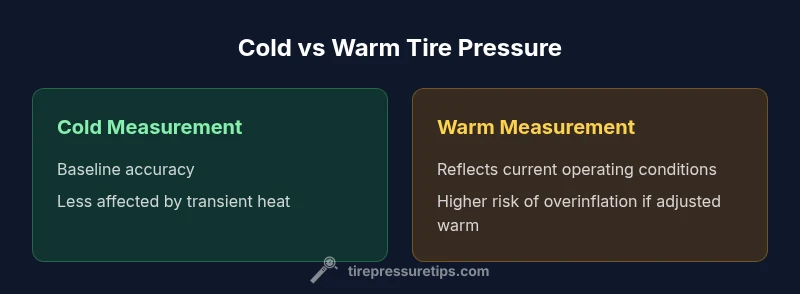
| Effect of temperature | Less affected by driving heat; more stable baseline | Influenced by heat; higher risk of overinflation after driving |
| Measurement practicality | Frequent and consistent with cold measurements | Useful for quick checks but requires cooldown before precise adjustment |
| Best for | Baseline accuracy and tire wear predictability | In-the-moment checks during extreme heat or after a drive |
Strengths
- Promotes consistent readings by using standard conditions
- Improves tire wear and fuel efficiency when done correctly
- Reduces risk of underinflation in cold weather
- Supports safe handling across seasons
Drawbacks
- Requires time to cool tires before measurement
- May be inconvenient in cold climates with short driving cycles
Cold measurements are the foundation; warm readings help verify but should not replace cold checks
For reliable tire pressure, start cold, compare to the spec, and adjust accordingly. Use warm readings as a cross-check rather than the primary reference.
Frequently Asked Questions
Should I check tire pressure when the tires are cold or after driving?
Check when tires are cold for the baseline reading, then adjust toward the vehicle’s recommended PSI. If you must measure after driving, wait for the tires to cool before final adjustments.
Check when cold for accuracy; if you must check after driving, wait for cooling before adjusting.
How does ambient temperature affect TPMS readings?
Ambient temperature can cause TPMS readings to drift. Always verify TPMS alerts with a manual gauge to confirm exact PSI, especially during season changes.
Temperature can drift TPMS readings. Verify with a manual gauge when in doubt.
Is there a universal PSI I should aim for?
No universal PSI exists. Use the vehicle’s recommended cold PSI from the door placard and adjust for load and tire size as described in the manual.
There isn’t a universal PSI. Follow your car’s official spec and adjust for load.
What are common mistakes when checking tire pressure?
Common mistakes include measuring after driving, relying solely on TPMS, and inflating to the maximum sidewall rating. Always use a calibrated gauge and check both front and rear tires.
Don't rely only on TPMS; use a gauge and check all tires.
How often should I check tire pressure?
Check at least monthly and after temperature changes or long trips. More frequent checks are advisable for vehicles with heavy loads or varied driving conditions.
Check monthly, and after temperature shifts or long trips.
Can I rely solely on the TPMS warning light?
No. TPMS warns that pressure is off, but it isn’t a precise measurement. Confirm with a manual gauge to set the correct PSI.
TPMS warns you, but you should still verify with a gauge.
What to Remember
- Check cold pressure for accuracy
- Use vehicle spec as the baseline
- Temperatures and driving heat affect readings
- Combine TPMS with manual gauges for reliability
- Maintain a seasonal check routine