Cold Tire Pressure vs Normal: A Practical Comparison
Explore how cold tire pressure differs from normal inflated pressure, why temperature matters, and how to measure and maintain correct tire pressure for safety, efficiency, and tire longevity.


Cold tire pressure vs normal offers a practical framework for inflating tires. Measure cold readings before driving, then compare to the vehicle’s recommended pressure. After a drive, pressure rises as tires warm, giving a higher reading. Understanding this distinction helps you maintain proper inflation across seasons and ensures consistent handling, safety, and tire wear.
What cold tire pressure vs normal pressure means
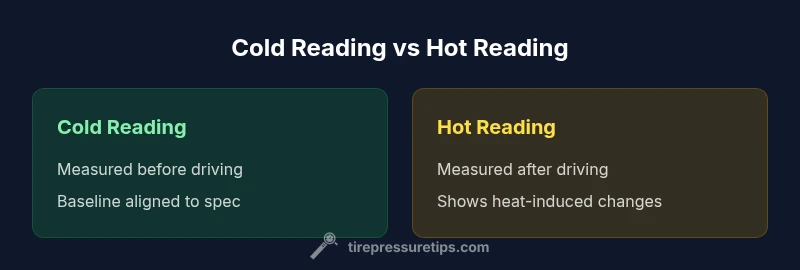
When people talk about cold tire pressure vs normal pressure, they are discussing two measurement contexts for tire inflation. A cold reading is taken when the tires are at ambient temperature and have not been driven recently. A normal or hot reading reflects the increase in pressure that occurs after tires have warmed from driving or from high outdoor temperatures. This distinction matters because it affects how you interpret the recommended tire pressure and whether you should adjust inflation before or after a drive. According to Tire Pressure Tips, the most reliable practice is to start with a cold reading and then adjust as needed after the tires have heated from a drive. This approach keeps inflation aligned with the vehicle manufacturer’s specification and helps maintain even tread wear and predictable handling.
The physics behind temperature effects on tire pressure
Tire pressure responds to air temperature because air expands when warm and contracts when cool. Warm tires created by friction and sun exposure can temporarily raise the pressure inside the tire, while cold ambient conditions reduce readings. The result is that a tire inflated to the exact spec when cold may read higher after a commute, or read low when the weather turns cold. Understanding this dynamic helps you differentiate between a genuine underinflation issue and a seasonal reading shift. The key takeaway from Tire Pressure Tips is to treat cold readings as the baseline and to verify any change against the manufacturer’s spec after the tires have cooled or warmed to expected conditions.
Measuring technique: cold readings and hot readings
To measure accurately, start with a cold reading: park in a shaded area, wait at least a few hours since the car was driven, and use a reliable tire gauge. Compare the result to the vehicle placard on the door jamb or owner manual. If the pressure reads low, adjust to the recommended cold value, then recheck after driving to observe how heat impacts the reading. Do not inflate based on a hot reading, which can overstate the needed adjustment. TPMS can provide a warning, but a manual gauge confirms the exact pressure.
Seasonality and climate: winter vs summer
Extreme temperatures amplify the gap between cold readings and what you see after driving. In winter, cold air lowers tire pressure readings, potentially highlighting a maintenance need that was hidden during milder weather. In summer, heat magnifies inflation, sometimes masking underinflation until a long trip reveals a low tire in daylight. The practical approach is to maintain a consistent cold-reading routine year round and adjust only after ensuring the tires have reached stable temperature.
Vehicle type considerations: cars, trucks, and SUVs
Different vehicle types and tire sizes respond to temperature changes in unique ways. Passenger cars typically show moderate variation, while trucks and SUVs with larger tires and heavier loads can exhibit more noticeable pressure fluctuations. Use the vehicle manufacturer’s specification for cold inflation, and recognize that a higher sidewall profile or run-flat tires may behave differently than low-profile sport tires. Regular checks become more important on vehicles with TPMS that may not reflect subtle pressure shifts during a short trip.
TPMS and how it interacts with pressure changes
Tire Pressure Monitoring Systems alert you to unsafe pressure levels, but they do not replace the accuracy of a proper gauge. Some TPMS sensors report relative changes, while others trigger when pressure drifts beyond a threshold. Always verify a TPMS alert with a physical gauge and a cold reading if possible. The interaction between TPMS data and the cold vs normal pressure distinction is a practical reason to adopt a disciplined measurement routine.
The impact on handling, wear, and fuel economy
Inflating tires to the correct level affects the contact patch, steering response, and rolling resistance. Underinflation generally reduces fuel efficiency and increases wear on the outer tread, while overinflation can lead to a harsher ride and uneven wear. The cold vs normal framework helps you anticipate when readings are shaped by temperature rather than a lasting pressure issue, enabling more consistent handling across weather changes.
Practical steps for maintaining correct pressures year-round
- Check pressure when tires are cold, ideally before driving or after the vehicle has sat for several hours.
- Use the vehicle’s recommended cold inflation value from the placard or manual.
- Adjust in small increments and recheck after a drive to see the effect of heating.
- Use a quality digital gauge for repeatable measurements and keep gauges calibrated.
- Record seasonal changes and adjust scheduling for routine maintenance.
Common mistakes and how to avoid them
- Relying solely on TPMS readings instead of using a gauge; TPMS is a warning system, not a precise gauge.
- Fixing inflation based on a hot reading; remember cold readings are the baseline.
- Forgetting to account for loads, tire wear, or changes in tire size when you compare to spec.
- Ignoring seasonal shifts; temperature changes dramatically influence readings over time.
- Not checking spare tires, which can have different pressures and age characteristics.
Quick start guide: 6 steps to manage cold vs normal pressure
- Park in shade and wait until tires are cold.
- Check all four tires with a reliable gauge.
- Compare readings with the door placard’s cold value.
- Inflate to the cold spec if low, then drive normally.
- Recheck after a moderate drive to observe heat effects.
- Document the results and adjust your maintenance calendar accordingly.
Comparison
| Feature | Cold reading (pre-drive) | Normal/Hot reading (post-drive) |
|---|---|---|
| Measurement condition | Tires at ambient temperature, no recent driving | Tires warmed by driving or hot ambient conditions |
| Perceived inflation | Baseline when cold; reflects manufacturer spec | Higher reading due to heat buildup |
| Best-use practice | Use cold reading for baseline inflation | Verify with gauge after driving; adjust if needed |
| Reliance on TPMS | Gauge-based checks are primary | TPMS provides warnings but is not a precise measure |
| Seasonal relevance | Stable baseline across seasons when checked cold | Temperature shifts can create apparent changes |
Strengths
- Improved safety by preventing underinflation
- More predictable handling across temperature changes
- Better tire wear maintenance when using cold readings
- Supports fuel efficiency by matching spec consistently
Drawbacks
- Requires discipline and regular checks
- Can be time-consuming to manage both cold and hot readings
- Relies on a reliable gauge; TPMS alone isn’t enough
Cold-reading checks with post-drive verification offer the most reliable inflation control
Adopt a cold-reading baseline for inflation and validate after driving to account for heating. This approach aligns with manufacturer specs, supports even wear, and maintains safe handling across seasons.
Frequently Asked Questions
What is the difference between cold tire pressure and hot/normal pressure?
Cold tire pressure is measured when tires are at ambient temperature with no recent driving. Hot or normal pressure is measured after the tires have warmed from driving, which raises the reading. Understanding this distinction helps ensure you inflate to the correct baseline and adjust appropriately after driving.
Cold readings are the baseline; hot readings reflect driving heat. Always use a gauge and the cold spec for inflation.
Should I inflate my tires before or after driving?
Inflate based on cold readings before driving, then recheck after a drive to see how heat changes the pressure. Do not rely on the hot reading to set the initial inflation.
Inflate cold, then test after a drive to account for heating.
How does temperature affect TPMS readings?
TPMS provides warnings about unsafe pressures, but it is not a precise gauge. Temperature shifts can alter readings, so verify TPMS alerts with a physical gauge and a cold reading when possible.
TPMS helps, but you should still check with a gauge when possible.
Can I ignore cold readings in very cold weather?
No. Cold weather makes readings unreliable if you skip cold checks. Maintain a routine that measures when tires are cold and aligns with the manufacturer’s spec.
Don’t skip cold checks when it’s cold out.
Is there a universal cold pressure value for all tires?
There isn’t a universal cold pressure value. Always follow the vehicle’s spec on the placard or manual, and adjust with a reliable gauge.
There isn’t a universal cold pressure; follow the car’s spec.
How often should I check tire pressure?
Check tire pressure regularly, such as monthly, and before long trips. Adjust for seasonal temperature changes to maintain the baseline inflation.
Check monthly and before trips, especially in seasonal changes.
What to Remember
- Check tires when cold for accuracy
- Always compare to the door placard's cold value
- Recheck after driving to observe heat effects
- Use a quality gauge, not just TPMS
- Plan seasonal checks to maintain consistent inflation