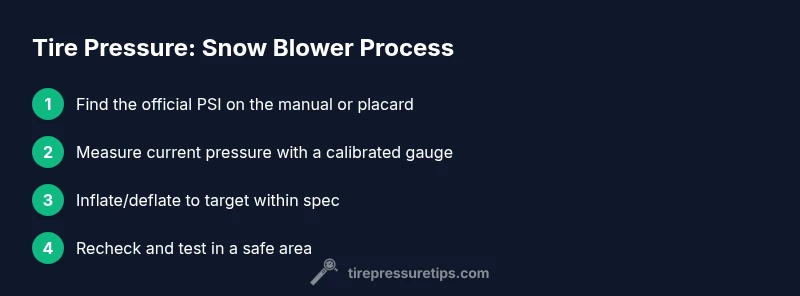
Tire Pressure for Snow Blower: A Practical Guide
Learn how to check, adjust, and maintain tire pressure on a snow blower to maximize traction, stability, and performance in winter weather. This guide covers specs, tools, safety, and practical tips from Tire Pressure Tips.


You’ll learn to check and adjust tire pressure on a snow blower to maximize traction and safe operation. Gather a tire pressure gauge, an air source, and the machine’s manual for the official PSI. Then follow the step-by-step process to measure, adjust, and verify both tires.
Why Tire Pressure Matters for Snow Blower Operation
Maintaining correct tire pressure on your snow blower isn't just about wheel firmness—it's about traction, stability, and efficiency when you push through snow and slush. Properly inflated tires grip better on packed snow and ice, help the machine cut through deeper drifts, and reduce the risk of wheel slip that can stall your job or cause equipment damage. The Tire Pressure Tips team notes that winter performance hinges on staying within manufacturer-recommended ranges and adjusting for ambient temperature. In cold air, rubber contracts and air molecules shrink; without verifying pressure, you might start a job with tires that are too soft. In this section we'll explain how pressure affects balance, wheel load distribution, and operator control. By understanding the logic behind the numbers, you can avoid common mistakes and keep your snow blower performing at peak efficiency throughout the season.
Understanding Snow Blower Tires vs Vehicle Tires
Snow blower tires are built for lightweight loads and consistent ground contact, but they differ from car tires in several ways. They support your machinery's weight, transmit torque, and provide traction on variable surfaces. Using car tire pressure as a guide is risky because snow blowers often have different wheel sizes, different tire compounds, and different recommended inflation for winter use. The Tire Pressure Tips team emphasizes consulting the owner's manual and the label on the machine for exact PSI; even two identical-looking snow blowers can have different specs. Under-inflated tires can flatten under load, reducing traction and making steering harder. Over-inflated tires reduce contact patch and decrease grip, increasing vibration and wear. In short, treat snow blower tires as a separate category from vehicle tires and set pressure to the manufacturer’s spec, not your car’s.
How Temperature Affects Tire Pressure on Outdoor Equipment
Ambient temperature can swing several degrees in a single day, and tire pressure responds to those changes. In winter, cold air reduces tire pressure, while a warmer garage may raise it. Because snow blowers are often stored outside or in unheated spaces, readings taken in the morning can differ from what you see after an afternoon sun or a heated shop. The Tire Pressure Tips analysis shows that reading pressure in cold weather requires care; the correct approach is to measure when tires are cold (before starting the engine) and adjust to the manufacturer’s prescribed level. If you do not know the exact cold-weather adjustment, err on the side of slightly higher pressure within the recommended range to avoid excessive tire deflection during compression cycles. Remember, a small change in pressure can noticeably affect traction on packed snow.
Finding the Right Pressure: Manufacturer Specs, Placards, and Manuals
Where do you find the correct number? Start with the snow blower's manual; many units place a tire pressure placard near the engine or under the hood, on the wheel well, or on the user’s guide. If the manual is missing, check the official product page from the manufacturer or contact customer support. The general rule is to match the listed PSI for each tire; if the unit uses different tires on the left and right sides, inflate accordingly to each side’s spec. The Tire Pressure Tips team reminds readers to use the same units and avoid mixing metric and imperial values. Keeping to the labeled PSI preserves traction, preserves tread geometry, and reduces wear on belts or axles.
Quick Troubleshooting: When Pressure Seems Off
Several signs hint that tire pressure needs adjustment. If the tire shows obvious sagging at rest, or if traction suddenly feels weak on flat ground, check quickly. Temperature shifts can cause slow changes, so recheck after a few hours or after a change in weather. The Tire Pressure Tips approach is to verify the measurement with a reliable gauge and to compare against the manual's recommended range for each tire. If you cannot reach the required range with standard inflating, ensure the valve stem is clean and that there are no leaks at the stem or bead. In some cases, tires may appear firm but still be losing air due to a faulty valve cap or a cracked seal; replace components as needed.
Quick Reference: Tools and Environment
Having the right tools and a clean, safe workspace makes tire pressure work straightforward. Gather a calibrated tire pressure gauge, an air pump or compressor, and your snow blower's manual for the exact specifications. Use gloves for grip and warmth, especially in cold weather, and work in a well-lit, dry area to avoid slips. Remember to check the air source and filters on your pump to ensure clean air and accurate readings. If you notice any hissing sounds or bubbling around the valve, stop and address the leak before proceeding. This upfront preparation saves time and keeps you out of trouble during a cold-weather session.
Tools & Materials
- Tire pressure gauge(Calibrated and capable of reading the range specified by your snow blower's manufacturer; use a gauge with clear, reusable readings.)
- Air pump or compressor(Ensure it can provide steady airflow without overheating; keep the nozzle clean and compatible with the tire valve type.)
- Snow blower manual or placard(Locate the exact PSI specification for each tire; some models have different specs left vs right.)
- Gloves(Keep hands warm and protected in cold weather; helps grip the gauge firmly.)
- Clean cloth(Wipe valve stems before measuring to ensure a good seal and accurate readings.)
Steps
Estimated time: 15-25 minutes
- 1
Identify the correct pressure specification
Locate the manufacturer's tire pressure specification for each tire in the snow blower manual or the placard on the machine. If the two tires have different specs, note both values so you can inflate each tire to its own target. This step ensures you aren’t guessing and helps prevent under- or over-inflation that can affect traction.
Tip: Always trust the manual over any memory or assumption about car tire pressures. - 2
Prepare your workspace and tools
Choose a cold, dry area away from traffic and hazards. Gather your gauge, air source, and the manual. Wearing gloves helps you maintain grip and protect your hands in cold weather.
Tip: Check that the gauge is calibrated before use and that the air source is clean and ready. - 3
Remove valve caps and check current pressure
Carefully unscrew the valve caps and attach the gauge to measure current pressure on both tires. Note readings for each tire and compare with the manufacturer’s targets.
Tip: If readings are inconsistent between tires, inspect for leaks or valve issues before inflating. - 4
Adjust to target pressure
Inflate or deflate each tire to reach its specified target within the recommended range. Make small adjustments and recheck after each change to avoid overshooting the target.
Tip: Inflation changes can be subtle; take your time and verify with a second measurement. - 5
Recheck both tires and confirm equality
Measure both tires again after adjustment to ensure they’re within tolerance and that both sides match your model’s specs. Unequal pressures can lead to instability in winter conditions.
Tip: If one tire won’t hold air, inspect for leaks, damaged stems, or bead seating issues. - 6
Test run in a safe area
Run the snow blower briefly in a clear area to assess traction and steering. If handling feels off, recheck the tires and adjust again if needed.
Tip: Short tests are safer and faster than lengthy adjustments in unsafe conditions.
Frequently Asked Questions
How do I know if my snow blower tires need air?
If tires look flat or you notice reduced traction, start by checking the official spec and measuring current pressure. Compare readings to the manual’s targets and adjust as needed.
Look for signs like reduced traction or a visibly underinflated tire, then check the manual and measure with a gauge.
Can I use car tire pressure specs for snow blower tires?
No. Snow blower tires have different specs. Always rely on the snow blower’s manufacturer guidance for each tire.
No—use the snow blower’s own specs, not car Tire pressure numbers.
Is it safe to check tire pressure while the engine is running?
No. Always measure with the engine off and tires cold to get an accurate reading and prevent injury.
Turn off the engine and check the tires when they’re cold.
What if one tire reads differently than the other after adjustment?
Recheck for leaks or valve issues on the tire with the odd reading. If needed, replace faulty components and remeasure.
If one tire reads differently, inspect for leaks and fix before rechecking.
Do all snow blowers have TPMS sensors?
Most household snow blowers do not include TPMS. If yours does, follow the sensor manufacturer’s calibration steps.
Generally, snow blowers don’t use TPMS, but if yours does, follow the sensor guide.
How often should I check tire pressure in winter?
Check before each use during heavy snow and recheck after any weather shift or long storage.
Check every time you plan to use it, especially in cold weather.
Watch Video
What to Remember
- Check the snow blower’s exact tire pressure spec before inflating
- Measure cold tires and adjust carefully to the manufacturer’s target
- Inflate or deflate with precision, then recheck both tires
- Inspect valves and stems to prevent slow leaks
- Test-drive in a safe area to confirm traction and control