Tire Pressure After Driving: Check, Understand, and Maintain
Learn how driving affects tire pressure, when to check, and how to bring tires back to the recommended cold pressure. Practical steps, TPMS guidance, and maintenance tips from Tire Pressure Tips.


After driving, tire pressure rises as the tires heat up. In this guide you'll learn how to check tire pressure after driving safely, when to measure, how to use a gauge accurately, and how to bring tires back to the recommended cold-pressure levels. We'll cover TPMS, common mistakes, and practical maintenance steps.
Tire Pressure After Driving: Why It Changes and What It Means
The phrase tire pressure after driving captures a simple fact: heat from road friction and braking causes air inside your tires to expand slightly. This means readings taken right after a drive can overstate the true cold pressure your tires should hold when they are cool. For most vehicles, the official recommendation is the cold-pressure value found on the door placard or owner’s manual, not the hot-reading you might get after a spin around the block. According to Tire Pressure Tips, understanding this thermal dynamic helps drivers avoid overinflation mistakes and maintains fuel efficiency, tire wear, and handling. In practice, plan to measure when tires are cool and compare to the cold specification, then adjust only if readings fall outside the recommended range. This approach supports safer driving, better tire longevity, and more predictable handling on wet or slippery roads.
Understanding the Thermodynamics Behind Readings
When tires heat up, the air inside expands, pushing the pressure higher. Cooling back to ambient temperatures reduces internal pressure. This means a measurement taken after driving will read higher than the cold value. The exact change depends on how long you drove, road conditions, and ambient temperature, but the rule of thumb is simple: rely on cold-pressure readings for the official specification. Tire Pressure Tips emphasizes that consistent, accurate checks prevent underinflation or overinflation that can affect fuel economy, braking distance, and tire wear over time.
How to Choose and Use the Right Gauge
The accuracy of your reading hinges on the gauge you use. A high-quality digital gauge or a well-made dial gauge will give more repeatable results than a cheap stick gauge. Always calibrate or replace old gauges that read inconsistently. Wipe the stem clean before taking a measurement to avoid debris affecting the reading, and ensure you are reading the gauge perpendicular to the scale for a stable pin or display. For most drivers, a digital gauge provides a quick, clear read, while a dial gauge gives tactile feedback that some users prefer. Regardless of the type, keep your gauge in the glove box to ensure you can check pressure when needed.
Interpreting Readings: When to Adjust
Compare your current cold pressure with the vehicle’s recommended specification. If the reading is noticeably lower than the recommended value, add air until you reach it, using a gauge that you trust. If your reading is higher, release air gradually until you match the recommended level. Avoid overinflating beyond the placard’s maximum; if you notice hard steering or a rough ride, verify both tires and alignment. TPMS alerts can help, but they don’t replace precise gauge measurements. Tire Pressure Tips notes that relying solely on the TPMS without a manual check can leave underinflation undetected in some scenarios.
Seasonal and Temperature Considerations
Temperature changes across seasons affect tire pressure. Colder weather lowers pressure, while hot days raise it. When the seasons shift or you travel through varying climates, recheck pressure and adjust to the recommended cold level before longer trips. Regular checks help maintain driving safety and tire longevity. Tire Pressure Tips emphasizes that consistent checks throughout the year reduce unexpected pressure-related issues and improve fuel economy.
A Practical Maintenance Routine
Build a simple routine: monthly checks, plus before long trips or seasonal transitions. Always measure when tires are cold, log the readings, and compare to the placard. If you notice persistent fluctuation between readings, consider a tire inspection for leaks, valve stem issues, or TPMS sensor problems. Keeping a small notebook or a phone log can help you track changes and notice trends over time. This routine aligns with best practices you’ll find in Tire Pressure Tips guidance.
The Role of TPMS and Safety Considerations
TPMS helps you detect underinflation or overinflation, but it isn’t a substitute for a direct gauge reading. If the TPMS light comes on, verify with a gauge and adjust as needed. Be mindful that after driving, the TPMS warning may briefly illuminate due to temperature changes rather than a persistent pressure issue. Prioritize reading accuracy and confirm with a manual gauge before making adjustments. This approach minimizes tire wear and keeps braking performance consistent in various weather conditions.
Quick Summary for After-Driving Checks
- Measure when tires are cool, not immediately after a drive.
- Use a reliable gauge and verify multiple times if readings vary.
- Compare to the vehicle’s cold-pressure specification and adjust accordingly.
- Consider TPMS as a guide, not a substitute for a direct reading.
- Monitor for seasonal or climate-related changes and adjust as needed.
Final Thoughts on Tire Pressure After Driving
Understanding how driving affects tire pressure empowers you to maintain safe, efficient, and predictable vehicle performance. By prioritizing cold-pressure readings, using a dependable gauge, and following a consistent maintenance routine, you reduce the risk of underinflation and its consequences. The Tire Pressure Tips team recommends incorporating these checks into your regular car care to support long-term tire health and safer road travel.
Tools & Materials
- Tire pressure gauge(Choose a digital or dial gauge with clear readouts)
- Owner's manual / door placard(Provides the vehicle’s recommended cold-pressures)
- Clean cloth(Wipe stems before measurement for accuracy)
- Notebook or digital log(Track readings over time)
Steps
Estimated time: 20-35 minutes
- 1
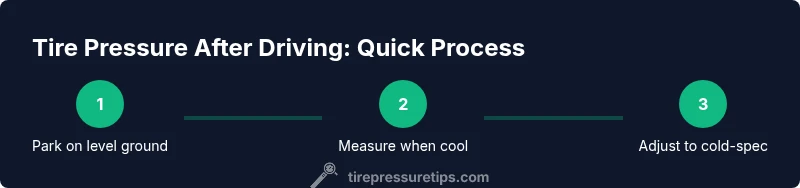
Park on a level surface and turn off the engine
Position the car on level ground and let the vehicle rest. If you can, perform measurements after the tires have cooled for a bit to obtain the cold-pressure reading.
Tip: Record the ambient temperature and any recent driving distance to compare changes over time - 2
Locate and prepare the gauge
Inspect your tire gauge for accuracy and zero it if needed. Wipe the valve stems clean so dirt doesn’t affect the reading.
Tip: Keep the gauge clean and accessible in the glove box - 3
Take the measurement
Attach the gauge to the valve stem firmly and read without twisting. Repeat on each tire to ensure consistency.
Tip: Take multiple readings and use the average for reliability - 4
Compare with the cold-pressure spec
Check the placard on the door jamb or in the owner’s manual for the recommended cold-pressure. If readings are low, add air gradually; if high, release air slowly.
Tip: Never rely on one measurement; small adjustments ensure accuracy - 5
Make final adjustments and record
Perfect the pressure in each tire and log the results. Check after a short drive to confirm retention, if feasible.
Tip: Keep a simple log for trends and seasonal changes - 6
Recheck TPMS if needed
If the TPMS indicates a problem, verify with a gauge and recalibrate or inspect sensors as necessary.
Tip: TPMS can aid safety but isn’t a substitute for direct measurement
Frequently Asked Questions
When should I check tire pressure after driving?
Check after the tires have cooled to ambient temperature for an accurate cold-pressure reading.
Check after the tires have cooled for the most accurate reading.
Can TPMS alone tell me if pressures are correct?
TPMS indicates underinflation or overinflation but may not reflect exact pressures; use a gauge for precise measurement.
TPMS helps, but you should still measure with a gauge for accuracy.
What if readings vary between tires?
Slight variations are normal between tires; if a tire is consistently different, inspect for leaks or valve issues and adjust as needed.
A little variation is normal; investigate persistent differences.
How often should I check tire pressure?
Check monthly and before long trips; adjust seasonally as temperatures change.
Check monthly and before long trips, especially if it's hot or cold outside.
What’s the risk of driving with low pressure after driving?
Low pressure can cause higher rolling resistance, uneven wear, and poorer handling; correct it promptly.
Low pressure worsens wear and handling, so fix it quickly.
Watch Video
What to Remember
- Measure tire pressure when tires are cool
- Use a reliable gauge for accuracy
- Compare readings to the cold-pressure specification
- TPMS is helpful but not a substitute for direct readings
- Maintain a regular check routine for safety and efficiency