Check Tire Pressure After Driving: A Practical Guide
Learn how heat affects tire pressure readings after a drive, when to check, and how to inflate to the correct PSI safely and accurately.


How Temperature Affects Tire Pressure
If you’re wondering can you check tire pressure after driving, the short answer is yes, but temperature plays a big role in what you read. When a tire heats up from friction with the road, the air inside expands. That expansion raises the air pressure, which means a post-drive reading will typically be higher than the true cold reading you’d get after the tire has cooled. The Tire Pressure Tips team notes that the most consistent measurements come when tires are at ambient temperature, so plan your check accordingly. If you want to understand the physics behind this, think of the tire as a sealed balloon: as it warms, the gas expands and the pressure inside rises. Even a small change in temperature can move a few psi, which matters when you’re aiming for a precise specification from your vehicle’s door placard. This is why many experts recommend checking tire pressure after the tires have cooled, especially when you perform maintenance or rotate tires.
Is It Safe to Check After Driving?
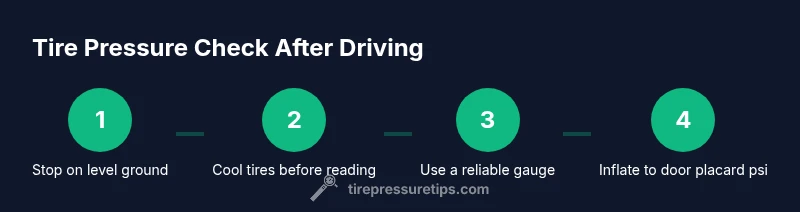
Checking tire pressure after driving is safe as long as you take standard safety precautions. Find a level, shaded area away from traffic, power down the engine, and apply the parking brake before you begin. Do not reach into moving parts or lean over a wheel while the car is in gear. If you parked on a slope or hot surface, wait for the tires to cool down a bit; rapid cooling can also affect readings on some gauges. In short, perform checks in a stable, safe environment so you can read the gauge accurately and avoid accidents. The goal is to verify that your tires are inflated to the recommended PSI without risking personal injury or damage to the wheel.
When to Check for Best Accuracy: Cold Readings vs After-Drive Readings
Best practice is to check when tires are cold, ideally after they’ve sat for at least three hours or before you drive for the day. If you’ve just completed a highway trip or a hot day, you’ll see higher numbers due to heat. In this guide we’ll show you how to plan checks to minimize confusion between cold and warm readings, and how to interpret the differences. If you’re pressed for time, check once you’ve allowed the tires to cool for 15–30 minutes; the readings will still be useful for adjusting to the recommended PSI, especially if you’ve driven a short distance on the last trip.
Tools You Need to Check Tire Pressure
Having the right tools makes the process quick and accurate. You’ll want a reliable tire pressure gauge (digital or dial), the vehicle’s recommended PSI from the placard on the door jamb or in the owner’s manual, and a note pad or phone to record readings. A portable air compressor (many gas stations have these) or a shop with an air hose is helpful for adjusting pressure. If you ever notice a fluctuating reading, you may need a calibration check of your gauge or a TPMS service. Keeping clean, dry valve stems and ensuring the gauge is calibrated at least yearly helps prevent reading drift. The Tire Pressure Tips team emphasizes consistency: use the same gauge each time to minimize variability.
Interpreting Your Readings: PSI, Temperature, and Tires
A reading is only as good as its context. Always compare the gauge reading to the vehicle’s recommended PSI—formatted in the owner’s manual or door placard—when tires are cold. A reading that’s higher than spec after a drive is expected due to heat; you’ll bring it back to spec by adjusting when the tires are cool. Remember that different tires and rims can have slightly different baselines, and seasonal temperature changes can shift readings by a few psi. For example, in cold weather a tire might read a lower cold PSI, while in heat months it can rise slightly; adjust accordingly and verify with a final cold check after a significant drive.
Handling Under-Inflation or Over-Inflation Found After a Drive
If you discover under-inflation after a drive, top up with the appropriate amount of air to reach the recommended PSI, ideally using a gauge that you trust. If you find over-inflation, let some air out slowly and recheck until you’re at the target. After adjustments, recheck each tire to ensure readings are consistent across all corners. If the gauge consistently shows odd values or if pressure changes rapidly from one check to the next, consult a professional to inspect for leaks, TPMS faults, or damaged valves. The goal is stable, safe tire pressure that ensures optimal traction and wear patterns.