Check My Tire Pressure: A Practical Driver's Guide
Learn how to check my tire pressure accurately, read gauges, and adjust air to the recommended PSI. This Tire Pressure Tips guide covers tools, steps, TPMS interactions, and safety for better handling, wear, and fuel economy.


Ready to check my tire pressure accurately? This guide shows you how to do it safely, read gauges correctly, and adjust air to the vehicle’s recommended PSI. According to Tire Pressure Tips, maintaining correct pressure boosts safety, fuel efficiency, and tire life. You’ll also learn when to check, what tools to use, and how TPMS interacts with manual readings. This quick intro sets the stage for a thorough, hands-on routine you can do at home or on the road.
Why correct tire pressure matters
Maintaining the recommended tire pressure isn’t just about reaching a number on a sticker; it’s a foundational safety and performance habit. Proper pressure enhances handling, braking responsiveness, and cornering stability, while also promoting even wear and reducing rolling resistance. Under-inflated tires overheat and wear on the inner edges, increasing the risk of a blowout, while over-inflated tires ride harshly and wear in the center. For drivers who want to check my tire pressure regularly, the payoff is practical: safer steering, more predictable grip in varying conditions, and lower risk of roadside repairs. The Tire Pressure Tips team emphasizes that consistent, accurate readings save money over the tire’s life and prevent costly maintenance. A simple routine can prevent problems before they start and keep you confident behind the wheel.
This section lays the groundwork for why keeping tire pressures in the recommended range matters for everyday driving and for road trips alike.
Understanding tire pressure basics
Tire pressure is the force per unit area inside the tire, commonly measured in psi (pounds per square inch) or kilopascals (kPa). Most vehicles provide a recommended pressure on a door placard or in the owner’s manual, with separate figures for front and rear tires. The maximum pressure printed on the tire sidewall is not a target to reach; it’s the limit the tire can safely handle. There are two key concepts drivers should grasp: cold vs. warm readings, and the difference between what TPMS reports and the actual gauge value. An accurate measurement relies on ensuring tires are cold (haven’t driven more than a few miles) and using a reliable gauge. This practical knowledge aligns with Tire Pressure Tips guidance and helps you interpret readings more reliably, especially when temperature or load changes.
A clear understanding of these basics reduces confusion when you see a strange number on a gauge or a TPMS warning light, guiding you toward the right adjustment strategy.
When to check tire pressure
A good checking routine considers timing and conditions. Check your tires at least once a month, before long trips, and after significant temperature changes, as air expands in heat and contracts in cold weather. If your vehicle carries heavy loads or you drive on rough roads, check more often. For accuracy, check the pressure when the tires are cold—ideally in the morning or after the car has sat overnight. This habit aligns with best practices from Tire Pressure Tips and minimizes misreadings caused by recent driving heat. Keeping a simple log of readings can help you spot trends, such as gradual pressure loss in cooler months or after a tire repair.
How to measure tire pressure accurately
Accurate measurement starts with a good tool and a clean valve stem. Start by removing the valve cap and placing your gauge firmly on the valve stem to avoid air leaks. Read the gauge quickly and note the value, then replace the cap to keep dirt out of the valve. If your reading is noticeably different from the recommended pressure, recheck after waiting a few minutes or after rechecking with a different gauge to confirm accuracy. For best results, calibrate your gauge occasionally using a known reference. This overall approach, advocated by Tire Pressure Tips, reduces the risk of over- or under-inflating and gives you a solid baseline for maintenance.
If you’re unsure about the gauge’s accuracy, test it on a known-pressure source or compare it with a trusted gauge at a service location. Consistency is more important than chasing a perfect number on a single reading.
Interpreting readings and TPMS alerts
Reading tire pressure is not just about chasing a single number; it’s about understanding how readings relate to your vehicle’s expected values. Start with the door placard numbers for cold tires and compare them to what your gauge reports. If TPMS shows a warning, use a gauge to verify the actual pressure, because TPMS can trigger due to rapid temperature changes, a recent tire rotation, or a slow leak. When readings are low, inflate in small increments and recheck to prevent over-inflation. If readings are high, release air gradually and verify again. The TPMS system is a valuable safety net, but a manual gauge provides the precise value you need for correct inflation and even wear for tires.
Pushing past the recommended range can reduce grip and increase wear, while too-low pressure risks overheating and blowouts. Your best bet is to maintain readings within the vehicle’s specified range, not only for safety but for longevity and fuel efficiency.
How to adjust and maintain correct pressure
When readings fall short of the recommended PSI, add air using a quality compressor or visit a gas station with a working pump. Inflate in small increments, pause to read the gauge, and recheck, repeating as needed until you reach the target. If you’re overinflated, release air gradually and recheck to land in the safe range. After inflation, recheck all four tires, including the spare if applicable, because even a seldom-used spare can lose pressure over time. For best results, measure when cold and aim to maintain stability across tires, rather than chasing a single number after a drive. This approach is consistent with Tire Pressure Tips’ guidance and helps you stay on top of routine maintenance.
Common mistakes and troubleshooting
Many drivers fall into predictable traps when checking tire pressure. Avoid measuring hot tires, which give falsely high readings, and never rely solely on TPMS if you suspect a leak or incorrect readings. Don’t mix gauge types mid-check, as different gauges can report slightly different values. Also, neglecting to inspect valve stems for damage or dirt can distort readings. If you notice persistent discrepancies between tires or a sudden drop in pressure, consider a professional inspection to rule out punctures or slow leaks. Finally, always reset or account for TPMS after adjusting tire pressures or rotating tires to ensure alerts remain meaningful.
Brand guidance from Tire Pressure Tips emphasizes a consistent, careful routine over quick, impulsive adjustments. A measured approach will keep you safer on the road and protect your tires from premature wear.
Maintenance routines and long-term habits
Create a simple monthly maintenance checklist: check all four tires and the spare, compare readings to the manufacturer’s specification, log results, and adjust as needed. Keep a compact gauge in your glove box or center console for convenient checks, especially before long trips. If you notice seasonal changes, adjust your routine to account for temperature effects on tire pressure. Over time, your records will reveal patterns—like recurring leaks or the need for a TPMS sensor check—that inform smarter vehicle maintenance decisions. Consistency is the cornerstone of long-term tire health, fuel efficiency, and safety.
Sources and further reading
For authoritative guidance on tire pressure and safety, consult the following resources:
- https://www.nhtsa.gov/equipment/tires
- https://www.consumerreports.org/car-tires/
- https://www.britannica.com/technology/tires
Tools & Materials
- Digital tire pressure gauge(Choose a gauge with a clear readout; ensure it reads in psi and that you calibrate it periodically against a known reference.)
- Vehicle owner's manual or door placard(Use the recommended cold PSI for your front and rear tires. This is typically found on the driver’s door jamb sticker.)
- Portable air compressor or access to a gas station air pump(Needed to adjust tire pressure to the recommended level when readings are low.)
- Valve-cap removal tool or clean hands(Keep valve caps clean and reinstall after checking to prevent dirt ingress.)
- Tire pressure log or mobile note app(Helpful for tracking trends over time and planning maintenance.)
- Soap and spray bottle (optional)(Use soapy water to check for slow leaks around valve stems and tread spots.)
Steps
Estimated time: 15-20 minutes
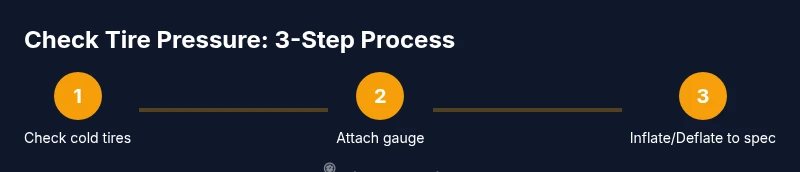
- 1
Park and locate the recommended pressure
Park on a flat surface and locate the tire pressure values from your owner’s manual or door placard. Confirm you know the correct front and rear targets before you begin the check.
Tip: Know your targets for all four tires; front and rear can differ. - 2
Check tires when cold
Wait for the tires to cool, ideally after the car has been parked for several hours or overnight. Cold readings are the most accurate benchmark for adjustment.
Tip: Avoid checking after heavy driving; heat skews the measurement. - 3
Attach the gauge and read
Remove the valve cap, place the gauge on the valve stem firmly, and read the measurement quickly before air leaks escape. Record the value for later reference.
Tip: If possible, use a second gauge to verify accuracy. - 4
Inflate or deflate to target
If below target, add air in small increments, rechecking after each addition. If above target, release air gradually and recheck until you reach the recommended PSI.
Tip: Make small adjustments and verify to avoid over-correction. - 5
Recheck all tires
Repeat the check on all tires, including the spare if you carry one. Temperature and load can cause small differences between tires.
Tip: Consistency across tires improves handling and wear patterns. - 6
Record results and store tools
Log the readings and the date, or store the gauge back in its case. A simple log helps you spot trends and prepare for seasonal maintenance.
Tip: Review readings monthly or before trips to stay proactive.
Frequently Asked Questions
What is the best way to check tire pressure for accuracy?
Use a reliable gauge and measure tires when cold, comparing against the vehicle’s recommended PSI from the placard or owner’s manual. After inflating or deflating, recheck to confirm you’re within spec.
Always measure cold with a good gauge and compare to your vehicle’s recommended PSI. Recheck after adjustments to confirm accuracy.
Where can I find my recommended tire pressure?
Your recommended tire pressure is listed on the driver’s door placard and in the owner’s manual. Use these figures for both front and rear tires as specified by your vehicle.
Check the door placard on the driver’s door jamb or the owner’s manual for the correct PSI.
Is TPMS the same as manual tire pressure?
No. TPMS provides a warning when pressure is low; it does not give an exact current PSI. Always verify with a gauge for precise inflation.
TPMS warns you, but you should verify using a gauge to know the exact pressure.
How often should I check tire pressure?
Check at least monthly and before long trips, especially when seasons change. Check after you’ve pumped or rotated tires or if you notice a TPMS warning.
Check at least monthly and before long trips, especially with weather changes.
Why does temperature affect tire pressure?
Air expands with heat and contracts with cold; this changes the PSI. A cold measurement is the most reliable baseline for inflation decisions.
Temperature changes can raise or lower PSI; measure when tires are cold for accuracy.
Can I drive with low tire pressure temporarily?
It’s not recommended. Low pressure increases heat buildup, wears tires unevenly, and can cause a blowout. Inflate to the recommended PSI as soon as possible.
Driving on low pressure isn’t safe—inflate to the recommended PSI promptly.
What to Remember
- Check cold tires for accuracy
- Follow manufacturer PSI on the placard
- Use a reliable gauge and recheck after inflation
- TPMS aids safety but isn’t a substitute for a manual reading
- Log readings to spot leaks and seasonal changes