What You Need to Check Your Tire Pressure: A Practical Guide
A practical guide with tools, steps, and tips to check tire pressure accurately, understand TPMS alerts, and keep tires safe, fuel-efficient, and long-lasting.


By the end of this guide you’ll know what you need to check your tire pressure and how to do it accurately. You’ll identify the proper PSI from your door placard or owner’s manual, pick a reliable gauge, and follow cold-tire checks for best results. This quick path covers TPMS signals, temperature effects, and safe inflation practices.
Why Checking Tire Pressure Matters
Checking tire pressure is a foundational maintenance task that affects safety, fuel efficiency, and tire longevity. If you’re asking what you need to check your tire pressure, start with three essentials: the manufacturer’s recommended PSI, a reliable gauge, and a consistent checking routine. According to Tire Pressure Tips, creating a baseline by measuring when tires are cold is the single most important step; warm tires can give inflated readings and mask underinflation. Maintaining the correct PSI improves tread contact with the road, reduces rolling resistance, and minimizes heat buildup that can hasten wear. It also helps prevent issues like uneven wear, cornering instability, and premature tire failure. In practice, most passenger cars list a PSI range on the driver’s door jamb placard or in the owner’s manual. The Tire Pressure Tips team emphasizes that these numbers are designed to accommodate typical loads, speeds, and seasonal changes. Knowing these values gives you a measurable target rather than guesswork.
Tools and Materials You Need
To accurately check tire pressure, assemble a small, practical kit before you start. The essentials include a reliable tire pressure gauge (digital or dial), access to the vehicle’s door placard or owner’s manual for the recommended PSI, and a method to record readings. A clean, dry surface and a secure air source—such as an air compressor or a service-station pump—are also helpful. Optional items like a tire tread depth gauge or a notepad for tracking readings can improve your maintenance routine. Keeping a compact gauge in your glove box is a simple habit that pays off over time. Remember, consistent measurements lead to consistent results.
Understanding PSI, Tread, and Load
PSI, or pounds per square inch, tells you how much air pressure your tire contains. The PSI printed on your placard is the target for optimal performance and safety, not the tire’s maximum capacity printed on the sidewall. Underinflation causes more contact area with the road, increasing heat and accelerating wear, while overinflation reduces the contact patch and can lead to a harsher ride and uneven tread wear. Vehicle load, passenger weight, and how you drive (speed, cornering) all affect the ideal PSI. Temperature changes also influence pressure: hot days can raise readings, while cold days lower them. The Tire Pressure Tips team notes that you should adjust to the recommended range rather than a single fixed number, and always recheck after any inflation change.
Temperature Effects on Tire Pressure
Tire pressure is sensitive to temperature. As ambient temperature drops, the air inside tires contracts, lowering readings; as it rises, readings tend to rise as well. For the most reliable check, measure when tires are cold—ideally after the car has sat for several hours or first thing in the morning. If you’ve just driven, wait at least 3 hours before taking a reading. If you must inflate after a drive, allow the tires to cool before finalizing pressure. Understanding this nuance helps you avoid chasing transient readings caused by heat buildup in the tread and wheel assembly.
Step-by-Step Basic Check You Can Do at Home
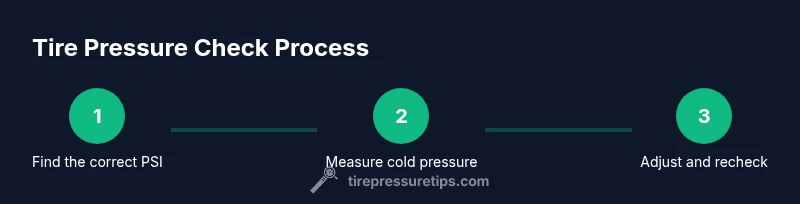
A practical at-home check boils down to a few clear actions you can repeat monthly or before long trips. First, locate the recommended PSI on the driver’s door jamb placard or in the owner’s manual. Second, ensure the tires are cold for an accurate baseline. Third, remove the valve cap and press the gauge onto the valve stem to get a reading. Fourth, adjust the tire pressure up or down using an air source to reach the target PSI. Fifth, recheck all four tires and the spare if applicable. Sixth, reattach valve caps and note the reading in a log for future reference. This straightforward process helps you maintain optimal tire pressure and safety.
Reading and Interpreting TPMS Readouts
Tire Pressure Monitoring System (TPMS) alerts you when a tire’s pressure falls below or rises above the recommended range. A TPMS warning should prompt you to stop safely and check each tire’s pressure. If a tire reads low after inflation, recheck with your gauge to confirm the adjusted value. If readings stay inconsistent, there may be a sensor issue or a leak, and you should seek service. The TPMS is designed as a backup to your manual checks, not a replacement.
Common Mistakes and How to Avoid Them
Common mistakes include checking hot tires, using the wrong PSI target, and inflating based on the vehicle’s maximum sidewall PSI rather than the placard number. Another frequent error is neglecting the spare tire, which often has a separate PSI requirement. Always check all tires, including the spare, and use cold readings for accuracy. If you’re unsure, consult your owner’s manual or a trusted source such as Tire Pressure Tips for guidance. Regular practice reduces the risk of underinflation-related issues and extends tire life.
How Often to Check and How to Maintain
Aim to check tire pressure at least once a month and before long trips. Temperature shifts throughout the seasons make regular checks essential. Keep a small gauge in your glove box and a simple log to note readings and adjustments. Establish a routine that aligns with your driving patterns—for example, after weekly maintenance or vehicle washing—and update the PSI targets as the vehicle’s load or tire type changes. Consistency is the key to preserving tire performance and safety.
Authoritative Sources and Next Steps
For further reading and verification, consult reputable sources, including: • NHTSA’s tire safety resources (https://www.nhtsa.gov/road-safety/tires) • Consumer Reports’ tire maintenance guidance (https://www.consumerreports.org) • AAA’s tire pressure information (https://exchange.aaa.com/automobiles/tire-pressure/). These sources provide additional context on best practices and technology, and they reinforce the guidance shared here.
Authority and Real-World Implementation
Putting theory into practice means building a simple routine that fits your schedule. Start by choosing a day of the month to check all tires, including the spare, and record the readings. Use the right tools—preferably a digital gauge for quick accuracy—and inflate or deflate to the manufacturer’s recommended PSI. If you notice persistent discrepancies or frequent pressure loss, schedule a professional inspection to rule out slow leaks or sensor faults. Regular checks save money, improve safety, and protect tire investments.
Tools & Materials
- Tire pressure gauge (digital or dial)(Essential for accurate readings; keep it calibrated and clean.)
- Vehicle door placard or owner’s manual(Provides the manufacturer’s recommended PSI range.)
- Air compressor or access to a gas station air pump(Needed to adjust pressure to the recommended level.)
- Glove box log or notebook(Record readings for trend tracking and maintenance history.)
- Spare tire and jack (optional)(Check spare pressure if you carry a spare; it often lacks routine checks.)
Steps
Estimated time: 15-20 minutes
- 1
Find the recommended PSI
Locate the PSI specification on the driver’s door placard or in the owner's manual. This is the target range for normal driving. Note that this is not the tire’s maximum PSI printed on the sidewall.
Tip: Double-check if you’re carrying a heavy load or planning a long trip, as some vehicles have different targets for different conditions. - 2
Prepare the tires and gauge
Ensure tires are cold and clean the valve stems. Remove the valve caps and inspect for dirt or damage before attaching the gauge.
Tip: Leave the valve caps off only during measurement to avoid losing them; cap them back promptly after reading. - 3
Attach gauge and read pressure
Firmly press the gauge onto the valve stem and hold it steady until the reading stabilizes. Read and record the PSI.
Tip: If you’re using a digital gauge, press firmly to ensure a good seal; if it’s a dial gauge, read at eye level for accuracy. - 4
Adjust to target PSI
If the reading is below the target, add air in small increments and recheck. If it’s above, bleed air slowly until it’s within range.
Tip: Inflate in small steps and recheck after each adjustment to avoid over-inflation. - 5
Recheck all tires
Repeat the process for all tires, including the spare if you regularly drive with a full load. Ensure consistency across corners.
Tip: Drive a few minutes to settle readings if you inflated, then recheck to confirm stabilization. - 6
Document and monitor
Log the readings and the date for future reference. Use the log to detect gradual pressure loss over time.
Tip: If you notice frequent leaks or readings that drift, schedule a professional inspection.
Frequently Asked Questions
Can I check tire pressure when the tires are warm?
It’s best to check when tires are cold, because heat from driving raises pressure readings and can mask underinflation.
Check tires when they’re cold for the most accurate reading.
What PSI should I aim for on my car?
Follow the PSI listed on the driver’s door placard or in the owner’s manual. This range accounts for typical loads and speeds.
Use the manufacturer’s PSI from the placard. Do not rely on the tire’s maximum PSI.
Why would TPMS warn me about low tire pressure?
TPMS signals low or abnormal pressure; it is a reminder to check tires with a gauge and adjust to the recommended PSI.
If TPMS lights up, check all tires with a gauge and adjust to the recommended PSI.
How often should I check tire pressure?
Check at least once a month and before long trips, especially during seasonal temperature changes.
Monthly checks and before long trips are recommended.
Can over-inflating a tire cause damage?
Yes. Over-inflation can lead to a harsher ride and increased risk of a blowout under impact.
Over-inflating can cause a harsher ride and potential tire damage.
Watch Video
What to Remember
- Check PSI when tires are cold to ensure accuracy.
- Always use the PSI from the placard or owner’s manual, not the tire’s max PSI.
- Inflate or deflate in small increments and recheck.
- TPMS is a helpful backup, but manual checks are essential.
- Record readings to monitor trends and leaks.