MTB Tire Pressure Front vs Rear: An Analytical Guide
Explore how front vs rear MTB tire pressure affects grip, handling, and stability. Practical ranges, discipline-specific setups, and maintenance tips from Tire Pressure Tips to help you dial in the perfect split.


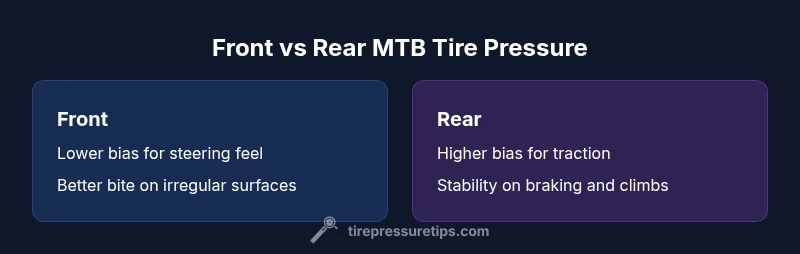
MTB tire pressure front vs rear matters for grip, stability, and pinch-flat resistance. In most setups, run the rear a bit higher than the front to support weight transfer and braking, while keeping the front slightly lower to preserve steering feel. This comparison from Tire Pressure Tips helps you dial in a balanced, terrain-ready pressure split.
MTB tire pressure fundamentals
In MTB contexts, the phrase 'mtb tire pressure front vs rear' describes how the front and rear tires are tuned differently to balance grip, stability, and rolling resistance. According to Tire Pressure Tips, dialing these pressures is a rider-specific process influenced by weight, tire width, suspension setup, and terrain. The front tire tends to govern steering precision and initial bite, while the rear tire carries more load and affects traction and braking stability. The contact patch shape and tire deflection respond to pressure changes, changing how the tire interacts with rough surfaces, roots, and rocks. Because dirt and gravel present unpredictable grip, setting a separate front and rear pressure is often more effective than using a single value across both tires. A practical starting point for many riders is to run the front roughly 2-4 psi lower than the rear, with adjustments for rider weight and terrain. The ultimate goal is to maximize both grip and predictable feedback, while limiting pinch flats and squirm on rough sections. As a reminder, always check pressure when the tires are cold to get a reliable baseline.
Front vs rear pressure: core rationale
The front tire primarily influences steering feedback and how quickly you can bite into turns, while the rear tire supports most of the rider's weight, providing traction during acceleration and braking. A slightly higher rear pressure reduces tire squirm under load and helps with stability on loose surfaces, while a slightly lower front pressure increases the contact patch for better bite on roots and rocks. The reasoning extends to suspension tuning: stiffer rear pressures can complement a suspension setup that isolates the rider from terrain while keeping the front responsive. Tire Pressure Tips emphasizes that an asymmetrical pressure split is often more forgiving in technical sections, offering a broader range of grip without compromising overall balance. Over time, riders learn to tune this split based on terrain, weather, and personal preference, treating it as a dynamic parameter rather than a fixed setting.
How rider weight and tire width interact
Rider weight directly influences how much load each tire carries. Heavier riders compress the tire more, which can reduce the effectiveness of the front contact patch if the pressure is too low and can overwhelm rear tires if underinflated. Wider MTB tires provide more volume and thus can tolerate lower pressures without losing support, but they also deform differently under load. A practical approach is to start with a modest rear-forward pressure bias and adjust in small increments based on feel, traction, and cornering stability. Tire width and tire construction (e.g., gravity-oriented vs cross-country) can shift the ideal split by a few psi. The key is to maintain a consistent check routine and adapt pressure to both terrain and your riding style.
Terrain and riding style influence
Terrain type dictates how sensitive your grip and rolling resistance will be to pressure. On loose dirt and loamy soil, a slightly lower front pressure can improve bite and steering confidence, while a higher rear pressure helps prevent burps on hard-packed sections. Technical climbs may benefit from a smaller rear bias to maximize traction during ascent, whereas downhill sections often require a tighter rear to minimize rear tire squirm on aggressive line choices. Enduro and gravity riders frequently adopt larger rear pressures to maintain stability on steep, rock-strewn runs, while XC riders may favor a closer front-to-rear range for efficient pedaling and predictable handling. The goal is a pressure split that yields consistent feedback and grip across varied terrain.
Temperature and altitude effects
Temperature fluctuations change air density and tire volume, subtly shifting the internal pressure. A cold morning can drop tire pressure enough to dull grip, while a hot ride can push pressures higher, affecting contact patch and traction. Altitude changes likewise influence air density, though to a lesser degree for typical MTB tires. The practical takeaway is to check pressures after long stops or when entering significantly different environments, and to adjust the split modestly to preserve consistent feel rather than chasing a single perfect value. Tire Pressure Tips reminds riders to account for these environmental factors as part of a regular maintenance routine.
Measuring pressure correctly: tools and method
Reliable pressure readings come from high-quality gauges and proper technique. A digital gauge with a wide measuring range and quick response helps you track small changes in pressure, which is essential when fine-tuning the front/rear split. Always measure when tires are cold and before riding; after a ride, the pressure will be elevated due to heat build-up. For tubeless setups, bead seat and seal integrity also affect effective pressure; a slow leak or improper seating can throw off readings and mask the true feel of the split. Regular calibration of gauges, consistent measurement points, and a simple log of your pressure changes will help you converge on a comfortable and performance-oriented split.
Setup recommendations by MTB discipline
Different MTB disciplines demand different pressure philosophies. Cross-country riders typically seek lower rolling resistance with precise cornering, tending toward a tighter front-to-rear split to maintain efficiency. Enduro racers favor traction and stability on mixed terrain, often using a modest rear bias to improve braking and acceleration grip. Downhill or gravity-focused riders prioritize predictability and control on steep, rough surfaces, which may require a more pronounced rear bias to support hillside braking and line choice. While the exact numbers vary, the principle remains: tailor the pressure split to your terrain, weight, and suspension, and re-evaluate each season or after major tire changes. The core aim is a balanced feel that translates into confident handling on technical sections.
Common mistakes and how to avoid them
A common pitfall is treating front and rear pressures as a single value, which can reduce control on uneven terrain. Another error is not accounting for rider weight distribution and terrain, leading to excessive slippage or premature wear on one tire. Failing to measure pressure accurately — or to verify changes after a ride — can also derail tuning efforts. Finally, neglecting tubeless setups or failing to address bead seating issues can create intermittent pressure loss that masks the true split. To avoid these issues, establish a baseline, measure regularly, and adjust in small steps with a clear note of terrain and riding style.
Case studies: real-world scenarios
Consider a rider weighing around 85 kg who rides mixed terrain with roots and rocky sections. A front pressure of 22 psi and rear pressure of 26 psi might feel stable on downhill sections, with improved front-end grip. Another rider with a heavier winter setup may find that increasing the rear pressure further to 28 psi while keeping the front at 22 psi yields better pedal efficiency and more predictable braking. A third rider on soft soil could test a lower front pressure in the low 20s to boost bite without sacrificing steering feel. These examples illustrate how the front/rear split responds to weight, terrain, and personal preferences. Tailor the split and re-test under similar conditions to build a reliable, repeatable setup.
Transitioning to tubeless setups
Tubeless tires open possibilities for adjusting your front/rear split due to the ability to run lower pressures without pinch flats. Tubeless systems help sustain a larger contact patch and improve traction, especially in loose terrain. With tubeless, you can experiment with slightly lower front pressures to increase grip while maintaining a solid rear to control braking and acceleration. In many cases, riders report improved feedback and cornering stability when moving toward a tubeless configuration paired with a thoughtful front/rear pressure split. Always verify bead seating and sealant condition when moving to tubeless.
Maintenance routine and TPMS roles on MTB
Tire pressure maintenance is part science, part habit. Use a reliable gauge, check pressure cold, and log changes over time. TPMS (tire pressure monitoring systems) are less common on mountain bikes but can be helpful where installed, especially on e-bikes or riders who travel long distances. The Tire Pressure Tips team recommends a quick post-ride pressure check to catch slow leaks and confirm the split remains effective after heavy braking or technical sections. A simple monthly review of the split, factoring in weight, terrain, and season, will keep you in a position to dial in the best available setup.
Short takeaway on the pressure split approach
Bottom line: most riders benefit from a slightly higher rear pressure than front, with the exact split tuned to weight, tire width, terrain, and riding style. The exact numbers vary, but the principle remains the same: optimize contact patch and feedback, manage pinch risk, and adjust with environmental changes. Regular checks and disciplined logging ensure you keep the balance aligned with your goals and conditions.
Comparison
| Feature | Front tire (mtb) | Rear tire (mtb) |
|---|---|---|
| Recommended pressure range | Front: 18-22 psi | Rear: 20-26 psi |
| Ride feel and traction | Front emphasizes steering bite and predictability | Rear emphasizes stability, braking grip, and acceleration |
| Puncture risk and contact patch | Front often more exposed to slashes; smaller contact patch | Rear bears more load; careful tuning reduces burps on hard surfaces |
| Tire wear and load distribution | Front wear reflects steering work and surface contact | Rear wear reflects braking and weight transfer |
| Setup adjustments for tubeless | Front bead seating and sealant checks are common | Rear bead seating critical for maintaining pressure |
Strengths
- Improved traction and grip on varied terrain
- Better stability during braking and cornering
- Customizable feel for rider weight and style
- Reduced risk of pinch flats with appropriate split
- Flexible for tubeless setups and changing seasons
Drawbacks
- Requires regular monitoring and adjustment
- Can be confusing for new riders
- Incorrect split can cause inconsistent handling
- Tubeless setups add complexity and maintenance
Adopt a rear-biased split with a tuned front, then refine by terrain
Most riders gain grip and stability by incrementally increasing rear pressure relative to the front. Tailor the split to weight, tire width, and typical terrain, then re-test after weather or season changes.
Frequently Asked Questions
What is the general rule of thumb for front vs rear tire pressure on MTBs?
A common starting point is to run the rear pressure slightly higher than the front to support weight transfer and braking, while the front remains a touch lower to maintain steering feedback. Fine-tune based on terrain, weight, and tire width.
Start with rear a bit higher than front to balance grip and steering; adjust gradually based on terrain and rider weight.
How do I determine the exact split for my bike?
Begin with a conservative rear bias, ride, and note how the bike feels on corners, climbs, and drops. Increase or decrease rear pressure in small steps (1-2 psi) and test under similar conditions until you find a stable, confident feel.
Test in small steps and compare how it feels on corners and climbs.
Does tire width affect the front/rear split?
Yes. Wider tires can tolerate lower pressures and still maintain support, which can shift the ideal split toward a slightly lower front or higher rear depending on ride feel. Always re-check after changing tire width.
Wider tires can change the ideal split; recheck after changing width.
Is TPMS useful for MTB riding?
TPMS can help monitor air pressure in some MTB setups, particularly on e-bikes or setups with complex tubes. For most standard MTBs, a reliable gauge and routine checks are sufficient.
TPMS helps in some setups, but a good gauge and checks are usually enough.
Should I adjust pressure for tubeless setups?
Tubeless systems allow lower pressures with no pinch flats, which can change the front/rear split. Start with tubeless-friendly ranges and verify bead seating and sealant before riding aggressively.
Tubeless can permit lower pressures; adjust split accordingly.
How often should I re-check my front/rear split?
Re-check after significant terrain changes, after a ride in cold or hot weather, and whenever you change tires, rider weight, or suspension setup. Keeping a simple log helps track what works.
Check after terrain or weather changes and whenever you adjust tires or weight.
What to Remember
- Start with a rear-forward pressure bias
- Tune the split to rider weight and terrain
- Measure cold, adjust gradually, log changes
- Consider tubeless to maximize grip
- Check pressure after environmental changes