Front vs Rear Tire Pressure: A Practical Guide
Explore how front vs rear tire pressure affects handling, wear, and safety. Learn axle-specific guidance, how to read placards, and when to adjust pressure for load, speed, and season.


Front vs rear tire pressure directly affects handling, traction, and tire wear. The quick takeaway is to use the vehicle’s placard as the baseline for both axles, ensuring balanced pressures across the front and rear. Adjust within the manufacturer’s range for load, speed, and season, but avoid deviating from those baselines unless required by conditions.
Why Front vs Rear Tire Pressure Matters
Understanding front vs rear tire pressure is essential for safe driving because it influences steering response, braking grip, and tire wear. The difference in axle pressures stems from weight distribution, drivetrain layout, and how your vehicle carries cargo and passengers. When pressures align with the manufacturer’s specifications for each axle, the car responds predictably to steering input, braking, and cornering. Conversely, driving with unequal pressures or pressures far from the placard can cause oversteer or understeer, reduce grip in wet or slippery conditions, and accelerate tire wear on one axle more than the other. In short, axle-specific pressures aren’t a luxury; they are a safety baseline that helps your vehicle perform as designed under a wide range of conditions.
The goal for most drivers is to maintain a balanced contact patch across the front and rear tires while staying within the OEM-recommended range. Temperature, load, and road conditions interact with tire pressure, so a one-size-fits-all approach is rarely optimal. For daily driving on a typical sedan or crossover, matching the front and rear pressures to the placard values on the door jamb label is a reliable starting point. For vehicles with asymmetric recommended pressures, the correct approach is to respect the axle-specific numbers. This careful calibration improves steering feel, braking confidence, and tire life, especially over the long term.
How to Determine Correct Pressures for Each Axle
The first step is to locate the official pressure numbers for your vehicle. Look on the door jamb placard, inside the fuel-filler door, or in the owner's manual. These numbers specify the recommended tire pressure for each axle and may differ between front and rear tires. Once you have the axle-specific values, pull the vehicle tires when they are cold (ideally before you’ve driven more than a mile). Use a high-quality gauge to measure the air pressure and compare it to the placard values. If the readings fall outside the recommended range, inflate or deflate within the specified limits. If you frequently carry heavy loads, tow a trailer, or drive in extreme weather, consult the vehicle manufacturer’s weight and load guidance for any axle-specific deviations. Regularly checking pressures, even when the car feels fine, helps prevent unexpected handling changes and prolongs tire life. In the end, your daily routine should center on the placard and consistent, cold measurements rather than ad hoc adjustments based on feel alone.
Front vs Rear: Handling, Wear, and Safety Fundamentals
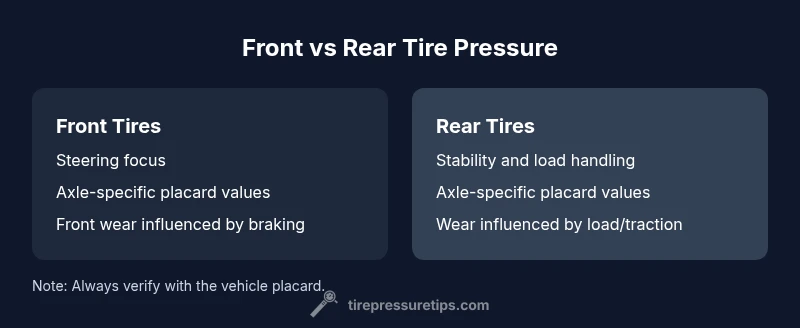
The front tires are primarily responsible for steering and braking in most passenger cars, while the rear tires contribute to overall stability and traction under acceleration and cornering. Consequently, slight differences in axle pressure can influence how the car turns in and how it tracks straight under load. For example, higher front pressure can sharpen steering response but may reduce grip at the front contact patch in wet conditions, while lower front pressure can improve grip at the cost of steering precision. The rear axle’s pressure influences how the vehicle distributes load during cornering; under-inflated rear tires can feel unstable, while over-inflated rear tires may reduce traction in slippery surfaces. The key takeaway: keep both axles within their specified ranges, and avoid large pressure gaps that create unpredictable handling.
Vehicle Type and Drivetrain Considerations
Drivetrain architecture matters. Front-wheel-drive (FWD) cars often benefit from maintaining slightly higher front pressures to preserve steering response because a larger portion of the vehicle’s weight sits on the front axle. Rear-wheel-drive (RWD) or all-wheel-drive (AWD) configurations may place more load on the rear tires during acceleration or when towing, which can shift the ideal balance of front and rear pressures. Performance-oriented models sometimes use asymmetric pressure settings to optimize grip for track or spirited driving, but only within the manufacturer’s guidance. It’s essential to treat the placard as the authoritative source for both axles, and to apply any deviations only when the vehicle’s design requires them and you understand the trade-offs in wear, fuel efficiency, and handling.
Seasonal, Load, and Temperature Effects
Seasonal temperature changes and cargo load alter tire pressure naturally. In hot weather, air expands, increasing tire pressure, while cold weather lowers pressure. If you routinely carry heavy cargo, the rear tires may require a modest adjustment to maintain the intended contact patch and stability. The best practice is to check pressures when tires are cold, especially after a season change or a heavy load, and confirm that both axles remain within the placard’s recommended range. TPMS readings are a helpful check, but they should complement, not replace, manual measurements with a trusted gauge.
Best Practices for Monitoring and Maintenance
Establish a simple pressure-check routine: check once a month, before long trips, and after significant temperature swings. Use a quality tire gauge and verify cold tires for accuracy. If you observe consistent under- or over-inflation on one axle despite following the placard, consult a tire center or the vehicle’s service manual; there may be a variant in the recommended pressures due to wear, suspension changes, or tire size. Rotate tires according to your vehicle’s maintenance schedule; rotation helps ensure even wear and accurate pressure behavior on both axles. Finally, keep TPMS warning lights in mind; if they illuminate, investigate promptly to avoid reduced handling or tire damage.
Common Myths and Misconceptions
A common misconception is that you should inflate all tires to the same pressure regardless of axle. In reality, many vehicles require different front and rear pressures. Another myth is that you should never adjust tire pressures based on load; in fact, loads and towing conditions can justify axle-specific adjustments within the placard range. A third misconception is that TPMS alone is sufficient for maintaining proper pressures; TPMS alerts you to under-inflation or over-inflation but does not replace regular gauge checks or the exact axle-specific values recommended by the manufacturer.
Practical Steps: A Quick Routine for Your Next Tire Check
- Locate the axle-specific pressures on the placard. - Check both axles when tires are cold. - Use a reliable gauge to measure each tire. - Inflate or deflate to match the placard values for each axle. - Re-check all tires after adjustment to confirm accuracy. - Record changes if you frequently adjust for load or season. - Schedule a professional inspection if you notice persistent pressure drift.
Comparison
| Feature | Front tires | Rear tires |
|---|---|---|
| Pressure guidance | Axle-specific values from the placard/owner's manual | Axle-specific values from the placard/owner's manual |
| Primary performance focus | Steering feel and grip at the front | Stability and load handling at the rear |
| Wear impact | Front wear influenced by braking and cornering stresses | Rear wear influenced by load balance and traction |
| Temperature sensitivity | Front and rear respond to heat/cold; steering dynamics can amplify effects | Rear response affected by load and traction; temperature changes shift pressure needs |
| Maintenance ease | Check both axles against placard and TPMS regularly | Check both axles against placard and TPMS regularly |
Strengths
- Promotes balanced handling and predictable steering
- Encourages even tire wear when both axles stay in range
- Simplifies maintenance by aligning with manufacturer guidance
- Supports safer braking and traction across conditions
Drawbacks
- Overgeneralization can miss drivetrain-specific needs
- Some vehicles require asymmetric pressures for optimal performance
- Frequent cargo or towing changes mean more adjustments
Follow the placard for both axles and adjust within range based on load and season
Axle-specific pressures defined by the manufacturer provide the safest baseline. Use that baseline for daily driving, then fine-tune within the recommended range only when you have a clear need due to load, weather, or driving style. Regular checks help prevent under- or over-inflation and extend tire life.
Frequently Asked Questions
Why is there often a difference between front and rear tire pressures?
Front and rear pressures differ because weight distribution and drivetrain dynamics place different loads on each axle. Steering and braking demands typically come from the front, while stability and traction are influenced by the rear. Axle-specific recommendations ensure predictable handling and even wear.
Differences arise from weight and how the car uses each axle. Follow the placard for safe, balanced handling.
Should I inflate my tires to the same pressure on both axles?
Not necessarily. Many vehicles have different front and rear recommended pressures. Always follow the exact axle-specific values on the placard and adjust within that range based on load and conditions.
Follow the axle-specific numbers on your placard; don’t assume both axles should be identical.
How often should I check tire pressures?
Check at least once a month and before long trips. Do it when tires are cold to get an accurate reading, and recheck after adjustments.
Aim for monthly checks and before big trips; check when cold for accuracy.
Can TPMS tell me if front vs rear pressure is wrong?
TPMS alerts under-inflation or over-inflation, but it can’t always indicate axle-specific differences. Use a gauge to verify axle pressures against the placard.
TPMS warns you, but you should also measure with a gauge for axle-specific accuracy.
How do seasonal temperature changes affect tire pressure?
Temperature affects air volume; hot weather raises pressure, cold weather lowers it. Check and adjust within the placard range during season changes.
Temperature shifts can move pressure; recheck when seasons change.
What to Remember
- Always start with axle-specific placard values
- Maintain balanced pressures within the recommended range
- Check tires when cold and confirm with a gauge
- Consider load and temperature when adjusting within the range
- Use TPMS as a supplementary safety check