Tire Pressure Front vs Back: A Practical Guide for 2026
Discover how tire pressure front vs back affects handling, wear, and efficiency. Practical checks, TPMS tips, and setup guidance for all vehicle types.


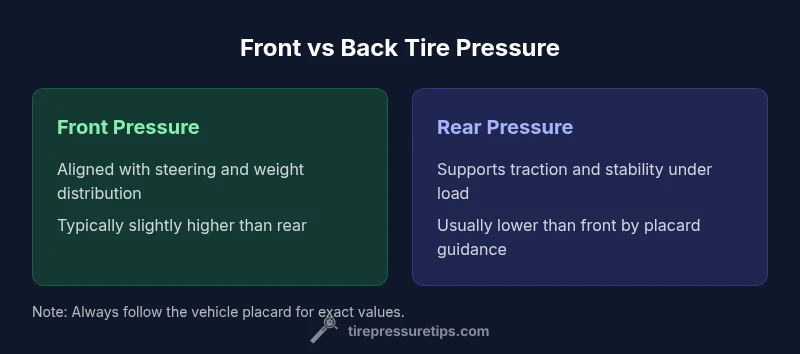
Front and rear tire pressures are not interchangeable; always follow the vehicle’s official front-vs-back specification. Differences help balance grip, stability, and wear across a load spectrum. See our detailed comparison chart for scenarios and exact guidelines.
Core Concept: Front vs Back Tire Pressure
In most passenger cars, the front tires bear more weight and shoulder the primary steering load, while the rear tires manage traction and stability during acceleration, braking, and cornering. Because of these different duties, the ideal tire pressure front vs back is not identical from one model to the next. It’s a specification that balances several factors: handling precision, ride comfort, tire wear, and even fuel economy. According to Tire Pressure Tips, most manufacturers publish a distinct front-vs-back guideline on the placard attached to the door frame or in the owner's manual. This baseline should be your starting point for every routine inflation check, regardless of how you drive. If you switch to a heavier load, frequent highway trips, or a different drivetrain configuration, you may see a shift in the recommended front-rear gap. The key takeaway is that “one number fits all” rarely holds true in real-world use; your car’s design reflects deliberate front-rear pressure relationships to accommodate weight transfer, steering efforts, and tire contact patch behavior.
Factors That Drive Different Pressures
The decision of what front and rear pressures should be, across a wide range of cars, depends on several interrelated factors. Weight distribution: front-heavy vehicles typically benefit from higher front pressures to preserve steering control and minimize squirm under load. Traction needs: the rear axle often requires adequate inflation to maintain even contact with the road, particularly under acceleration or heavy braking. Drivetrain layout: front-wheel-drive (FWD) cars focus more on keeping the front tires steady to manage steering, while rear-wheel-drive (RWD) vehicles may use different rear pressures to optimize traction. Load conditions: carrying passengers, cargo, or towing gear often shifts the load balance and can justify a larger front-to-rear gap. Tire type and size: performance or low-profile tires may have stiffer sidewalls and demand slightly different pressures than touring tires. Temperature and driving style: hot weather can raise tire pressure; heavy highway speeds can influence how much you want to tailor the mix. The common thread, though, is that the front-vs-back specification is vehicle-specific and changes with aim, family, or work use. Always start with the placard and adjust cautiously, testing how the car responds as you drive.
How Manufacturers Define Front vs Rear Pressures
Manufacturers craft front-vs-back recommendations based on expected loading, suspension geometry, and the intended use of the vehicle. The official number is published on the tire placard and in the owner’s manual, and it often differs between the front and rear axles. In many cases, the variance is modest, but for performance cars or heavy-duty applications, the gap can be more pronounced. When the vehicle is designed for all-wheel drive, the manufacturer may tailor the numbers to account for dynamic weight transfer during cornering and braking. It’s important to note that the placard is authoritative for cold inflation, which means you should measure tires when they are cold (before a drive) for the most accurate reading. If you’ve changed wheel sizes, upgraded tires, or altered suspension components, you should re-check the recommended front and rear pressures and adjust according to the new configuration. In short, the manufacturer’s front-vs-back specification is your most reliable guide; deviating without testing can cause uneven wear, reduced grip, or unpredictable handling.
Checking Your Vehicle: TPMS and Manual Methods
Tire Pressure Monitoring Systems (TPMS) provide a live readout of current pressure, but they don’t replace the placard’s official values. Use a quality gauge and check pressures when the tires are cold, ideally before you drive or after they’ve been stationary for several hours. Compare the reading to the front and rear targets on the placard to ensure you’re within the recommended band. For quick checks, press the gauge on each valve stem, note the numbers, and inflate or deflate in small increments (1–2 psi at a time) until you reach the target. If your vehicle’s load changes—such as an impending family trip with luggage, or towing a trailer—repeat the measurement after adjusting to the new configuration. And remember, if you rotate tires or switch to a different size, re-check the entire front-vs-back specification to keep performance predictable.
Handling and Performance Impacts
The relationship between front and rear pressures directly affects how the car feels in corners, on straightaways, and under braking. A higher front pressure generally tightens steering response and can reduce front tire squirm, which improves nimbleness at the cost of ride comfort if overdone. A higher rear pressure tends to reduce squat on acceleration and can help stability when the car is loaded or cornering at higher speeds. The front-rear balance also influences understeer and oversteer characteristics: if the front tires are overinflated relative to the rear, you may experience sharper understeer, while overly high rear pressures can make the rear end feel anxious or skittish in fast corners. Remember that even small adjustments—2 psi, or a change due to temperature—can shift the dynamic balance noticeably. The key is to test in safe conditions, drive defensively, and return to the manufacturer’s recommended front-vs-back numbers after any experiment.
Tire Wear and Fuel Economy Considerations
Inflation levels affect tire wear patterns. Underinflated tires wear on the edges and can cause increased rolling resistance, reducing fuel economy and accelerating heat buildup. Overinflated tires wear along the center tread, decreasing grip during wet or slippery conditions and increasing the risk of a harsh ride. When front and rear pressures are set according to the placard, wear typically distributes more evenly across the tire footprint. Keeping the recommended front-vs-back pressures also helps maintain even wear over time between axles, particularly when the vehicle carries load or drives long distances. If you drive with a consistent over- or under-inflation on one axle, you’ll see different wear rates that can complicate alignment and trim costs. Regularly checking the accuracy of the TPMS readings and verifying with a physical gauge can catch slow leaks or gradual changes that would otherwise bias wear toward one axle.
Seasonal, Load, and Temperature Effects
Temperature has a direct impact on tire pressure; rising ambient temperature increases the air inside the tire, causing pressure to rise, while cold weather reduces it. This makes front-vs-back differences more pronounced in extreme conditions, and it’s common to re-check pressures when seasons change or before a long trip in hot weather. Load shifts—such as extra passengers, roof luggage, or towing—also alter the load distribution that the front-vs-back specification assumes. Always re-check after a heavy cargo load or after a tire rotation. If you notice unusual handling, such as more understeer in winter or more oversteer in summer, verify that the front and rear pressures align with the placard, and adjust as necessary within the manufacturer’s recommended range.
AWD, FWD, and RWD Scenarios: When to Equalize vs Differentiate
FWD cars often prioritize the front axle for steering feel, so the front pressure might be closer to the placard value with a modest rear difference. RWD models emphasize rear traction, sometimes requiring a more pronounced rear or balanced approach depending on chassis tuning. AWD vehicles seek a careful middle ground to manage weight transfer across all corners and preserve predictable behavior under varied grip conditions. In high-performance or sport-oriented trims, the gap between front and rear pressures may be adjusted to optimize handling characteristics for the track or daily driving. The universal rule remains: use the car’s official front-vs-back specification as your baseline, then test carefully with safe loads and temperatures to refine for your typical driving scenarios.
How to Set and Maintain Recommended Pressures
- Find the placard and read the front and rear targets. 2. Check tires when cold using a reliable gauge. 3. Inflate or deflate by small steps (1–2 psi) to reach the targets. 4. Recheck after driving a short distance to observe changes. 5. Repeat checks with load variations to ensure stability. 6. When rotating tires or changing sizes, revisit the front-vs-back numbers. 7. If TPMS indicates any abnormal pressure, inspect for leaks and verify the readings with a gauge. This practical routine helps maintain safety, stability, and longevity of tires for the long term.
Common Mistakes and Troubleshooting
Common mistakes include inflating all four tires to the same number, neglecting the placard, ignoring temperature shifts, and failing to account for load changes. Troubleshooting tips: re-check after a cold start, verify the gauge accuracy, and confirm that the right front-vs-back targets are being used. If a tire shows persistent underinflation on one axle, you may have a slow leak or a dangerous issue; do not delay maintenance. Finally, remember that changes in vehicle load or design can warrant recalibrating front vs back pressures, so periodically re-check the manufacturer guidance as part of routine maintenance.
Comparison
| Feature | Front Pressure Setup | Rear Pressure Setup |
|---|---|---|
| Recommended Source | Vehicle placard/owner's manual | Vehicle placard/owner's manual |
| Impact on Handling | Tighter steering balance; improves turn-in when front is higher | Increases rear stability; may reduce understeer when rear is higher |
| Tire Wear Pattern | Promotes even wear when set per placard | Promotes even wear when set per placard |
| Best For | Steering-heavy, weight-forward vehicles | Stability-focused, load-heavy or traction-priority |
| Special Considerations | All-wheel-drive and performance models may differ | Same as above but with different calibration for AWD |
Strengths
- Improved handling consistency when following placard values
- Promotes even tire wear across axles when used as directed
- Can enhance fuel efficiency by preserving rolling resistance
- Supports reliable TPMS readings when calibrated to spec
Drawbacks
- Requires model-specific data from placard/manual
- Small changes can affect ride comfort and noise
- Incorrect values risk imbalance and uneven wear
Follow the vehicle manufacturer’s exact front-vs-back specification for optimal balance.
Adhering to placard values ensures predictable handling, even wear, and reliable TPMS readings. Recheck under load and temperature changes to maintain accuracy.
Frequently Asked Questions
What is the difference between tire pressure front vs back?
The front and rear pressures are designed to suit the axle duties of weight bearing, steering, traction, and stability. The placard provides distinct targets to achieve balanced handling and even wear. Deviations should be tested to maintain safe performance.
Front and rear pressures are set differently to balance steering and traction. Always follow the placard values and test how the car feels after changes.
Should I inflate front tires more than rear?
Not automatically. If the placard specifies higher front pressures, follow that; otherwise, avoid inflating one axle beyond the recommended values. Adjust for load and season as needed but stay within the manufacturer’s targets.
Follow the vehicle’s official front-vs-back numbers, and adjust for load or weather only within those targets.
Can I run equal pressures front and back?
Some vehicles allow equal pressures, but most require a front-rear difference for optimal handling. If you’re unsure, check the placard and test carefully under safe conditions before making changes.
Usually not recommended unless the manufacturer allows it; start with the placard and test carefully if you change anything.
How often should I check front and rear pressures?
Check pressures at least monthly and before long trips, especially when load, temperature, or tire rotations change. Use cold readings for accuracy and recheck after adjustments.
Check monthly and before trips, especially with load changes or seasonal shifts.
Does TPMS show separate front/rear pressures?
TPMS typically reports overall tire pressure by wheel location and isn’t a substitute for the official front-vs-back targets. Use TPMS as a warning tool and verify with a gauge against the placard.
TPMS helps you monitor air, but you still need the exact front and rear targets from the placard.
Does load affect front vs rear pressures differently?
Yes. Additional load shifts weight to both axles and can widen the required front-rear gap. Recheck pressures after loading for trips, towing, or extra passengers.
Load changes can shift the balance; recheck and adjust to the placard values as needed.
What to Remember
- Check the placard for front and rear targets
- Adjust for load and temperature changes
- Test handling after small changes, revert to spec if uncertain
- Use TPMS as a guide, not the sole source of truth
- Recheck after tire rotation or size changes