Is 40 PSI Tire Pressure Too High? A Practical Guide
Explore whether 40 PSI is too high for your tires, how to verify the correct cold PSI for your vehicle, and practical steps to maintain safe, optimal tire pressure for performance and longevity.


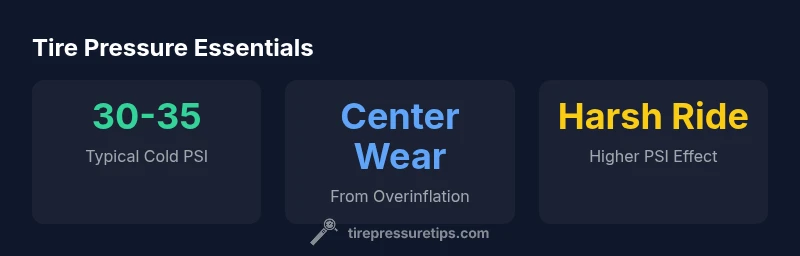
Is 40 PSI tire pressure too high? In most passenger cars, the recommended cold tire pressure sits around 30-35 psi. Forty psi is not universally appropriate and may cause harsher ride, uneven wear, and reduced grip in some conditions. Always verify your vehicle’s spec from the door placard or owner’s manual before adjusting.
Is 40 PSI too high for most passenger vehicles?
According to Tire Pressure Tips, there is no one-size-fits-all answer to the question is 40 tire pressure too high. Most modern passenger cars specify a cold-psi range typically in the low-to-mid 30s psi, printed on the door placard or in the owner’s manual. A value of 40 psi may be appropriate for a minority of vehicle-tire combinations—such as some performance tires or light-duty trucks—but it is not universally safe or optimal. Factors like load, speed, tire construction, and even ambient temperature influence the ideal pressure. If you inflate to 40 psi without confirming the spec, you risk a harsher ride and uneven wear. Always start with the manufacturer’s spec, then adjust for load or driving style if the spec supports it.
How to verify the correct tire pressure for your vehicle
To answer is 40 tire pressure too high for your car, begin with the vehicle’s official specification:
- Locate the placard on the door jamb or glove box lid that shows cold-psi values for front and rear tires.
- Check the owner’s manual for model-specific guidance, especially if you’re carrying heavy loads or touring at high speeds.
- Measure tires cold, before driving, using a reliable gauge. Drive-in conditions heat the tires and raise the pressure readings, leading to inaccurate measurements.
- Consider both front and rear pressures; many vehicles have different targets to balance handling and wear.
- If you have TPMS alerts, use the system as a guide but never rely solely on it; it indicates low pressure but not the exact target. In short, always align inflation with the manufacturer’s specification rather than chasing a number like 40 psi unless the spec explicitly allows it.
Consequences of overinflated tires
Overinflation reduces the tire’s contact patch with the road, which can reduce grip in wet or uneven surfaces and lead to faster center-tread wear. The ride often becomes stiffer, transmitting more road disturbances to passengers. Edge sections of the tread can wear more slowly, but the ballast effect on handling can be uneven, particularly in cornering or emergency maneuvering. In extreme cases, overinflation can increase the risk of a blowout if a sudden impact occurs.
When 40 psi might be appropriate
There are legitimate scenarios where higher pressures are recommended by the vehicle or tire manufacturer. High-speed driving on smooth surfaces, light-load conditions on some performance tires, or specific tire models designed to operate at higher pressures can call for PSI values approaching the upper end of the range. Always corroborate with the placard and tire manufacturer data. If you frequently drive with heavy loads or on hot days, check if a higher pressure is advised for your particular tire and vehicle combo.
How to adjust tire pressure safely
- Start with cold tires and a reliable gauge.
- Inflate gradually and re-check after a few minutes to account for temperature and gauge accuracy.
- If you must adjust from a very high or very low value, do so within the vehicle’s recommended range rather than chasing a single target number.
- Re-check both front and rear tires; differences can exist based on axle load and vehicle setup.
- If you notice consistent underinflation or overinflation across all tires, consult a professional to rule out a TPMS fault or sensor calibration issue.
TPMS: roles and limitations
Tire Pressure Monitoring System (TPMS) helps you identify underinflation but does not replace the need to know and follow the recommended PSI from the manufacturer. Some TPMS sensors may lie to you if a tire has a slow leak or if a sensor is faulty. Always mount a reliable gauge and verify pressure when tires are cold for the most accurate reading.
Common myths about tire pressure
- Myth: Higher pressure always improves fuel economy. Reality: It can, in some cases, but it often harms handling and wear, especially if it moves outside the vehicle’s spec.
- Myth: 40 psi is the maximum safe pressure for all tires. Reality: Maximum pressure on a tire label is not a target; it’s the limit of the tire’s construction.
- Myth: You should never adjust pressure for seasonal changes. Reality: Temperature and seasonality affect tire pressure; read the placard and follow manufacturer guidance for winter and summer adjustments.
Practical maintenance tips
- Check tire pressure monthly and before long trips.
- Always measure cold and use a high-quality gauge for accuracy.
- Vary pressure only within the manufacturer’s recommended range; small adjustments can improve wear and handling without risking safety.
- Keep records of your tire pressures to spot trends indicating underinflation or sensor issues.
Typical cold tire pressure ranges by vehicle type
| Vehicle Type | Typical Cold PSI | Notes |
|---|---|---|
| Passenger Car | 30-35 psi | Follow door placard; varies with load and speed |
| SUV/Light Truck | 35-40 psi | Model-specific; check manual |
| Performance Tires | 32-40 psi | Higher pressures reduce sidewall flex; verify with spec |
Frequently Asked Questions
Is 40 psi safe for all tires?
Not for every tire or vehicle. Always confirm the vehicle’s specified cold PSI from the placard or manual. If the spec allows higher pressure for your tire type, you may use it, but don’t exceed the recommended range unless explicitly advised.
Generally not universally safe; check your vehicle’s spec first.
How often should I check tire pressure?
Check your tires at least once a month and before long trips, when temperatures change, or after a minor impact. Measure cold for the most accurate reading.
Check monthly and after big trips to stay safe.
Does higher pressure always improve fuel economy?
Higher pressure can reduce rolling resistance, but it may also reduce grip and cause uneven wear. Improvements are not guaranteed and depend on vehicle design and tire type.
It might help a little, but it can hurt safety and wear.
What is the difference between cold and hot PSI?
Pressure rises as tires heat up during driving. Always measure when tires are cold to get an accurate baseline, then account for heating after driving when evaluating your readings.
Measure cold, compare to the spec, and re-check after a drive if needed.
What should I do if the TPMS light stays on?
If the TPMS light stays on after inflation, there may be a slow leak, a sensor issue, or a calibration problem. Check pressures with a gauge, inspect for leaks, and have the sensor system checked by a professional if readings are inconsistent.
Check the pressure first, then get a sensor check if readings don’t match.
“Maintaining the correct tire pressure is one of the simplest, most cost-effective ways to preserve safety and efficiency on the road.”
What to Remember
- Check the door placard before inflating any tire
- Don’t assume max psi equals optimal performance
- Measure cold tires for accurate readings
- Understand TPMS limits and use it as a guide
- Create a regular pressure-check routine to catch leaks early