How Much Tire Pressure Is Too Much? A Practical Guide for 2026
Discover what constitutes too much tire pressure, how to measure it correctly, and safe ranges by vehicle type. Learn how cold PSI, TPMS, and temperature affect tire pressure with expert guidance from Tire Pressure Tips.


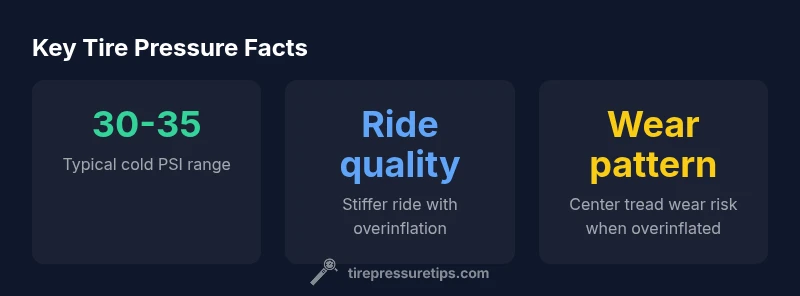
How much tire pressure is too much hinges on your vehicle's recommended cold PSI, not the tire's maximum rating. For most passenger cars, the target is around 30-35 psi, with 32 psi as a common baseline. Going above the recommended cold pressure can reduce the contact patch, worsen grip on wet surfaces, and accelerate wear in the center. Always follow the door jamb sticker or owner's manual.
What is 'too much' tire pressure? Defining the line
According to Tire Pressure Tips, too much tire pressure means exceeding the vehicle's recommended cold PSI. This is different from the tire's maximum sidewall rating, which is a hard limit for safety under extreme conditions. Most modern passenger cars operate best in a narrow band around 30-35 psi when the tires are cold. Going above this band reduces the tire's contact patch with the road, which can compromise grip, especially on wet or uneven surfaces. It also tends to stiffen the ride and can cause center-tread wear if sustained. Understanding where your vehicle’s operating range lies is the first step in avoiding overinflation.
How manufacturers decide the recommended cold PSI
Vehicle manufacturers determine recommended cold PSI by balancing load capacity, driving dynamics, and typical operating temperatures. The door jamb sticker and the owner's manual specify this range for safety and performance. Vehicle testing under real-world conditions helps determine a baseline that accommodates normal luggage, passenger weight, and common speeds. Tire width, aspect ratio, and sidewall construction also influence the final number, but the recommended range remains the most important reference. Always start with the OEM specification and adjust only for substantial loads or frequent highway speeds.
The role of load, speed, and tire type
Load and speed create nuanced needs that can push you slightly toward higher or lower pressures within the recommended range. Heavier loads (more passengers or cargo) may justify a modest increase to maintain handling, while high-speed driving on long trips can demand a slightly firmer setup for stability. Tire type matters too: performance tires often have stiffer sidewalls that respond differently to pressure changes than touring tires. The key takeaway is to stay within the vehicle’s recommended cold PSI and adjust only when you understand your specific usage patterns.
Temperature effects: cold vs hot tire pressure
Tire pressure is sensitive to temperature. Colder ambient temperatures typically reduce PSI, while heat generated by driving raises PSI. A tire that reads 32 psi when cold can rise to 34 or more psi after a long highway run on a hot day. Because the tire is weakest when cold, always check pressure when the tires are cold—ideally before you’ve driven for several hours. This practice ensures you’re comparing against the true cold-recommended PSI and avoids masking underinflation or overinflation caused by heat buildup.
Consequences of overinflation on handling and wear
Overinflated tires have a smaller contact patch, which can reduce traction in rain, snow, and uneven pavement. Steering can feel less compliant, and minor potholes may translate into harsher impacts. Wear tends to concentrate in the center of the tread, shortening tire life and potentially causing premature failure if the situation is prolonged. In extreme cases, overinflation increases the risk of a blowout, especially when combined with high speeds, hot roads, or rough terrain.
Measuring pressure accurately: tools and technique
Use a reliable gauge and measure when the tires are cold. Remove any dirt from the valve stem, press the gauge onto the valve stem firmly, and note the reading. Digital gauges are convenient and reduce user error, but any gauge should be checked for calibration. Compare your reading to the OEM spec. If your reading diverges by more than 2-3 psi from the recommended value, recheck after cooling for consistency. Log readings periodically to spot trends over time.
Safe adjustment steps and verification
If you determine you’re overinflated, let air out gradually until you reach the recommended cold PSI. Don’t guess—use a gauge and recheck. If you’re underinflated, add air in small increments, rechecking after each addition. After adjusting, perform a final visual inspection of the tire surface for uniform contact with the road and even wear. Confirm that TPMS alerts are reset if needed after any pressure change, and verify the vehicle’s handling behavior in a safe, controlled area.
Common myths about tire pressure
Myth 1: Higher PSI improves fuel economy indefinitely. Reality: Once you exceed the OEM spec, any potential gain is offset by poorer grip and wear. Myth 2: The tire’s maximum PSI is a safe limit for normal driving. Reality: The max rating is not the operating pressure; your car’s recommended cold PSI matters most. Myth 3: Overinflation makes tires last longer. Reality: It can reduce evenness of wear and shorten tread life in the center.
Practical tips for daily checks and maintenance
- Check pressure monthly and before long trips.
- Always test when tires are cold.
- Use a trusted gauge and maintain a simple log of PSI readings by tire position.
- If you’re adjusting for load, reference the OEM specification first, then test drive slowly to confirm handling feels balanced.
- Consider TPMS as a supplemental check, not a sole indicator of proper pressure.
Representative ranges by vehicle type and notes
| Vehicle Type | Recommended Cold PSI Range | Notes |
|---|---|---|
| Compact car | 28-32 psi | Door-sticker baseline; adjust for small loads |
| Sedan | 32-34 psi | Common baseline; verify in owner’s manual |
| SUV | 34-38 psi | Higher range for heavier loads and varied speeds |
| Truck/Van | 40-65 psi | Load-based; consult manual for specific models |
Frequently Asked Questions
What is considered 'too much' tire pressure for most vehicles?
Exceeding the vehicle’s recommended cold PSI is considered overinflation for most cars. It reduces traction, increases ride harshness, and can cause uneven tread wear. Always return to the OEM specification rather than chasing the tire’s maximum rating.
Exceed the car’s recommended cold PSI, not the tire’s max, and check your tires with a gauge.
Is the tire's maximum pressure the limit I should never exceed?
No. The tire’s maximum PSI is the highest pressure the tire can safely handle, not the operating pressure for daily driving. Use the vehicle’s recommended cold PSI as the safe operating range.
Don’t rely on the max printed on the tire; follow the car’s recommended cold PSI.
How does temperature affect tire pressure?
Temperature affects PSI: cold temperatures reduce pressure, while heat from driving increases it. Check tires when cold to compare with the vehicle’s spec and avoid misreading changes caused by heat.
Pressure changes with temperature; measure when cold to stay within spec.
What should I do if TPMS warns of high pressure?
If TPMS alerts you to high pressure, pull over safely and verify with a gauge. If readings are high, release air gradually to the recommended cold PSI and recheck after cooling.
Use a gauge, then adjust to the recommended PSI and recheck when cold.
Can overinflation cause a blowout?
Yes, extreme overinflation raises the risk of a blowout, especially on hot days or rough roads. Stay within the manufacturer’s recommended range.
Yes, it can increase blowout risk; keep within the car’s spec.
How often should I check tire pressure?
Check at least once a month and before long trips. Always measure when tires are cold for accuracy.
Check monthly and before trips when tires are cold.
“Overinflation reduces the tire’s contact patch, which can compromise grip in wet or uneven conditions and accelerate center tread wear. Always start from the vehicle’s recommended cold PSI and verify with a gauge.”
What to Remember
- Know your car's official cold PSI and treat the tire's max as a hard limit, not a target.
- Check tires when cold and use a reliable gauge for accuracy.
- Overinflation can reduce grip and wear centered on the tread; avoid unnecessary increases.
- Temperature and driving conditions affect PSI; recheck after long trips or hot days.
- TPMS helps monitor pressure but should not replace regular manual checks.
- Regular checks and proactive maintenance protect safety and extend tire life.